
Introduction to the History of Egypt
Egypt is one of the oldest and most fascinating civilizations in human history. Located in the northeastern corner of Africa along the banks of the Nile River, Egypt has been home to powerful kingdoms, legendary pharaohs, monumental temples, and extraordinary achievements for thousands of years.
The history of Egypt dates back more than 7,000 years and has influenced the development of art, architecture, religion, science, writing, and government across the ancient world. From the construction of the Great Pyramids of Giza to the discovery of Tutankhamun’s tomb, Egypt continues to capture the imagination of travelers and historians from around the globe.
Ancient Egyptians built one of the world’s first advanced civilizations. They created hieroglyphic writing, developed complex religious beliefs, mastered engineering techniques, and established strong political systems ruled by kings known as pharaohs. The fertile land surrounding the Nile River allowed Egyptian society to flourish for centuries.
Throughout its long history, Egypt passed through many important eras, including:
- Ancient Egypt and the Age of the Pharaohs
- The Old Kingdom and the Pyramid Age
- The Middle Kingdom
- The New Kingdom and the Golden Age of Egypt
- Greek and Roman Egypt
- Islamic Egypt
- Modern Egypt
Today, Egypt remains one of the most important cultural and historical destinations in the world. Millions of visitors travel every year to explore its pyramids, temples, museums, tombs, and ancient cities that tell the story of one of humanity’s greatest civilizations.
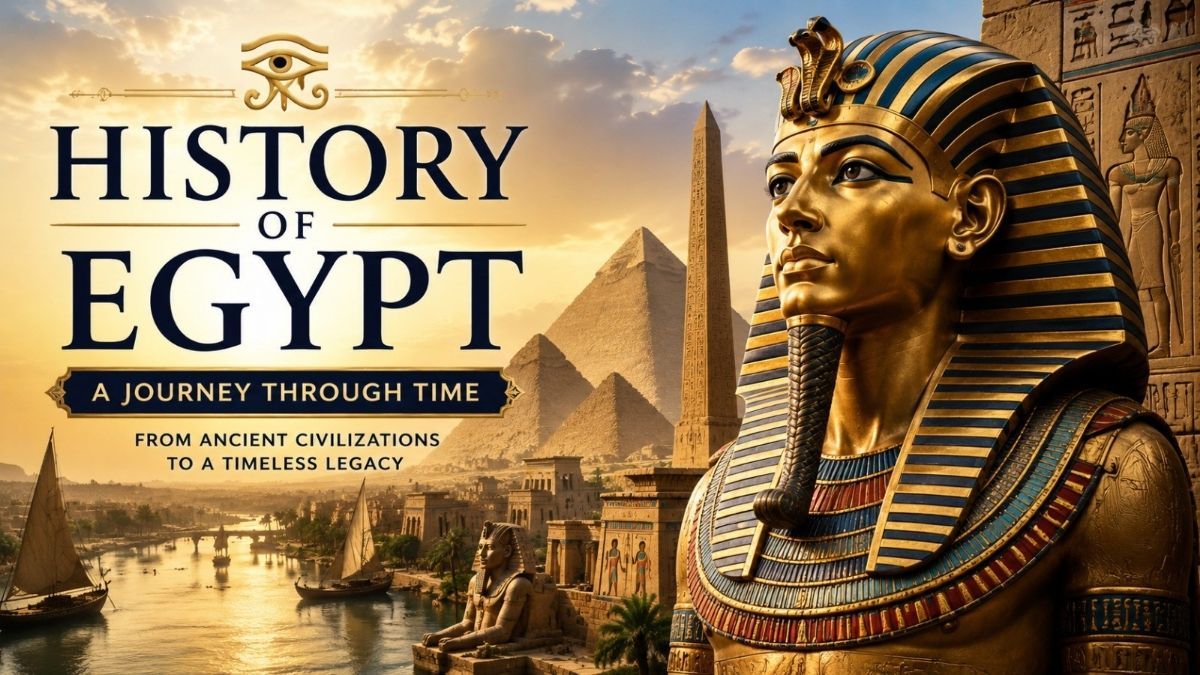
Ancient Egypt and the Age of the Pharaohs
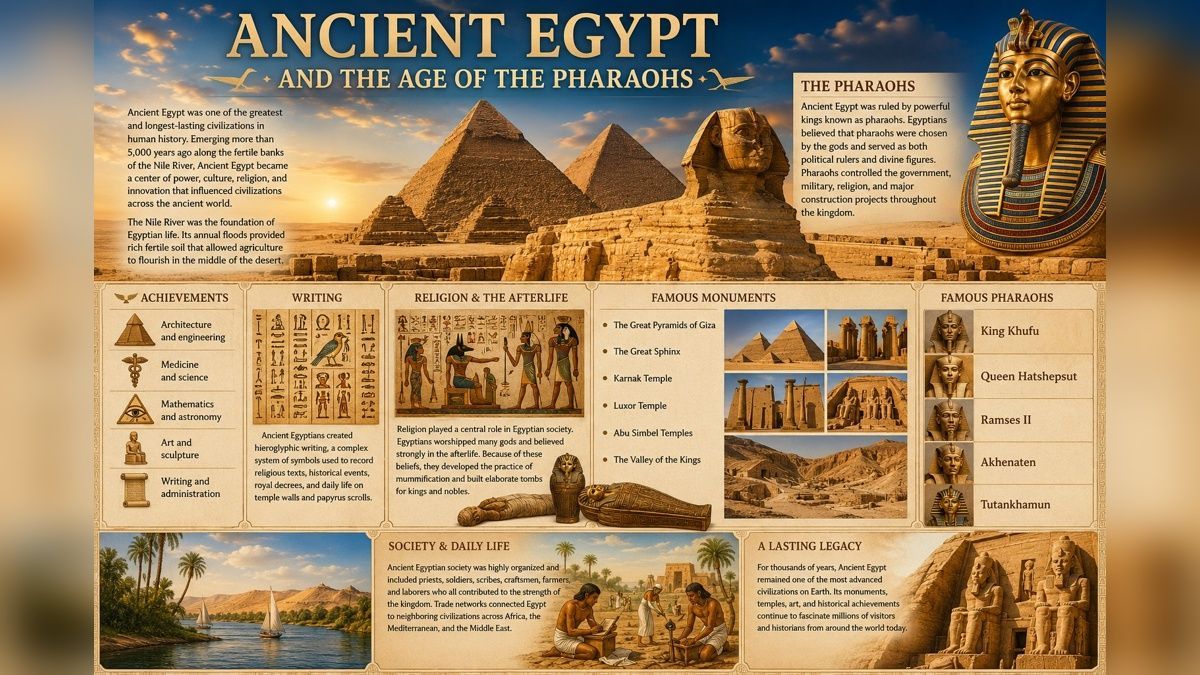
Ancient Egypt was one of the greatest and longest-lasting civilizations in human history. Emerging more than 5,000 years ago along the fertile banks of the Nile River, Ancient Egypt became a center of power, culture, religion, and innovation that influenced civilizations across the ancient world.
The Nile River was the foundation of Egyptian life. Its annual floods provided rich fertile soil that allowed agriculture to flourish in the middle of the desert. This natural cycle helped ancient Egyptians grow crops, build cities, and support a large and organized society for thousands of years.
Ancient Egypt was ruled by powerful kings known as pharaohs. Egyptians believed that pharaohs were chosen by the gods and served as both political rulers and divine figures. Pharaohs controlled the government, military, religion, and major construction projects throughout the kingdom.
The civilization of Ancient Egypt became famous for its remarkable achievements in many fields, including:
- Architecture and engineering
- Medicine and science
- Mathematics and astronomy
- Art and sculpture
- Writing and administration
One of the greatest achievements of the ancient Egyptians was the creation of hieroglyphic writing, a complex system of symbols used to record religious texts, historical events, royal decrees, and daily life on temple walls and papyrus scrolls.
Religion played a central role in Ancient Egyptian society. Egyptians worshipped many gods and believed strongly in the afterlife. Because of these beliefs, they developed the practice of mummification to preserve bodies after death and built elaborate tombs for kings and nobles.
The most famous monuments of Ancient Egypt include:
- The Great Pyramids of Giza
- The Great Sphinx
- Karnak Temple
- Luxor Temple
- Abu Simbel Temples
- The Valley of the Kings
The pyramids were constructed as royal tombs and remain among the greatest architectural wonders in human history. The Great Pyramid of Giza, built for Pharaoh Khufu, is the only surviving wonder of the ancient Seven Wonders of the World.
Ancient Egypt also produced some of history’s most famous rulers, including:
- King Khufu
- Queen Hatshepsut
- Ramses II
- Akhenaten
- Tutankhamun
Tutankhamun became world-famous after the discovery of his nearly intact tomb in 1922 by archaeologist Howard Carter. The treasures found inside provided extraordinary insight into Ancient Egyptian culture and royal life.
Ancient Egyptian society was highly organized and included priests, soldiers, scribes, craftsmen, farmers, and laborers who all contributed to the strength of the kingdom. Trade networks connected Egypt to neighboring civilizations across Africa, the Mediterranean, and the Middle East.
For thousands of years, Ancient Egypt remained one of the most advanced civilizations on Earth. Its monuments, temples, art, and historical achievements continue to fascinate millions of visitors and historians from around the world today.
The Old Kingdom and the Pyramid Age
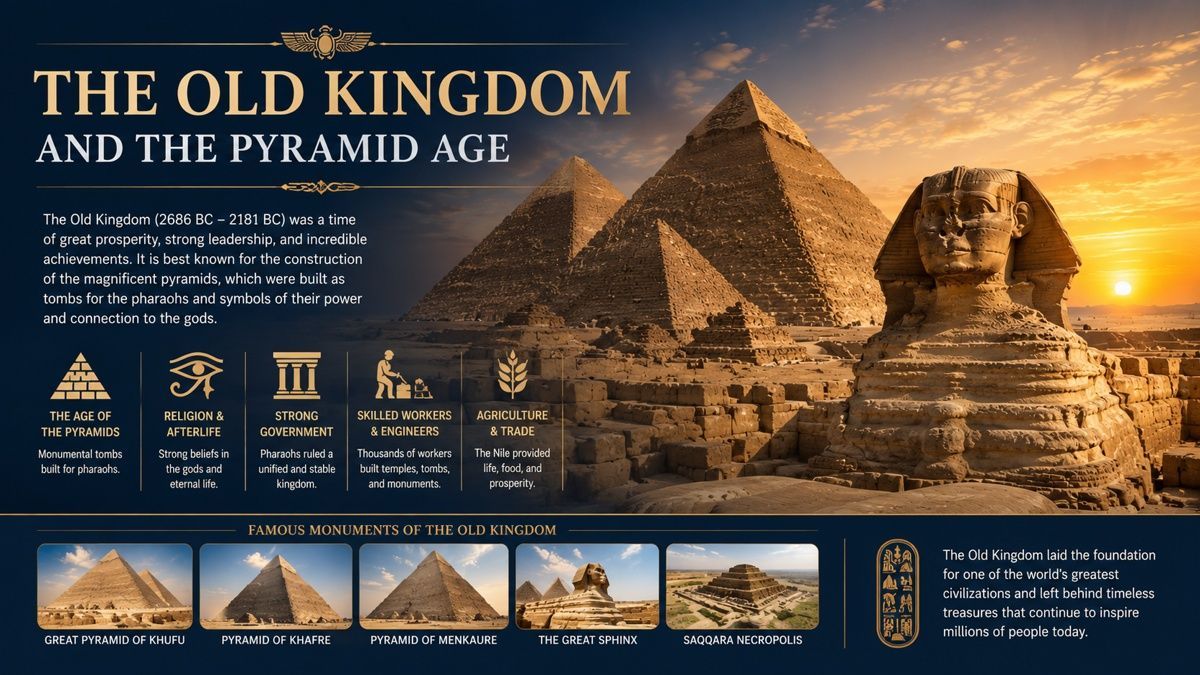
The Old Kingdom was one of the most important periods in Ancient Egyptian history and is often called the “Age of the Pyramids.” This era lasted approximately from 2686 BC to 2181 BC and marked a time of political stability, economic prosperity, and extraordinary architectural achievements.
During the Old Kingdom, Egypt was ruled by powerful pharaohs who strengthened the central government and expanded royal authority throughout the kingdom. The capital of Egypt during much of this period was Memphis, located near modern-day Cairo.
The Old Kingdom is most famous for the construction of the pyramids, especially the Great Pyramids of Giza. These monumental structures were built as royal tombs for pharaohs and were designed to help rulers journey into the afterlife according to ancient Egyptian religious beliefs.
The most famous pyramids include:
- The Pyramid of King Khufu (Cheops)
- The Pyramid of King Khafre
- The Pyramid of King Menkaure
The Great Pyramid of Khufu remains one of the Seven Wonders of the Ancient World and is considered one of humanity’s greatest engineering achievements.
Near the pyramids stands the Great Sphinx of Giza, a massive limestone statue with the body of a lion and the head of a pharaoh. Historians believe the Sphinx was built during the reign of King Khafre and symbolized royal power and protection.
The Old Kingdom also witnessed major developments in:
- Architecture and engineering
- Sculpture and art
- Religious ceremonies
- Government administration
- Trade and agriculture
Thousands of skilled workers, craftsmen, engineers, and laborers participated in building the pyramids and temples. Contrary to popular myths, historians believe many pyramid builders were paid workers and not slaves.
Religion remained at the center of Egyptian life during the Old Kingdom. Egyptians believed the pharaoh was chosen by the gods and would continue ruling in the afterlife. This belief inspired the creation of elaborate burial chambers, funerary temples, and sacred monuments.
Toward the end of the Old Kingdom, political instability, economic difficulties, and weakening royal authority led to the decline of central power in Egypt. This eventually brought the Old Kingdom to an end and opened the door to a new period known as the First Intermediate Period.
Today, the pyramids and monuments of the Old Kingdom remain among the most visited and admired historical sites in the world, attracting millions of tourists to Egypt every year.
The Middle Kingdom of Egypt
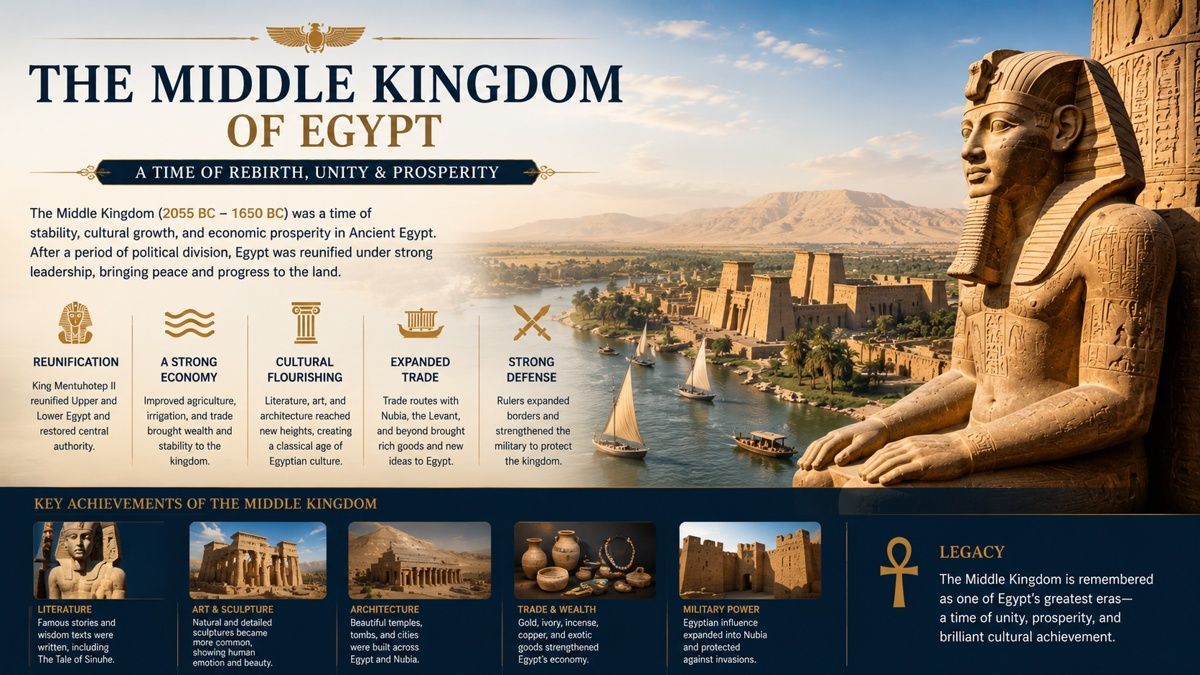
The Middle Kingdom was a remarkable period in Ancient Egyptian history that lasted approximately from 2055 BC to 1650 BC. After years of political division and instability during the First Intermediate Period, Egypt was reunited under strong leadership, bringing peace, prosperity, and cultural revival back to the kingdom.
The Middle Kingdom began when King Mentuhotep II successfully reunified Upper and Lower Egypt and restored central authority. This reunification marked the beginning of a new era of stability and growth for Egyptian civilization.
During the Middle Kingdom, Egyptian rulers focused on strengthening the government, improving agriculture, expanding trade, and protecting the country’s borders. The pharaohs of this period were seen not only as powerful rulers but also as leaders responsible for the welfare of the people.
The Nile River continued to play a vital role in Egyptian life. Large irrigation and farming projects helped increase agricultural production, allowing cities and communities to flourish across the kingdom.
The Middle Kingdom became known for its advancements in:
- Literature and storytelling
- Art and sculpture
- Architecture and temple construction
- Trade and economic development
- Military organization
Egyptian literature flourished during this time, and many famous stories, poems, and wisdom texts were written during the Middle Kingdom. Historians often describe this period as a classical age of Egyptian culture because of its intellectual and artistic achievements.
Trade expanded significantly during the Middle Kingdom. Egyptians established trade routes with Nubia, the Levant, and regions along the Red Sea. Valuable goods such as gold, ivory, incense, copper, and exotic animals entered Egypt through these trading networks.
The rulers of the Middle Kingdom also strengthened Egypt’s southern borders and expanded influence into Nubia, an area rich in gold and natural resources.
Religion remained deeply important in society, but religious beliefs became more accessible to ordinary people during this period. Concepts of the afterlife, once mainly reserved for kings and nobles, gradually became part of wider Egyptian culture.
The Middle Kingdom eventually declined due to internal weakness and foreign invasions by a group known as the Hyksos, who entered northern Egypt with advanced military technology, including horse-drawn chariots.
Despite its eventual fall, the Middle Kingdom is remembered as one of Ancient Egypt’s greatest eras of cultural achievement, economic prosperity, and political stability.
The New Kingdom and the Golden Age of Egypt
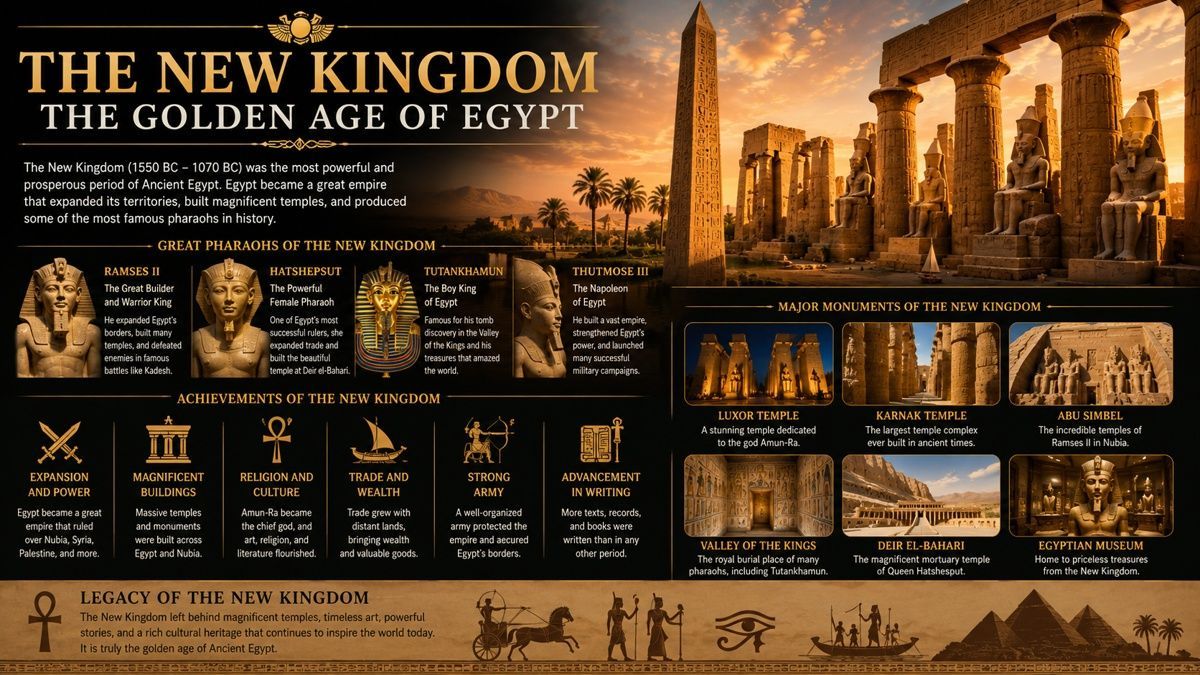
The New Kingdom was the most powerful and prosperous era in Ancient Egyptian history. Lasting approximately from 1550 BC to 1070 BC, this period is often called the “Golden Age of Egypt” because of its military strength, economic wealth, monumental architecture, and famous pharaohs.
The New Kingdom began after Egyptian rulers successfully expelled the Hyksos, foreign invaders who had controlled parts of northern Egypt during the Second Intermediate Period. After regaining independence, Egypt entered a new era of expansion and imperial power.
During the New Kingdom, Egypt became one of the strongest empires in the ancient world. Egyptian armies expanded the kingdom’s influence into regions such as Nubia, Syria, and the Levant, bringing enormous wealth and valuable resources into Egypt.
This period produced some of the most famous pharaohs in history, including:
- Ramses II
- Hatshepsut
- Tutankhamun
- Thutmose III
- Akhenaten
One of the most remarkable rulers of the New Kingdom was Queen Hatshepsut, one of the few female pharaohs in Egyptian history. She focused heavily on trade, architecture, and economic development, overseeing the construction of magnificent temples such as Deir el-Bahari.
Thutmose III became known as one of Egypt’s greatest military leaders due to his successful campaigns and expansion of the Egyptian Empire.
The New Kingdom is also famous for Tutankhamun, the young pharaoh whose nearly intact tomb was discovered in 1922 by Howard Carter. The treasures found inside his tomb became one of the greatest archaeological discoveries in history.
Religion played a major role during the New Kingdom. Pharaoh Akhenaten attempted to transform Egyptian religion by promoting the worship of a single god known as Aten, although traditional beliefs later returned after his reign.
The New Kingdom witnessed the construction of some of Egypt’s most extraordinary monuments, including:
- Karnak Temple
- Luxor Temple
- Abu Simbel Temples
- The Valley of the Kings
- Deir el-Bahari Temple
The Valley of the Kings became the royal burial site for many New Kingdom pharaohs. Unlike earlier rulers who built pyramids, New Kingdom kings preferred hidden rock-cut tombs designed to protect their treasures from thieves.
Art, architecture, literature, and trade flourished during this era. Massive temples, colossal statues, colorful wall paintings, and advanced engineering projects reflected Egypt’s wealth and cultural sophistication.
Toward the end of the New Kingdom, Egypt faced internal conflicts, economic decline, and foreign invasions from groups known as the Sea Peoples. These challenges weakened the empire and eventually led to the end of the New Kingdom.
Despite its decline, the New Kingdom remains one of the most celebrated periods of Ancient Egyptian civilization and left behind monuments and historical treasures that continue to attract millions of visitors to Egypt today.
Greek and Roman Egypt
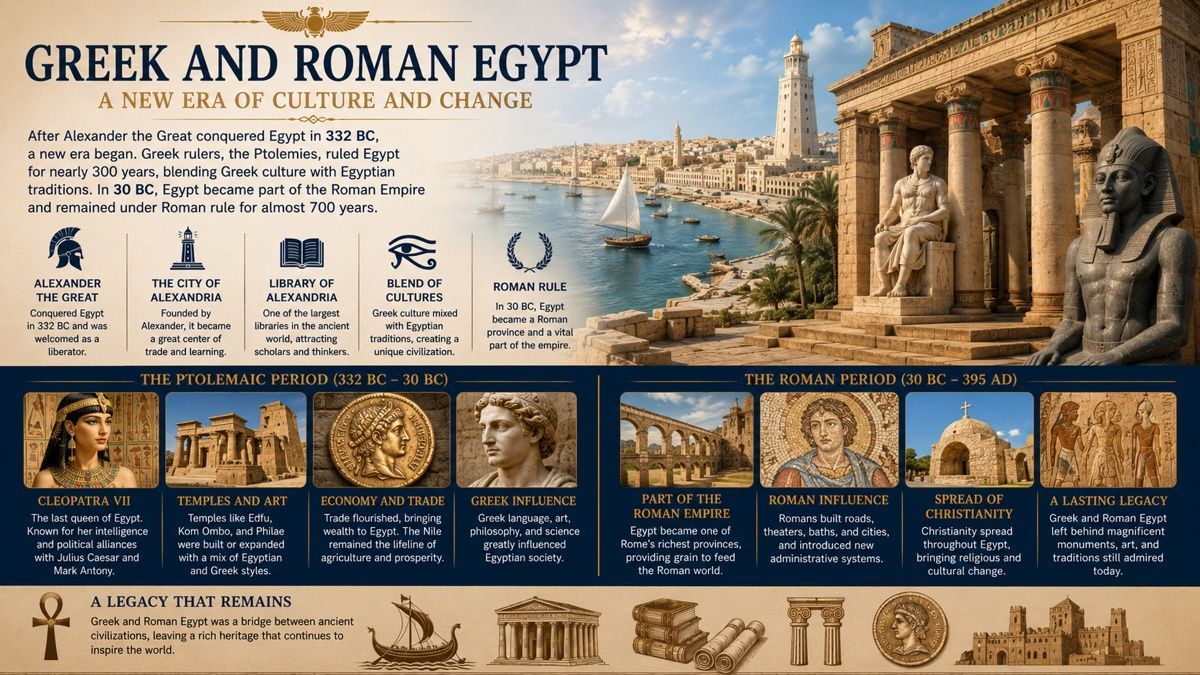
The Greek and Roman periods marked a major transformation in Egyptian history, bringing new cultures, political systems, and architectural influences to the country while preserving many traditions of Ancient Egypt.
The Greek period in Egypt began in 332 BC when Alexander the Great conquered Egypt after defeating the Persian Empire. Egyptians welcomed Alexander as a liberator, and he was declared a pharaoh according to Egyptian tradition.
One of Alexander’s greatest achievements in Egypt was the founding of the city of Alexandria on the Mediterranean coast. Alexandria quickly became one of the most important cities in the ancient world and developed into a center of learning, science, trade, and culture.
After Alexander’s death, one of his generals, Ptolemy I, took control of Egypt and established the Ptolemaic Dynasty, which ruled Egypt for nearly 300 years.
During the Ptolemaic period:
- Greek culture mixed with Egyptian traditions
- Alexandria became a global center of knowledge
- Massive temples continued to be built
- Trade and the economy expanded greatly
The famous Library of Alexandria was established during this period and became one of the largest and most influential libraries in ancient history. Scholars from across the world traveled to Alexandria to study science, mathematics, medicine, philosophy, and astronomy.
The Ptolemaic rulers adopted many Egyptian customs and presented themselves as traditional pharaohs. Temples such as Edfu Temple, Kom Ombo Temple, and Philae Temple were constructed or expanded during Greek rule using a combination of Egyptian and Greek artistic styles.
One of the most famous rulers of Greek Egypt was Cleopatra VII, the last queen of the Ptolemaic Dynasty. Cleopatra became famous for her intelligence, political alliances, and relationships with Julius Caesar and Mark Antony during the power struggles of the Roman world.
After the defeat of Cleopatra and Mark Antony in 30 BC, Egypt officially became part of the Roman Empire under Emperor Augustus.
Under Roman rule, Egypt became one of Rome’s richest and most important provinces because of its agricultural production, especially grain exported from the Nile Valley to feed the Roman population.
The Romans continued many Egyptian traditions while also introducing:
- Roman architecture
- New administrative systems
- Expanded trade networks
- Military infrastructure
Christianity later spread throughout Egypt during the Roman period, leading to significant religious and cultural changes across the country.
Although the ancient pharaonic civilization gradually declined during these centuries, many temples, monuments, and cities continued to thrive under Greek and Roman influence.
Today, the legacy of Greek and Roman Egypt can still be seen in Alexandria, ancient temples, Roman theaters, catacombs, and archaeological sites that reflect the blending of Egyptian, Greek, and Roman civilizations.
Islamic Egypt
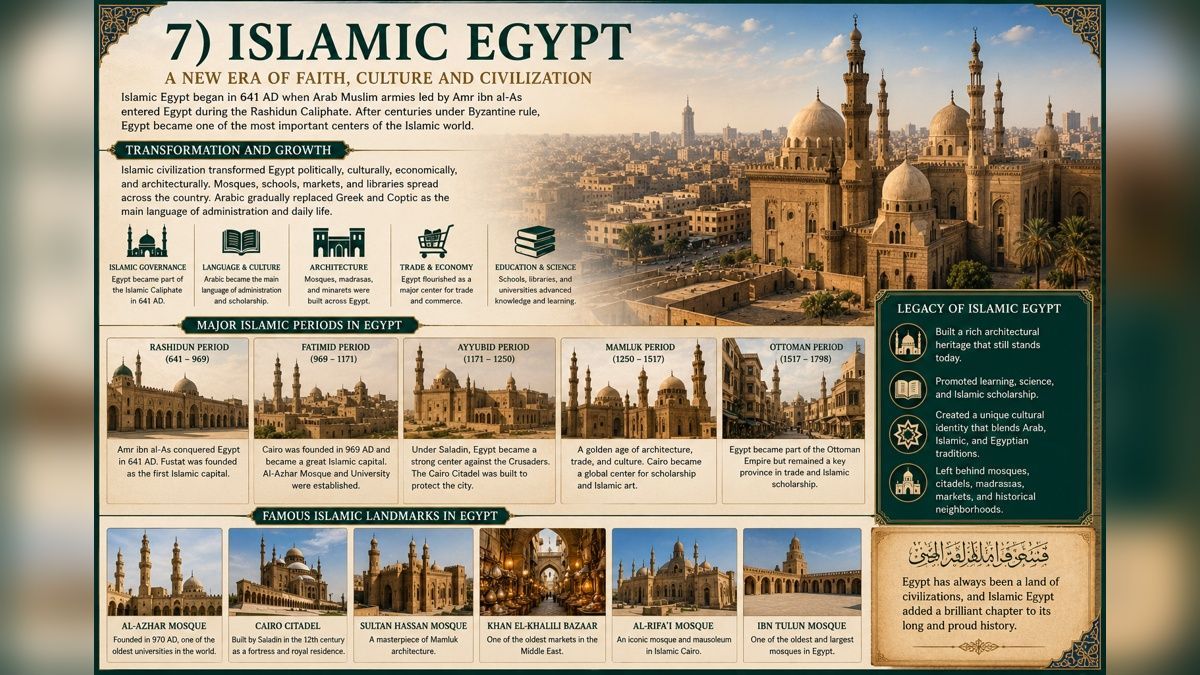
Islamic Egypt began in 641 AD when Arab Muslim armies led by Amr ibn al-As entered Egypt during the Rashidun Caliphate. After centuries under Byzantine rule, Egypt became one of the most important centers of the Islamic world. The city of Fustat was founded near present-day Cairo and became the first Islamic capital of Egypt.
Islamic civilization transformed Egypt politically, culturally, economically, and architecturally. Mosques, schools, markets, and libraries spread across the country, while Arabic gradually replaced Greek and Coptic as the main language of administration and daily life.
During the Fatimid period (969–1171), Cairo was founded and quickly became one of the greatest cities in the Islamic world. The Fatimids also established Al-Azhar Mosque, which later became one of the world’s oldest and most respected Islamic universities.
Under the Ayyubid dynasty led by صلاح الدين الأيوبي (Saladin), Egypt became a powerful center of resistance against the Crusaders. Saladin strengthened Cairo’s defenses by building the famous Cairo Citadel, which remained Egypt’s seat of government for centuries.
The Mamluk era (1250–1517) marked another golden age. Cairo became a global center for trade, scholarship, and Islamic architecture. Magnificent mosques, madrasas, and marketplaces were built during this period, many of which still stand today in Historic Cairo.
In 1517, Egypt became part of the Ottoman Empire, but it continued to play a major role in regional trade and Islamic scholarship. Islamic Egypt left behind an extraordinary architectural and cultural heritage that remains visible throughout modern Egypt.
Today, visitors can explore countless Islamic landmarks across Cairo and other cities, including mosques, citadels, ancient streets, and traditional bazaars that preserve the spirit of medieval Islamic civilization.
Modern Egypt
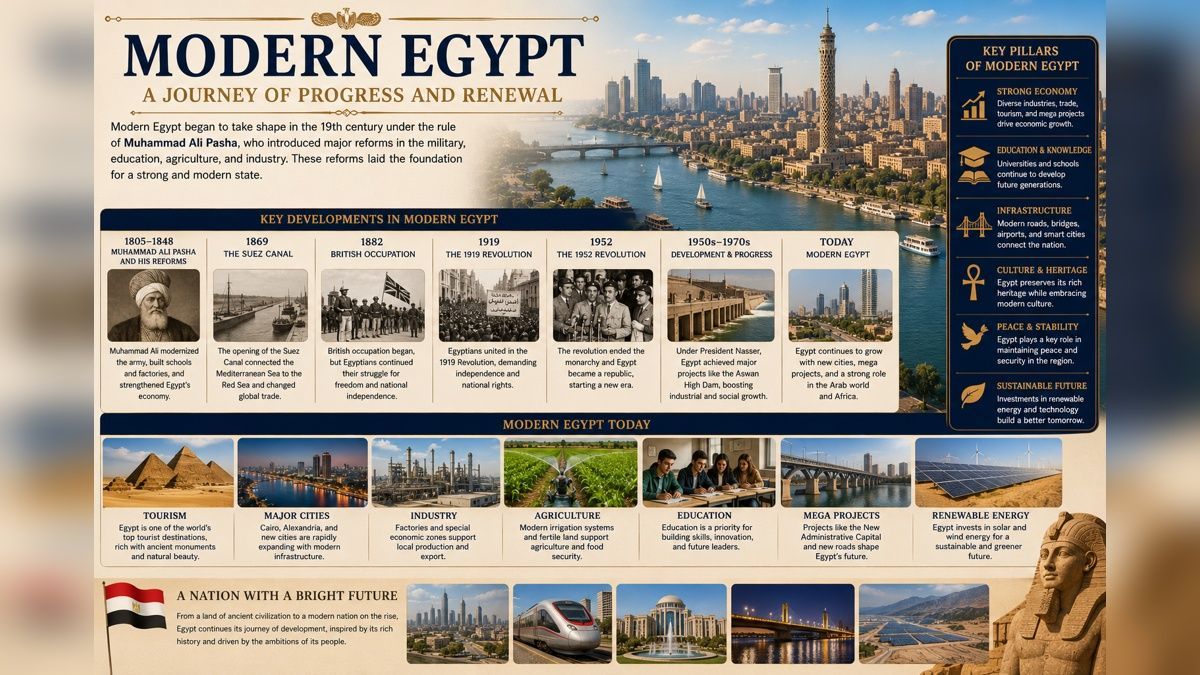
Modern Egypt began to take shape during the 19th century under the rule of Muhammad Ali Pasha, who is often considered the founder of modern Egypt. He introduced major reforms in the military, education, agriculture, and industry, transforming Egypt into one of the strongest powers in the Middle East during his time.
During the 19th century, Egypt experienced rapid modernization projects, including the construction of railways, factories, irrigation systems, and modern schools. One of the most important achievements was the opening of the Suez Canal in 1869, which connected the Mediterranean Sea to the Red Sea and became one of the world’s most important trade routes.
However, growing foreign influence and debt eventually led to British occupation in 1882. For decades, Egyptians resisted colonial rule through political movements and national revolutions. The 1919 Revolution became a turning point in Egypt’s struggle for independence and national identity.
In 1952, the Egyptian Revolution led by the Free Officers Movement ended the monarchy and established the modern republic. Gamal Abdel Nasser emerged as one of the most influential leaders in modern Egyptian history, promoting industrial development, Arab nationalism, and major infrastructure projects such as the Aswan High Dam.
In the following decades, Egypt continued to evolve politically, economically, and socially. Major cities expanded rapidly, tourism became a vital part of the economy, and Egypt strengthened its role as a cultural and political center in the Arab world and Africa.
Today, modern Egypt is a unique blend of ancient civilization and contemporary life. Visitors can experience world-famous historical monuments alongside modern cities, luxury resorts, museums, universities, and growing urban developments.
From the pyramids of Giza to the skyscrapers of New Cairo, Egypt continues to preserve its rich heritage while moving toward the future as one of the most influential countries in the Middle East and North Africa.
Famous Historical Sites in Egypt
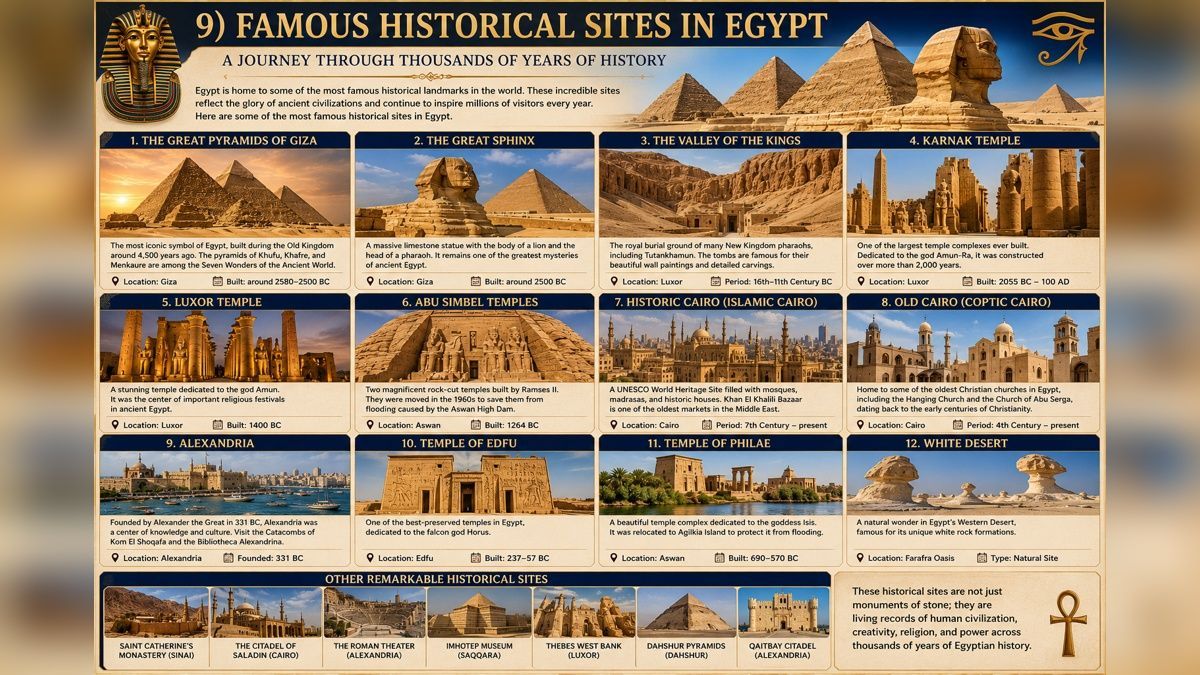
Egypt is home to some of the most famous historical landmarks in the world. Across thousands of years, ancient Egyptians, Greeks, Romans, Christians, and Muslims all left behind extraordinary monuments that continue to attract millions of visitors every year.
The Great Pyramids of Giza are the most iconic historical sites in Egypt. Built more than 4,500 years ago during the Old Kingdom, the pyramids served as royal tombs for the pharaohs Khufu, Khafre, and Menkaure. Nearby stands the Great Sphinx, one of the largest and most mysterious statues ever created in the ancient world.
In Luxor, visitors can explore the Valley of the Kings, where many pharaohs — including Tutankhamun — were buried in richly decorated tombs hidden deep inside the desert mountains. Luxor is also home to the magnificent Karnak Temple and Luxor Temple, two of the greatest religious complexes of ancient Egypt.
Further south in Aswan lies the beautiful Abu Simbel Temples, built by Ramses II. These massive rock-cut temples were relocated in the 1960s to save them from flooding caused by the construction of the Aswan High Dam.
Cairo preserves remarkable Islamic and Coptic landmarks. Historic Cairo contains ancient mosques, madrasas, and markets such as Khan El Khalili Bazaar, while Old Cairo includes some of Egypt’s oldest churches, including the Hanging Church and the Church of Abu Serga.
Alexandria, founded by Alexander the Great, became one of the greatest cities of the ancient Mediterranean world. Today, visitors can explore sites connected to its Greek and Roman heritage, including the Catacombs of Kom El Shoqafa and the modern Bibliotheca Alexandrina.
Egypt also contains many lesser-known treasures such as the White Desert, Saint Catherine’s Monastery in Sinai, the Temple of Edfu, the Temple of Philae, and countless archaeological sites spread throughout the country.
These historical sites represent more than monuments of stone — they are living records of human civilization, creativity, religion, and power across thousands of years of Egyptian history.
The Great Pyramids of Giza
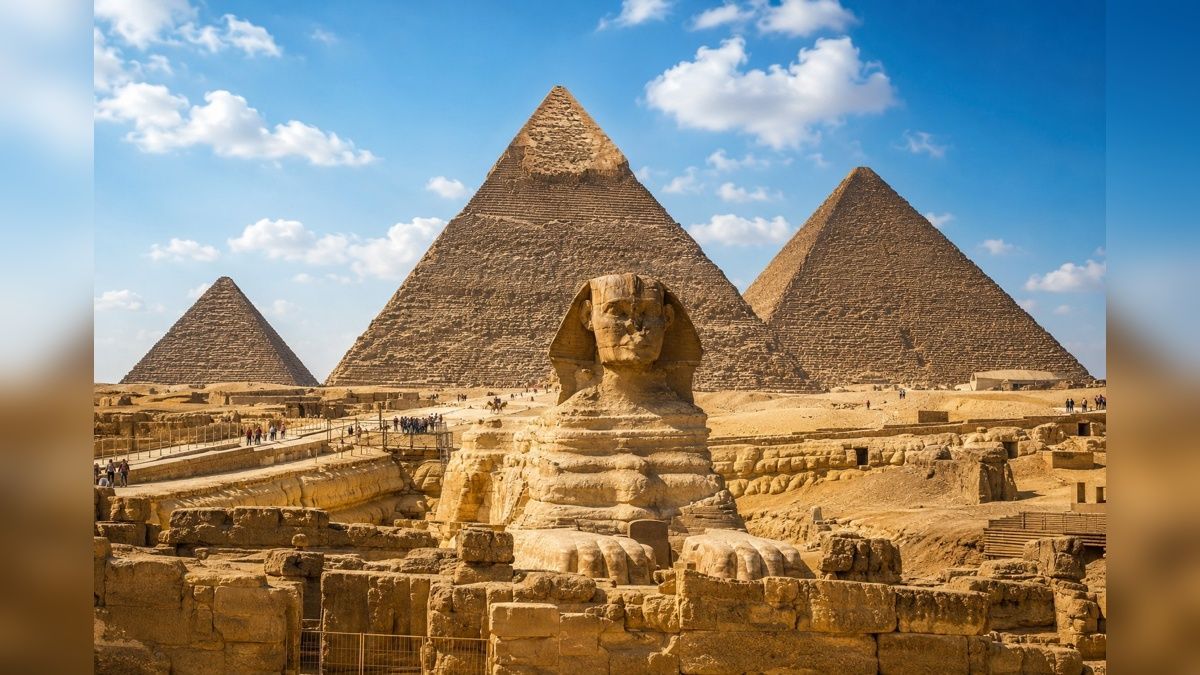
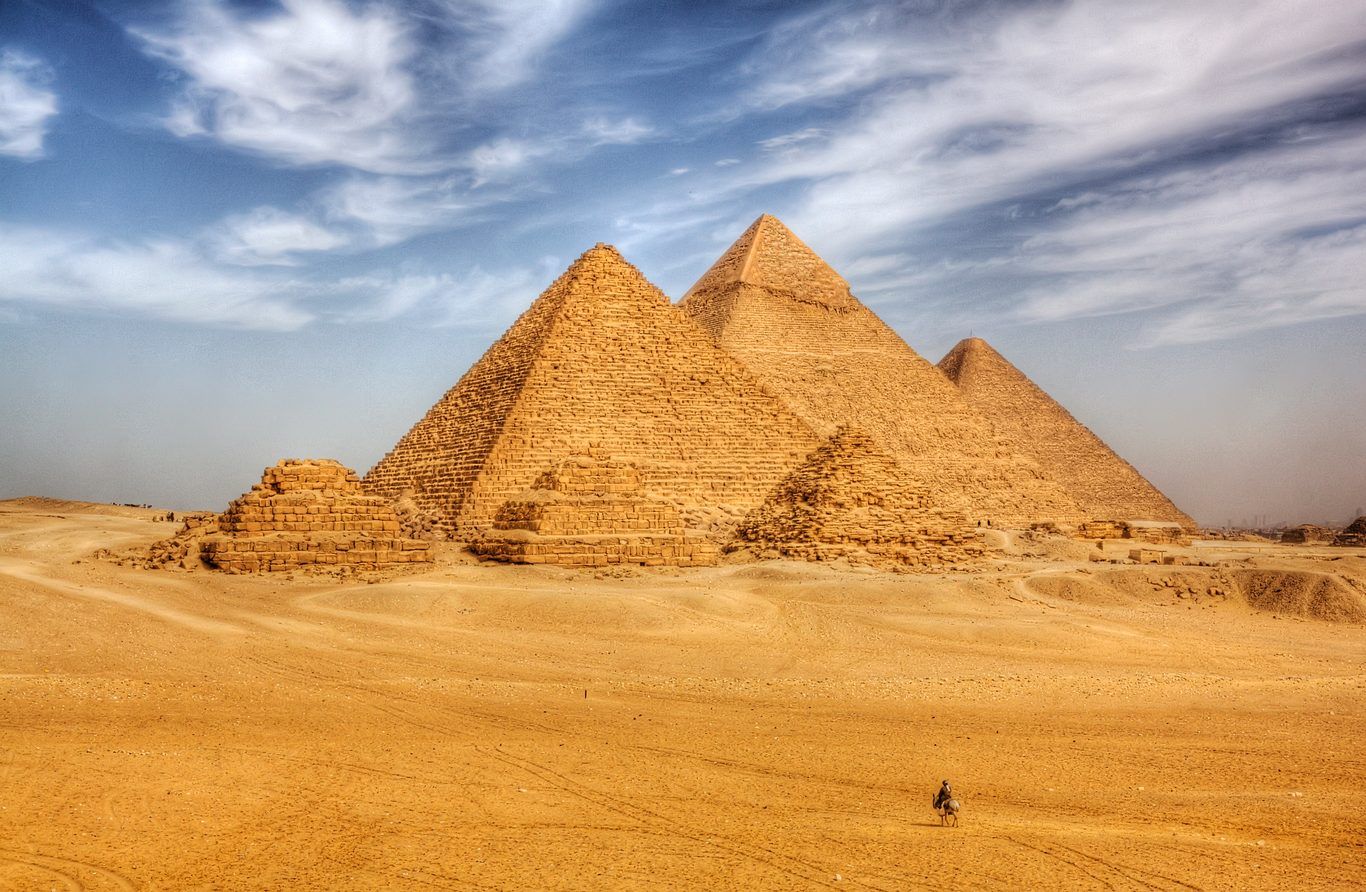
The Great Pyramids of Giza are among the most famous and recognizable monuments in the world. Located on the Giza Plateau near Cairo, the pyramids were built more than 4,500 years ago during the Old Kingdom period of Ancient Egypt and continue to stand as extraordinary symbols of Egyptian civilization and engineering.
The Giza pyramid complex includes three main pyramids:
- The Great Pyramid of Khufu
- The Pyramid of Khafre
- The Pyramid of Menkaure
These pyramids were constructed as royal tombs for the pharaohs of the Fourth Dynasty. Ancient Egyptians believed that the pharaoh would continue to live in the afterlife, so enormous tombs were built to protect the king’s body and treasures for eternity.
The largest and most famous structure is the Great Pyramid of Khufu, also known as the Pyramid of Cheops. Originally standing at approximately 146 meters tall, it remained the tallest man-made structure in the world for nearly 4,000 years. The pyramid was built using millions of massive limestone blocks, some weighing several tons.
Historians and archaeologists believe that tens of thousands of skilled workers, laborers, engineers, and craftsmen participated in the construction of the pyramids. Contrary to popular myths, modern evidence suggests that the pyramids were not built by slaves but by organized Egyptian workers who lived in nearby workers’ villages.
The exact construction methods used by the ancient Egyptians continue to fascinate researchers today. Scholars believe that ramps, sledges, ropes, and advanced planning techniques were used to transport and position the enormous stone blocks with remarkable precision.
Near the pyramids stands the Great Sphinx of Giza, one of the most mysterious monuments in Egypt. The Sphinx features the body of a lion and the head of a pharaoh, believed by many historians to represent Pharaoh Khafre. It was carved directly from limestone bedrock and served as a symbol of royal strength and protection.
The pyramids were originally covered with smooth white limestone casing stones that reflected sunlight brilliantly, making the monuments shine brightly across the desert landscape. Most of these outer stones were removed over centuries and reused in later construction projects around Cairo.
Inside the pyramids are narrow passageways, chambers, and burial rooms designed to protect the pharaoh’s tomb and sacred belongings. Ancient Egyptians placed jewelry, statues, food, weapons, and treasures inside the pyramids to accompany the king into the afterlife.
The Great Pyramid of Giza is the only surviving monument of the Seven Wonders of the Ancient World. Despite thousands of years of weather, earthquakes, and human activity, the pyramids remain one of humanity’s greatest architectural achievements.
Today, the Pyramids of Giza attract millions of visitors every year and remain one of Egypt’s most important historical and tourist destinations. They continue to inspire historians, engineers, archaeologists, and travelers from around the world who come to witness the greatness of Ancient Egyptian civilization.
You can visit pyramids of giza from sharm el sheikh and hurghada
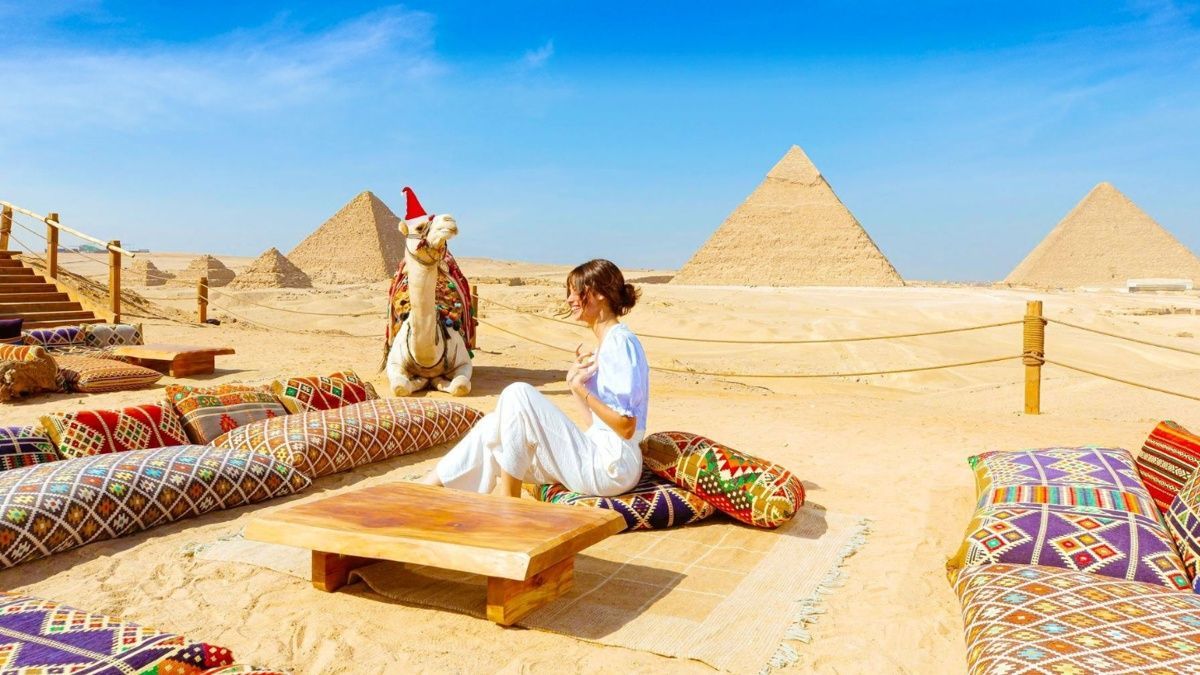
Pyramids of Giza & Egyptian Museum Day Tour from Sharm El Sheikh
Experience a comprehensive day tour from Sharm El Sheikh to the Pyramids of Giza and Egyptian Museum, exploring ancient landmarks and Egyptian history at the best price for 2026.
Pyramids Of Giza And Egyptian Museum Tour By Bus From Hurghada
Experience a full-day bus tour from Hurghada to Cairo, including visits to the Pyramids of Giza, the Great Sphinx, and the Egyptian Museum, with convenient hotel pickup and drop-off.
Mummification in Ancient Egypt
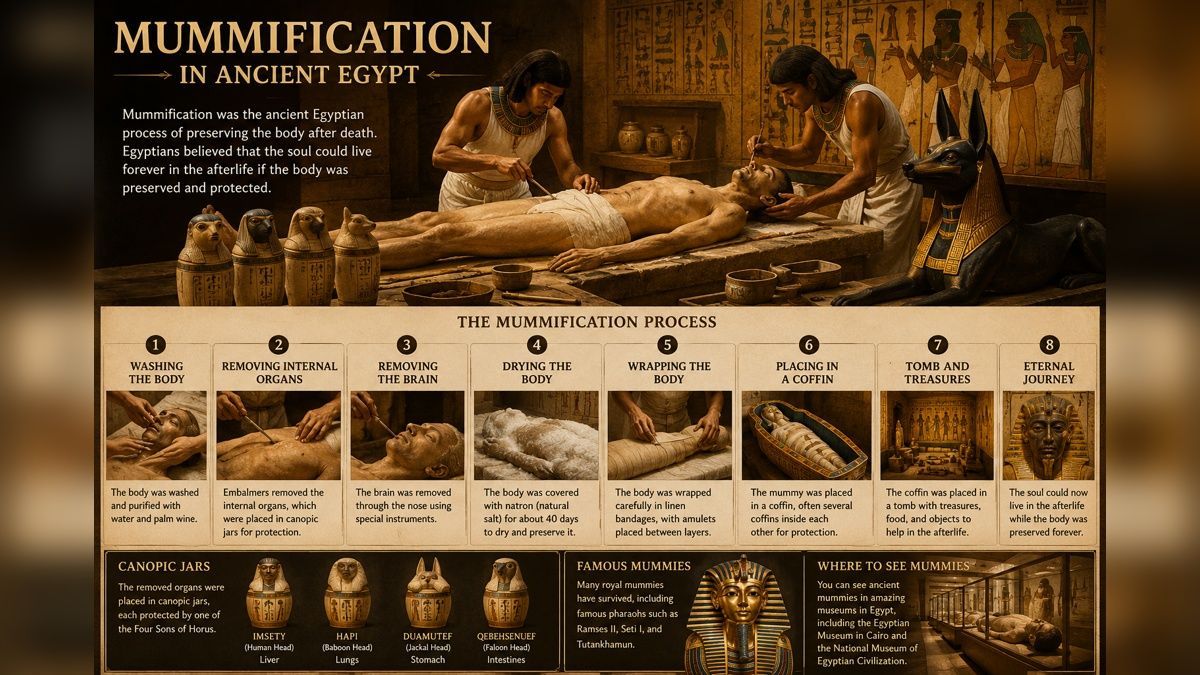
Mummification was one of the most important religious and cultural practices in Ancient Egypt. Ancient Egyptians believed strongly in the afterlife and thought that preserving the body after death was necessary for the soul to continue its journey in the next world.
The process of mummification developed over thousands of years and became highly advanced during the New Kingdom period. Egyptian embalmers used specialized techniques to preserve the bodies of pharaohs, nobles, priests, and wealthy individuals for eternity.
Ancient Egyptians believed that every person possessed several spiritual elements, including the “Ka” and the “Ba.” In order for these spiritual elements to survive after death, the physical body had to remain intact and recognizable.
The mummification process was complex and could take around 70 days to complete. The body was carefully prepared through several stages performed by trained priests and embalmers.
The first step involved washing and purifying the body. After this, embalmers removed the internal organs, including the lungs, liver, stomach, and intestines. These organs were preserved separately in special containers known as canopic jars.
The brain was usually removed through the nose using specialized instruments, while the heart was often left inside the body because Egyptians believed it was the center of intelligence, emotion, and the soul.
After removing the organs, the body was covered with natron, a natural salt used to dry and preserve the flesh. The drying process lasted approximately 40 days and removed moisture from the body to prevent decay.
Once the body was fully dried, it was wrapped carefully in long strips of linen cloth. Priests placed protective amulets and sacred objects between the layers of wrapping to protect the deceased in the afterlife.
The final mummy was then placed inside decorated coffins and elaborate tombs filled with treasures, food, jewelry, statues, furniture, and personal belongings intended to assist the deceased in the next life.
Many royal mummies have survived for thousands of years due to the extraordinary skill of Ancient Egyptian embalmers. Some of the most famous mummies belong to great pharaohs such as Ramses II, Seti I, and Tutankhamun.
The discovery of Tutankhamun’s tomb in 1922 revealed one of the most complete collections of funerary treasures ever found in Egypt and gave historians remarkable insight into Ancient Egyptian burial practices and royal traditions.
Today, ancient mummies can be seen in several Egyptian museums, including the Egyptian Museum in Cairo and the National Museum of Egyptian Civilization, where visitors can explore one of the most fascinating aspects of Ancient Egyptian history.
Mummification remains one of the greatest symbols of Ancient Egypt and continues to fascinate archaeologists, historians, and travelers from around the world.
Ancient Egyptian Gods and Religion
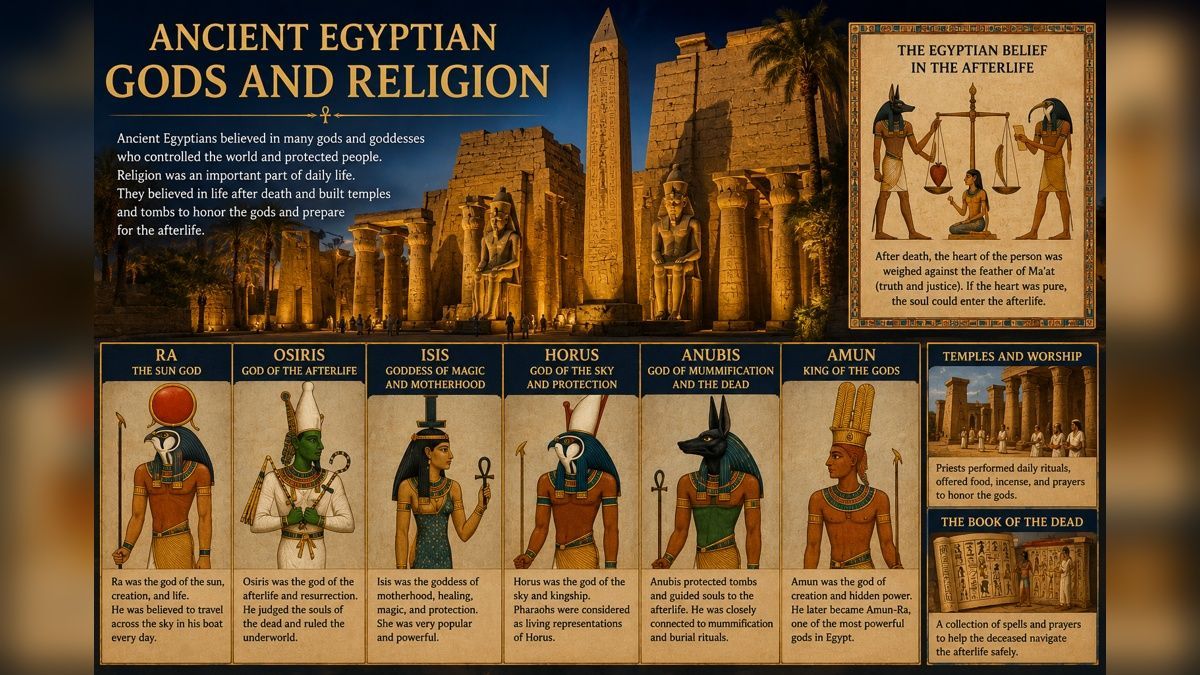
Religion was one of the most important parts of daily life in Ancient Egypt. Ancient Egyptians believed that the world was controlled by powerful gods and divine forces that influenced nature, life, death, and the afterlife. Their religious beliefs shaped Egyptian culture, architecture, government, art, and even the authority of the pharaohs.
Ancient Egyptians worshipped hundreds of gods and goddesses, each associated with specific powers, natural elements, or aspects of life. Many gods were represented with human bodies and animal heads, symbolizing their unique characteristics and abilities.
One of the most important gods in Ancient Egypt was Ra, the sun god. Egyptians believed that Ra traveled across the sky during the day and journeyed through the underworld at night before rising again every morning. The sun symbolized creation, life, and rebirth.
Osiris was another major deity and was considered the god of the afterlife, resurrection, and judgment. According to Egyptian mythology, Osiris ruled the underworld and judged the souls of the dead. Egyptians believed that good people could enter eternal paradise after death if they passed divine judgment.
Isis, the wife of Osiris, was worshipped as the goddess of motherhood, healing, magic, and protection. She became one of the most beloved and influential goddesses in Egyptian religion and later gained followers throughout the Roman world.
Horus, the falcon-headed god, symbolized kingship, protection, and the sky. Ancient pharaohs were often considered earthly representations of Horus, which strengthened their divine authority over Egypt.
Anubis, the jackal-headed god, was closely connected to mummification and funerary rituals. He was believed to protect tombs and guide souls safely into the afterlife. Priests performing mummification ceremonies often wore masks representing Anubis.
Amun became one of the most powerful gods during the New Kingdom period. Combined with Ra as Amun-Ra, he was worshipped as the king of the gods and associated with creation and universal power. Massive temples dedicated to Amun were built in Karnak and Luxor.
Ancient Egyptians strongly believed in life after death. They believed that the soul continued to live in another world after physical death, which is why preserving the body through mummification became extremely important.
Religious ceremonies and rituals were performed daily in temples across Egypt by priests who cared for sacred statues and offered prayers, food, incense, and gifts to the gods. Temples were considered holy places where humans could communicate with divine powers.
One of the most famous religious texts in Ancient Egypt was the Book of the Dead, a collection of spells, prayers, and instructions designed to help the deceased navigate the afterlife and overcome dangers in the underworld.
The afterlife judgment was one of the central beliefs in Ancient Egyptian religion. Egyptians believed that after death, the heart of the deceased would be weighed against the feather of Ma’at, the goddess of truth and justice. If the heart was pure, the soul could enter eternal paradise.
Religion influenced nearly every aspect of Ancient Egyptian civilization, from royal power and architecture to art, burial practices, and daily routines. The temples, tombs, statues, and sacred writings that survive today continue to reveal the deep spiritual beliefs of one of history’s greatest civilizations.
Valley of the Kings
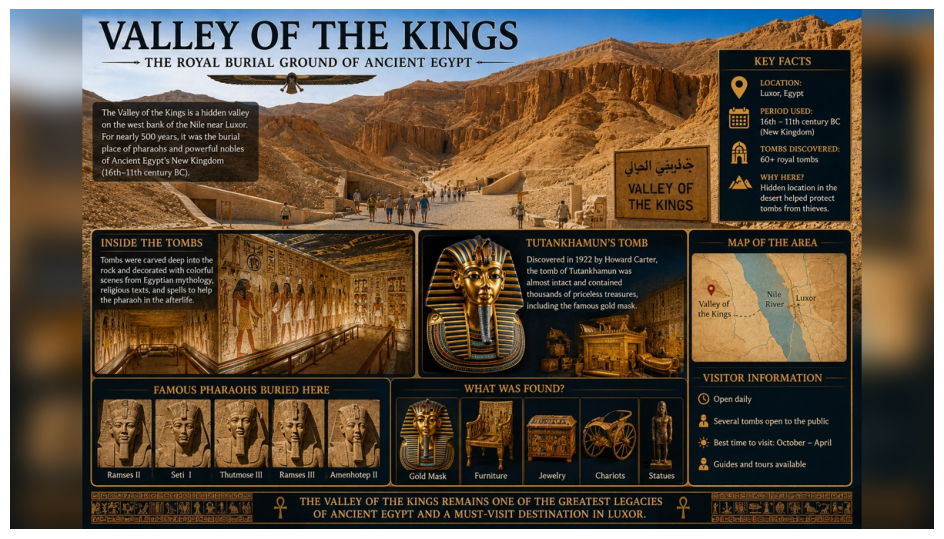
The Valley of the Kings is one of the most important archaeological sites in the world and one of the greatest treasures of Ancient Egypt. Located on the west bank of the Nile River near Luxor, the valley served as the royal burial ground for many pharaohs and powerful nobles during the New Kingdom period of Ancient Egypt.
The Valley of the Kings was used for royal burials for nearly 500 years, from approximately the 16th century BC until the 11th century BC. More than 60 tombs have been discovered in the valley, ranging from small burial chambers to massive underground tomb complexes decorated with extraordinary artwork and inscriptions.
Ancient Egyptian pharaohs chose the Valley of the Kings because its isolated desert location provided greater protection against tomb robbers compared to the large pyramids built during earlier periods. The hidden valleys and surrounding mountains made it more difficult for thieves to locate royal tombs and treasures.
The tombs were carved deep into the rocky cliffs and designed to guide the pharaoh safely into the afterlife. Inside the tombs, walls were covered with colorful paintings, religious texts, magical spells, and scenes showing the journey of the king through the underworld according to Ancient Egyptian beliefs.
One of the most famous tombs in the Valley of the Kings belongs to Pharaoh Tutankhamun. His tomb was discovered in 1922 by British archaeologist Howard Carter and became one of the greatest archaeological discoveries in history. Unlike many other tombs that had been robbed in ancient times, Tutankhamun’s burial chamber was found almost completely intact.
The discovery revealed thousands of treasures, including golden jewelry, royal furniture, statues, weapons, ceremonial objects, and the famous solid gold funerary mask of Tutankhamun. These artifacts provided historians with remarkable insight into Ancient Egyptian royal life and burial traditions.
The Valley of the Kings is also home to the tombs of many other powerful rulers, including:
- Ramses II
- Seti I
- Thutmose III
- Ramses III
- Amenhotep II
Some tombs are famous for their enormous size and stunning artwork. The tomb of Seti I, for example, is considered one of the most beautifully decorated royal tombs ever discovered in Egypt.
Ancient Egyptians believed that the tomb was not simply a burial place but an eternal home for the pharaoh. Because of this belief, tombs were filled with treasures, food, statues, chariots, clothing, and sacred objects intended to help the king survive in the afterlife.
Despite the hidden location of the valley, many tombs were robbed in ancient times. However, the surviving tombs and artifacts continue to provide valuable information about Ancient Egyptian religion, art, politics, and daily life.
Today, the Valley of the Kings remains one of Egypt’s most visited historical attractions and an essential destination for travelers interested in Ancient Egyptian history and archaeology. Visitors from around the world come to explore the royal tombs and witness one of the most extraordinary legacies of the pharaohs.
Visit Valley of the Kings from hurghada and sharm el sheikh
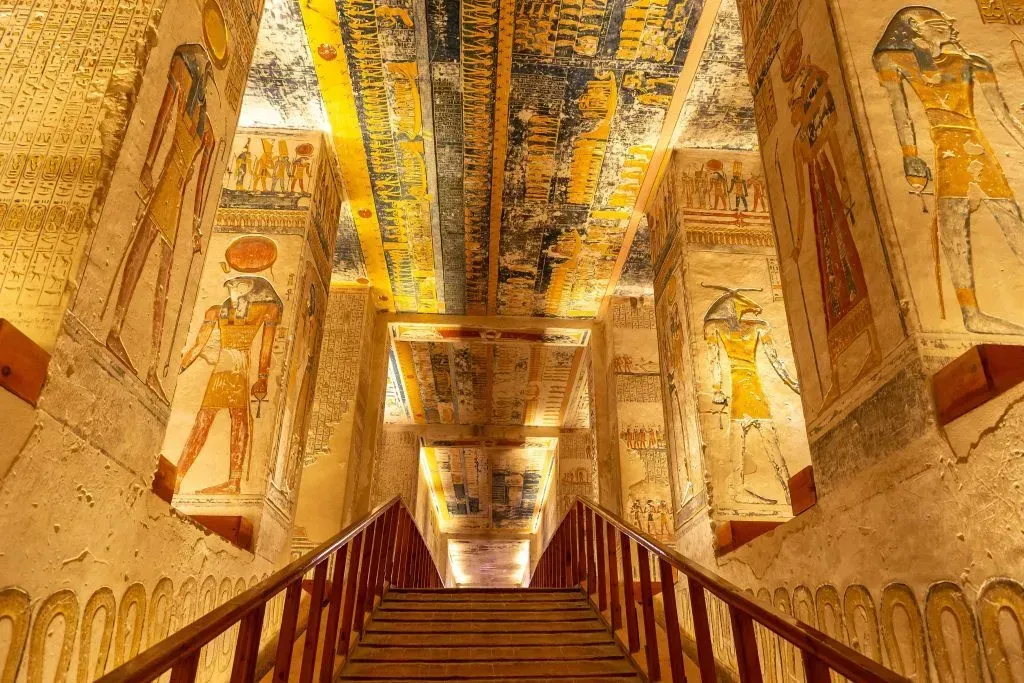
Luxor Historical Day Tour By Plane From Sharm El Sheikh
Experience a full-day Luxor tour from Sharm El Sheikh by plane, featuring visits to the Valley of the Kings, Karnak Temple, guided sightseeing, and convenient hotel pickup.
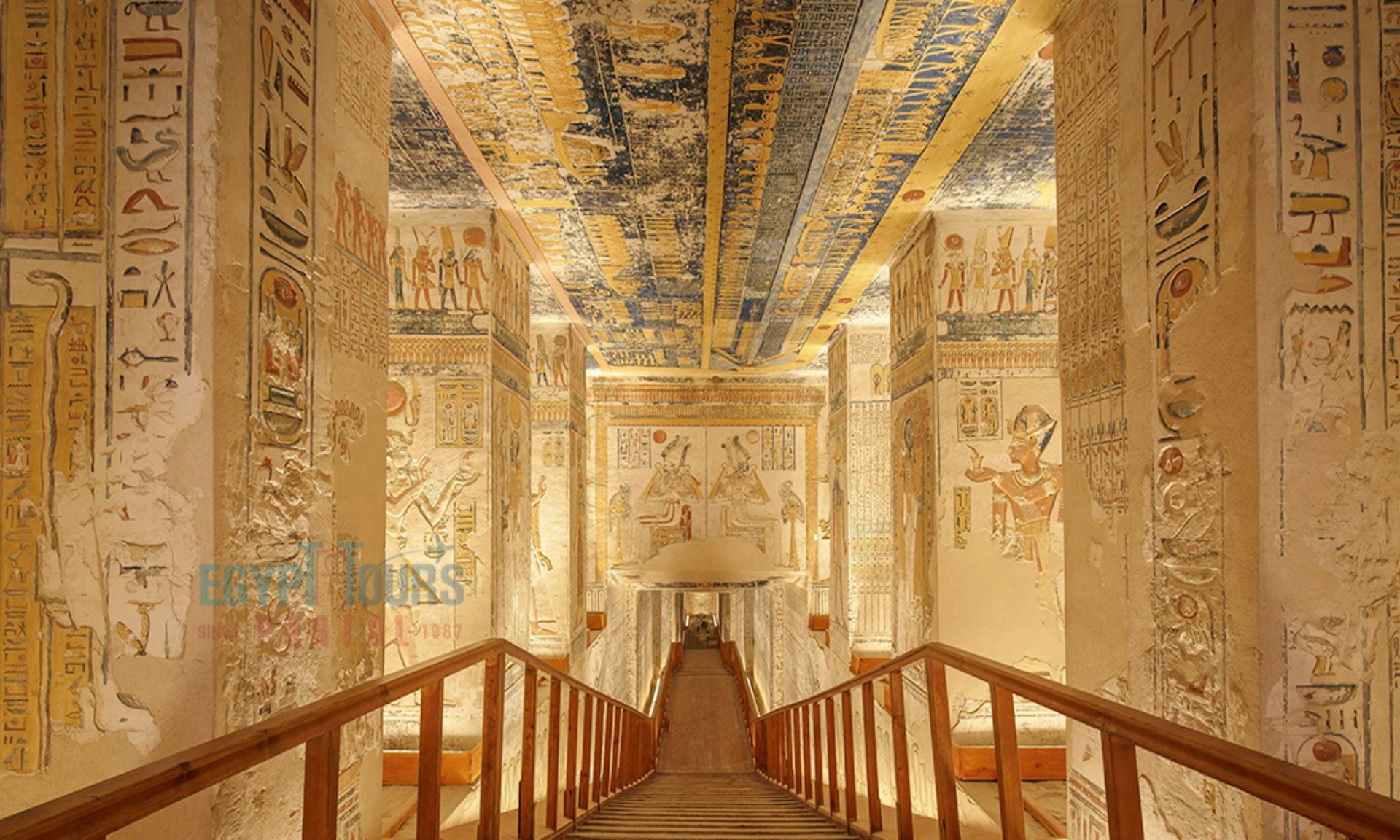
Luxor Valley Of The Kings day Tour By Bus From Hurghada
Experience a full-day guided bus tour from Hurghada to Luxor, including visits to the Valley of the Kings, Karnak Temple, Colossi of Memnon, and Hatshepsut Temple, with convenient hotel pickup and drop-off.
Tutankhamun and His Tomb
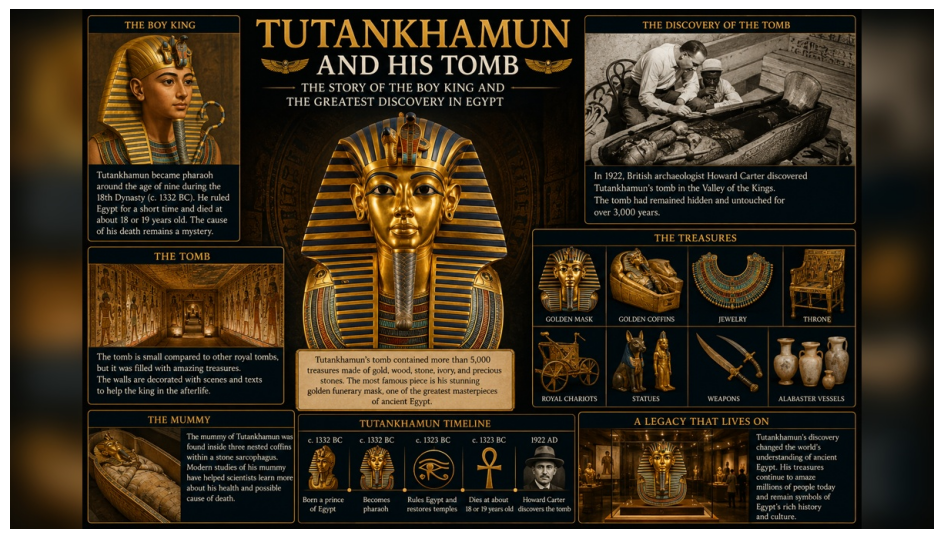
Tutankhamun, often called King Tut, is one of the most famous pharaohs in the history of Ancient Egypt. Although he ruled Egypt for only a short period and died at a young age, his name became world-famous after the discovery of his nearly intact tomb in 1922.
Tutankhamun ruled during the 18th Dynasty of the New Kingdom period around 1332 BC. He became pharaoh when he was still a child, possibly around the age of nine, which is why historians often refer to him as the “Boy King.”
Tutankhamun was the son of Pharaoh Akhenaten, a ruler known for attempting major religious changes in Ancient Egypt by promoting the worship of a single sun god called Aten. After Akhenaten’s death, Egypt experienced political and religious instability.
During Tutankhamun’s reign, many traditional Egyptian religious practices were restored. Temples dedicated to the old gods were reopened, and the royal court returned to supporting Egypt’s traditional beliefs and customs.
Despite his royal status, Tutankhamun’s reign was relatively short. He died unexpectedly at approximately 18 or 19 years old. The exact cause of his death remains a mystery and continues to be debated by historians, archaeologists, and medical researchers.
Some theories suggest that he may have died from illness, infection, genetic disorders, or injuries caused by an accident. Modern scientific examinations of his mummy have provided important clues, but no final conclusion has been confirmed.
Tutankhamun was buried in the Valley of the Kings near Luxor, where many New Kingdom pharaohs were laid to rest. Unlike many royal tombs that were looted in ancient times, Tutankhamun’s tomb remained largely hidden and untouched for over 3,000 years.
In 1922, British archaeologist Howard Carter discovered the tomb after years of searching. The discovery became one of the greatest archaeological events in history and attracted worldwide attention.
When Carter entered the burial chamber, he found thousands of extraordinary treasures, including:
- The famous golden funerary mask
- Golden coffins
- Jewelry and gemstones
- Royal chariots
- Furniture and statues
- Weapons and ceremonial objects
The treasures revealed the incredible wealth, craftsmanship, and artistic skill of Ancient Egypt during the New Kingdom period.
The golden mask of Tutankhamun became one of the most recognized symbols of Ancient Egypt and is considered one of the greatest masterpieces ever created in the ancient world.
Tutankhamun’s mummy was also discovered inside multiple nested coffins within a stone sarcophagus. The burial chamber was decorated with colorful religious scenes intended to guide the young king safely into the afterlife.
The discovery of Tutankhamun’s tomb provided historians with valuable insight into Ancient Egyptian royal life, burial traditions, religion, and art. Because the tomb remained mostly intact, it became one of the most important sources of information about Ancient Egypt ever found.
Today, many of Tutankhamun’s treasures are displayed in Egyptian museums and continue to fascinate millions of visitors from around the world. More than a century after the tomb’s discovery, the story of King Tut remains one of the greatest mysteries and legends of Ancient Egypt.
The Nile River and Ancient Egypt
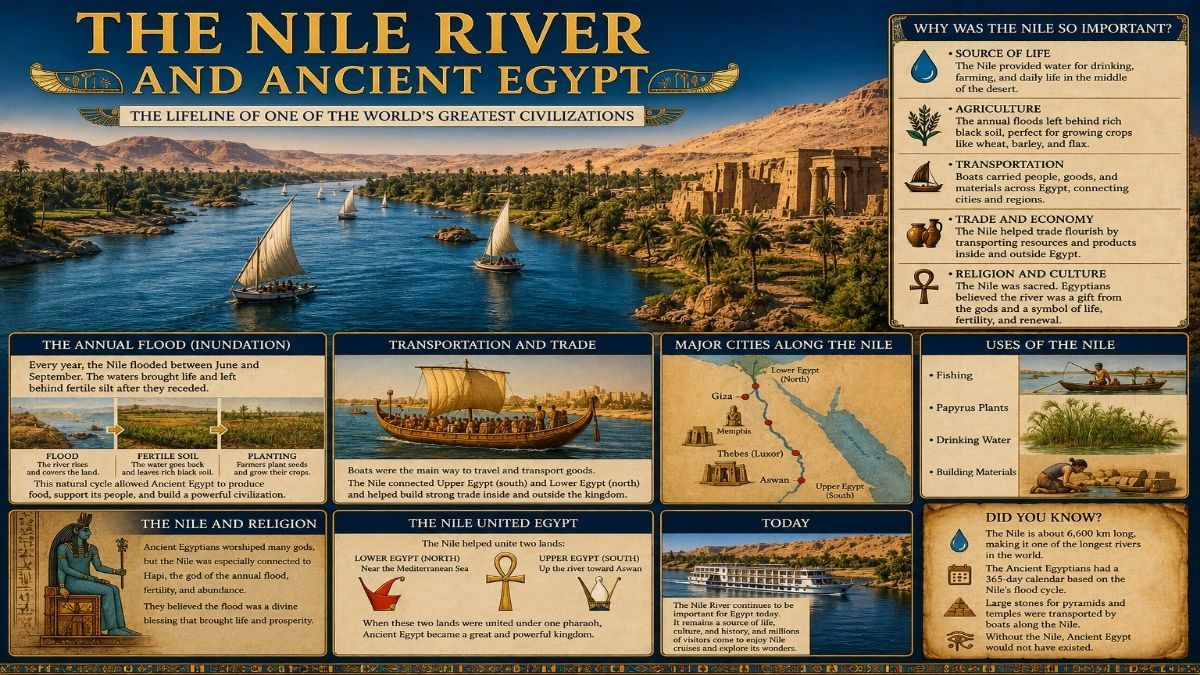
The Nile River was the lifeline of Ancient Egypt and one of the main reasons why Egyptian civilization was able to survive and flourish for thousands of years. Stretching more than 6,600 kilometers across northeastern Africa, the Nile is considered one of the longest rivers in the world and played a central role in Egyptian history, agriculture, trade, religion, and daily life.
Ancient Egypt developed almost entirely along the banks of the Nile River. While most of Egypt is covered by desert, the fertile land surrounding the Nile created ideal conditions for farming and permanent settlement. Because of this, ancient Greek historian Herodotus famously described Egypt as “the gift of the Nile.”
Every year, the Nile River flooded during a natural cycle known as the inundation. The floodwaters deposited rich black soil along the riverbanks, making the land extremely fertile for agriculture. Ancient Egyptians depended on these floods to grow crops such as wheat, barley, vegetables, and flax.
Agriculture allowed Egypt to produce large food supplies that supported population growth, economic stability, and powerful kingdoms. Farmers used irrigation systems, canals, and simple engineering techniques to distribute water across fields and improve crop production.
The Nile River also served as Ancient Egypt’s main transportation route. Boats traveled north and south carrying people, goods, stone blocks, grain, gold, papyrus, animals, and trade products between cities and regions. This transportation network helped unify Egypt politically and economically.
Major Ancient Egyptian cities and monuments were built close to the Nile, including:
- Memphis
- Thebes (Luxor)
- Aswan
- Giza
- Karnak
- Luxor Temple
The river was essential for construction projects because massive stones used to build pyramids and temples were transported by boat along the Nile from distant quarries.
The Nile also influenced Ancient Egyptian religion and spiritual beliefs. Egyptians considered the river sacred and connected it to several gods associated with fertility, life, and creation. The annual flooding was viewed as a divine blessing that brought prosperity and survival to the kingdom.
Fishing and hunting along the Nile provided additional food sources for Ancient Egyptians. Papyrus plants growing near the riverbanks were used to create paper, baskets, boats, ropes, sandals, and many everyday items.
The Nile River divided Egypt into two important regions:
- Upper Egypt in the south
- Lower Egypt in the north near the Mediterranean Sea
The unification of these two regions under one pharaoh marked the beginning of Ancient Egyptian civilization around 3100 BC.
For thousands of years, the Nile River shaped nearly every aspect of Egyptian life. Without the Nile, the rise of one of history’s greatest civilizations would not have been possible.
Today, the Nile remains one of Egypt’s most important natural and cultural landmarks. Millions of visitors travel to Egypt each year to experience Nile cruises, explore ancient temples along the riverbanks, and discover the remarkable history of the civilization that flourished beside its waters.
Ancient Egyptian Temples
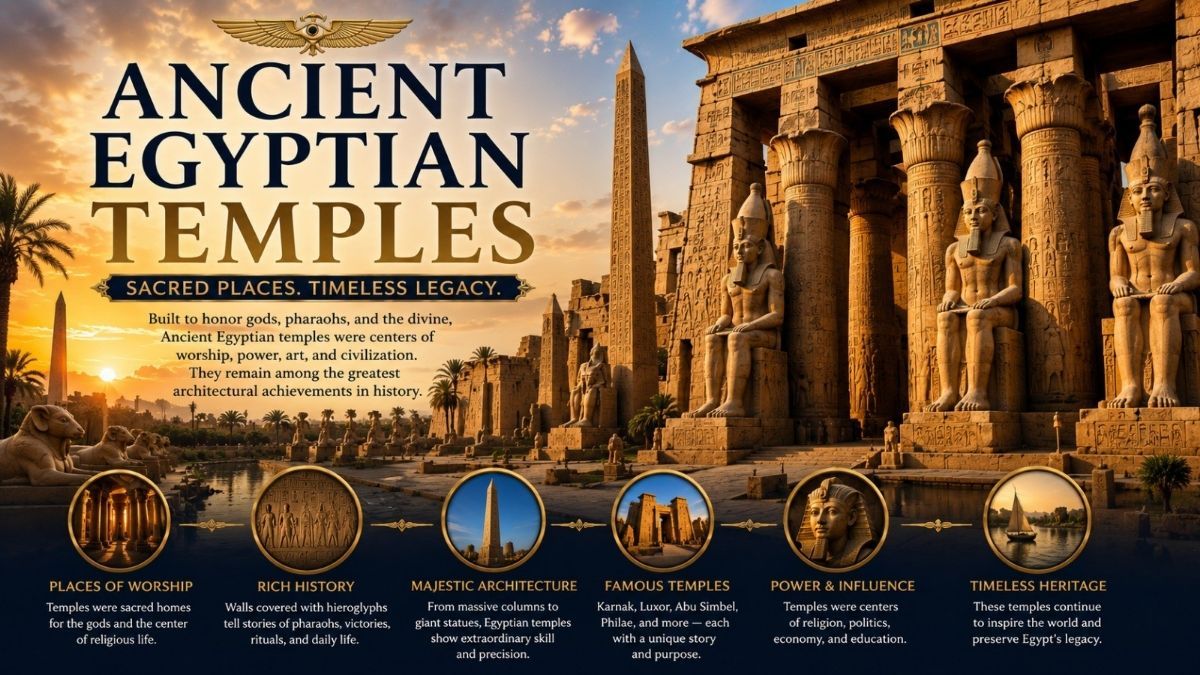
Ancient Egyptian temples were among the most magnificent and important structures ever built in the ancient world. These temples were not only places of worship but also centers of religion, politics, education, art, and economic activity. Built to honor gods, goddesses, and powerful pharaohs, the temples of Ancient Egypt remain some of the greatest architectural achievements in human history.
The ancient Egyptians believed that temples were sacred homes for the gods. Priests performed daily rituals inside the temples to honor the deities, offer food and prayers, and maintain harmony between the gods and the people of Egypt.
Most temples were carefully aligned with astronomical events and built according to religious beliefs and symbolic designs. Massive stone columns, giant statues, obelisks, sacred lakes, and beautifully carved walls were common features of Egyptian temple architecture.
The walls of the temples were covered with hieroglyphic inscriptions and detailed carvings showing religious ceremonies, military victories, offerings to the gods, and scenes from the lives of pharaohs. These inscriptions continue to provide historians with valuable information about Ancient Egyptian civilization.
One of the most famous temple complexes in Egypt is Karnak Temple in Luxor. Karnak is considered one of the largest religious complexes ever constructed and was expanded over many centuries by different pharaohs.
The Great Hypostyle Hall at Karnak contains enormous stone columns decorated with intricate carvings and hieroglyphics. The temple was mainly dedicated to the god Amun-Ra, one of the most important deities in Ancient Egyptian religion.
Another remarkable monument is Luxor Temple, located on the east bank of the Nile River in Luxor. Luxor Temple was connected to Karnak Temple by the famous Avenue of Sphinxes, a ceremonial road lined with sphinx statues.
Luxor Temple played an important role in royal ceremonies and religious festivals, especially the Opet Festival, which celebrated the connection between the pharaoh and the gods.
In southern Egypt near Aswan stands the magnificent Abu Simbel Temple, built by Pharaoh Ramses II. The temple is famous for its four colossal statues of Ramses II carved directly into the mountainside.
Abu Simbel was designed to demonstrate the power and greatness of Ramses II and also served as a symbol of Egyptian strength near the southern borders of the kingdom.
Another important temple is Philae Temple, dedicated to the goddess Isis. Located near Aswan, Philae became one of the last major centers of Ancient Egyptian religion during the Greco-Roman period.
The temple is admired for its elegant architecture, beautiful reliefs, and scenic island location on the Nile River.
Ancient Egyptian temples were also important economic centers. They owned farmland, employed workers, stored food, and controlled valuable resources. Large temple complexes supported entire communities and played a major role in Egypt’s economy.
The construction of these temples required extraordinary engineering skill and enormous labor forces. Massive stone blocks were transported across the Nile and assembled with remarkable precision using ancient tools and techniques.
Today, the temples of Ancient Egypt remain some of the country’s most popular tourist attractions. Millions of visitors travel to Luxor, Aswan, and other historic sites each year to explore these incredible monuments and experience the legacy of one of the world’s greatest civilizations.
The temples continue to inspire historians, archaeologists, architects, and travelers from around the globe, preserving the spiritual and cultural heritage of Ancient Egypt for future generations.
Cleopatra and the End of Ancient Egypt
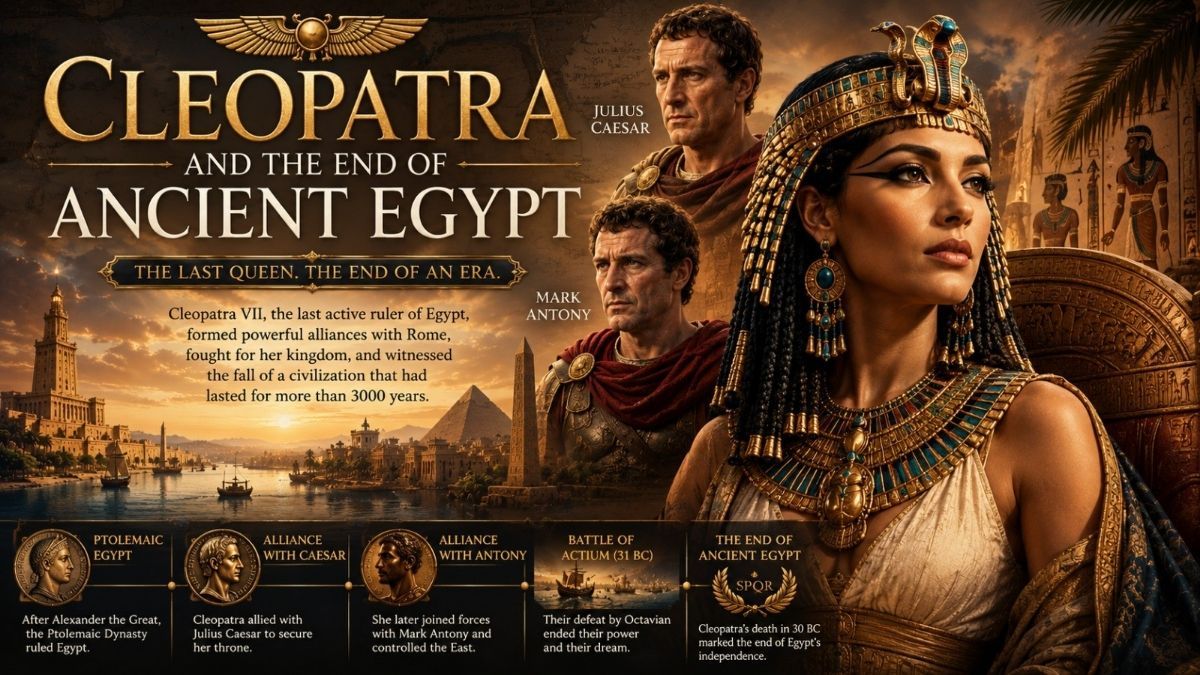
Cleopatra VII was the last active ruler of Ancient Egypt and one of the most famous women in world history. Known for her intelligence, political skill, and powerful alliances with Rome, Cleopatra became a symbol of beauty, leadership, and the dramatic end of Ancient Egyptian civilization.
Cleopatra was born in 69 BC during the Ptolemaic Dynasty, a Greek ruling family that governed Egypt after the conquest of Alexander the Great. Although the Ptolemies were of Greek origin, Cleopatra embraced many aspects of Egyptian culture and became one of the few rulers of her dynasty to learn the Egyptian language.
She became queen of Egypt at a young age and ruled during a time of political instability and growing Roman influence in the Mediterranean world. Cleopatra faced internal conflicts, economic challenges, and powerful enemies both inside and outside Egypt.
One of the most important events in Cleopatra’s life was her alliance with the Roman leader Julius Caesar. According to historical accounts, Cleopatra famously met Caesar in Alexandria and formed a political and personal relationship with him. Their alliance helped Cleopatra secure her position as queen after a struggle for power with her brother Ptolemy XIII.
Cleopatra later gave birth to a son called Caesarion, who was believed to be the child of Julius Caesar. After Caesar’s assassination in Rome in 44 BC, Cleopatra returned to Egypt and continued to strengthen her political position.
Another major chapter in her life began when she formed a relationship with the Roman general Mark Antony. Together, Cleopatra and Antony became powerful allies and controlled large territories in the eastern Mediterranean.
However, their alliance created conflict with Octavian, the future Emperor Augustus and rival leader in Rome. Tensions eventually led to a major military confrontation known as the Battle of Actium in 31 BC.
During the battle, the forces of Octavian defeated Antony and Cleopatra, marking a turning point in world history. After their defeat, Antony and Cleopatra retreated to Egypt while Roman forces advanced toward Alexandria.
Facing the collapse of their power and the loss of Egypt, Mark Antony took his own life. Shortly afterward, Cleopatra also died in 30 BC. According to popular tradition, she may have died from the bite of an asp, although historians still debate the exact circumstances of her death.
With Cleopatra’s death, Ancient Egypt officially lost its independence and became part of the Roman Empire. This event marked the end of the Ptolemaic Kingdom and the final chapter of Ancient Egyptian civilization ruled by pharaohs.
Despite the fall of Ancient Egypt, Cleopatra’s story survived through history, literature, art, and popular culture. She became one of the most legendary figures of the ancient world and continues to fascinate historians, filmmakers, archaeologists, and travelers today.
Cleopatra’s reign represented both the final glory and the dramatic end of one of the greatest civilizations in human history. Her legacy remains deeply connected to Egypt’s rich historical heritage and the enduring mystery of the ancient world.
Ancient Egyptian Inventions
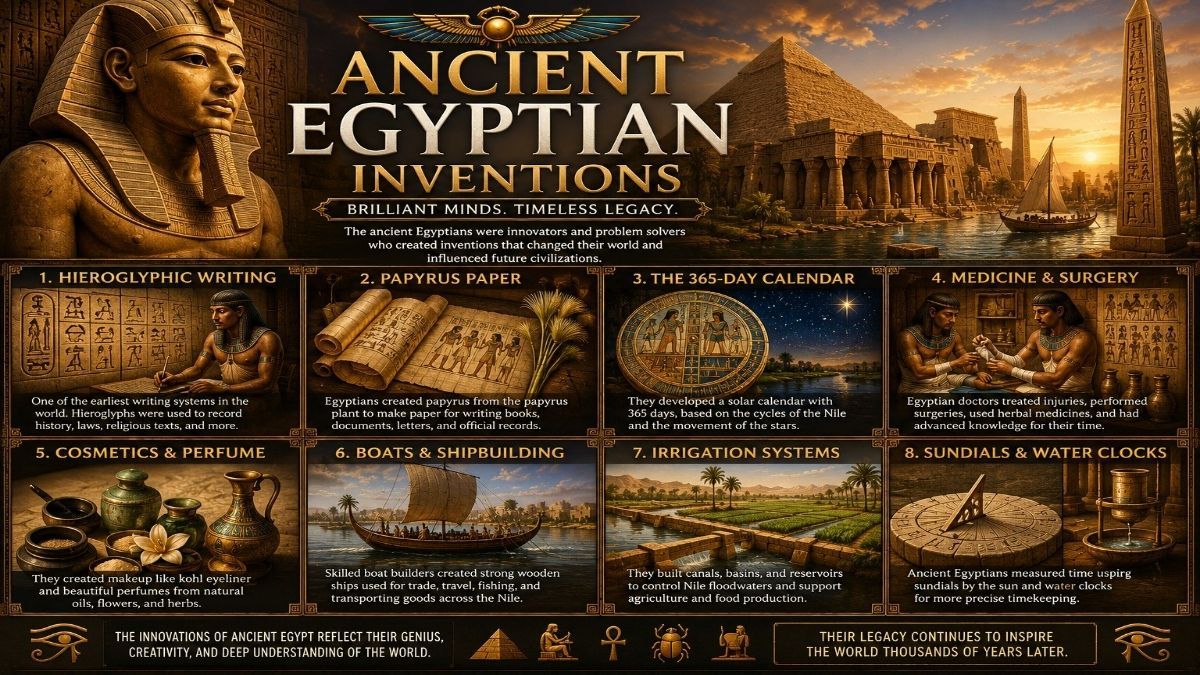
Ancient Egypt was one of the most advanced civilizations of the ancient world and made remarkable contributions to science, technology, medicine, engineering, writing, and daily life. Many inventions and innovations developed by the ancient Egyptians influenced later civilizations and continue to impact the modern world today.
One of the greatest achievements of Ancient Egypt was the development of hieroglyphic writing. Egyptian scribes used symbols and pictures to record religious texts, historical events, government records, and literature. Hieroglyphics became one of the earliest writing systems in human history and played a major role in preserving Egyptian culture for thousands of years.
The ancient Egyptians also invented papyrus, one of the earliest forms of paper. Papyrus was made from the papyrus plant that grew along the Nile River. Egyptians used papyrus to create books, official documents, letters, maps, and religious texts. This invention greatly improved communication and record-keeping.
Ancient Egyptians were highly skilled in mathematics and engineering. Their knowledge allowed them to construct massive monuments such as the pyramids, temples, obelisks, and tombs with remarkable precision. Engineers developed techniques for transporting enormous stone blocks and organizing large construction projects.
The Egyptian calendar was another important innovation. Ancient Egyptians created a solar calendar based on the cycles of the Nile River and the movement of stars. Their calendar contained 365 days and became one of the foundations of later calendar systems used throughout the world.
Medicine in Ancient Egypt was highly advanced for its time. Egyptian doctors studied anatomy, injuries, diseases, and surgical procedures. Medical texts discovered by archaeologists show that Egyptians treated wounds, performed surgeries, used herbal medicines, and understood the importance of hygiene.
Ancient Egyptians also developed early forms of dentistry and practiced medical specialization. Some physicians focused specifically on eye diseases, digestive problems, or other areas of health.
Cosmetics and beauty products were widely used in Ancient Egypt by both men and women. Egyptians created makeup such as kohl eyeliner and perfumes made from natural oils and flowers. In addition to beauty purposes, some cosmetics were believed to protect the skin and eyes from the sun and infections.
Boat building and navigation were essential Egyptian innovations because the Nile River served as the kingdom’s main transportation route. Egyptians built wooden boats and sailing vessels used for trade, travel, fishing, military purposes, and transporting construction materials.
Ancient Egyptians also created irrigation systems to improve agriculture. Canals, reservoirs, and water management techniques helped farmers control Nile floodwaters and increase crop production, which supported Egypt’s growing population and economy.
Timekeeping was another important area of innovation. Egyptians developed sundials and water clocks to measure time and organize religious ceremonies, work schedules, and agricultural activities.
Glassmaking, jewelry design, metalworking, and textile production were also highly developed in Ancient Egypt. Skilled craftsmen produced beautiful decorative objects, gold jewelry, statues, furniture, and tools admired throughout the ancient world.
Many Ancient Egyptian inventions demonstrated extraordinary creativity, intelligence, and practical problem-solving. Their achievements influenced Greek, Roman, and later civilizations and helped shape important aspects of science, architecture, medicine, and culture.
Today, historians and archaeologists continue to study Ancient Egyptian innovations to better understand how one of history’s greatest civilizations achieved such remarkable progress thousands of years ago.
Ancient Egyptian Writing and Hieroglyphics
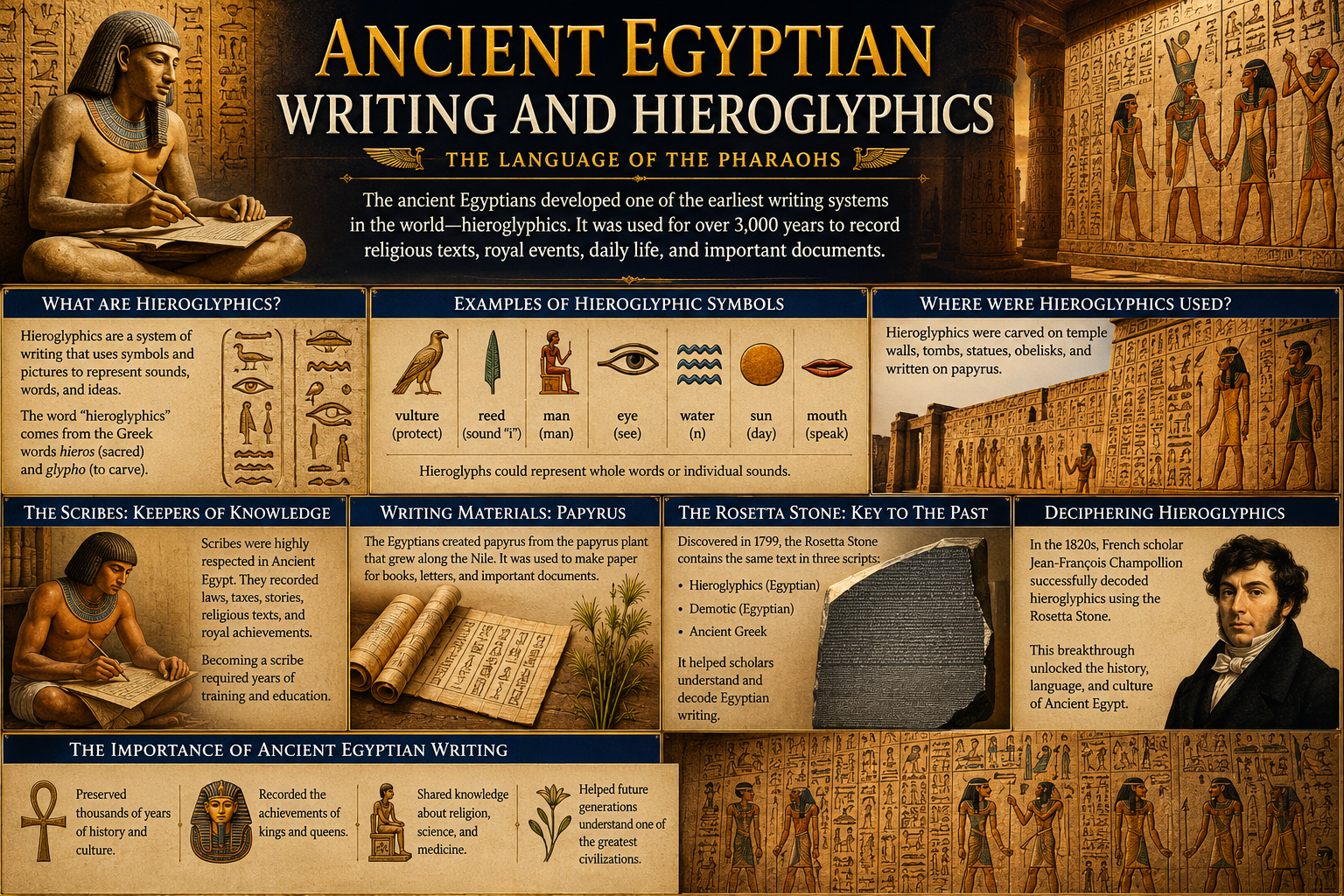
Ancient Egyptian writing was one of the greatest intellectual achievements of the ancient world and played a major role in preserving the history, religion, culture, and knowledge of Egyptian civilization for thousands of years. The most famous writing system developed by the ancient Egyptians was known as hieroglyphics.
Hieroglyphics consisted of symbols, pictures, and signs used to represent sounds, objects, words, and ideas. The word “hieroglyphics” comes from the Greek language and means “sacred carvings” because the symbols were often carved into temple walls, monuments, tombs, and statues.
Ancient Egyptians believed writing was a sacred gift connected to the gods. The god Thoth, associated with wisdom, knowledge, and writing, was believed to have invented language and hieroglyphic script.
Hieroglyphic writing appeared in Egypt more than 5,000 years ago and became one of the earliest writing systems in human history. Egyptians used hieroglyphics for religious texts, royal decrees, historical records, literature, mathematics, and administrative documents.
The symbols included images of humans, animals, birds, plants, tools, and abstract shapes. Some hieroglyphs represented entire words, while others represented individual sounds or combinations of sounds.
Hieroglyphics were usually written in rows or columns and could be read from left to right or right to left depending on the direction the symbols faced. Skilled scribes were trained to understand and write the complex language.
Scribes held an important position in Ancient Egyptian society. They were responsible for recording laws, taxes, trade transactions, religious ceremonies, military events, and royal achievements. Because literacy was limited, scribes were highly respected and often worked closely with government officials and priests.
In addition to stone carvings, Egyptians also wrote on papyrus, an early form of paper made from the papyrus plant growing along the Nile River. Papyrus scrolls allowed Egyptians to preserve books, letters, educational texts, and official records more efficiently.
For many centuries after the fall of Ancient Egypt, the meaning of hieroglyphics was lost and became one of history’s greatest mysteries. Scholars could see the symbols on temples and monuments but could not understand their meaning.
The breakthrough came after the discovery of the Rosetta Stone in 1799 during Napoleon’s campaign in Egypt. The stone contained the same text written in three scripts:
- Hieroglyphics
- Demotic Egyptian
- Ancient Greek
Because scholars could already understand Greek, the Rosetta Stone became the key to deciphering Ancient Egyptian writing.
French scholar Jean-François Champollion successfully decoded hieroglyphics in the 1820s, allowing historians and archaeologists to finally read ancient Egyptian inscriptions and uncover the secrets of one of history’s greatest civilizations.
Today, hieroglyphics remain one of the most recognizable symbols of Ancient Egypt. The inscriptions found in temples, tombs, pyramids, and papyrus scrolls continue to provide valuable insight into Egyptian religion, politics, daily life, science, and culture.
Ancient Egyptian writing helped preserve thousands of years of history and allowed modern civilization to better understand the extraordinary achievements of Ancient Egypt.
Daily Life in Ancient Egypt
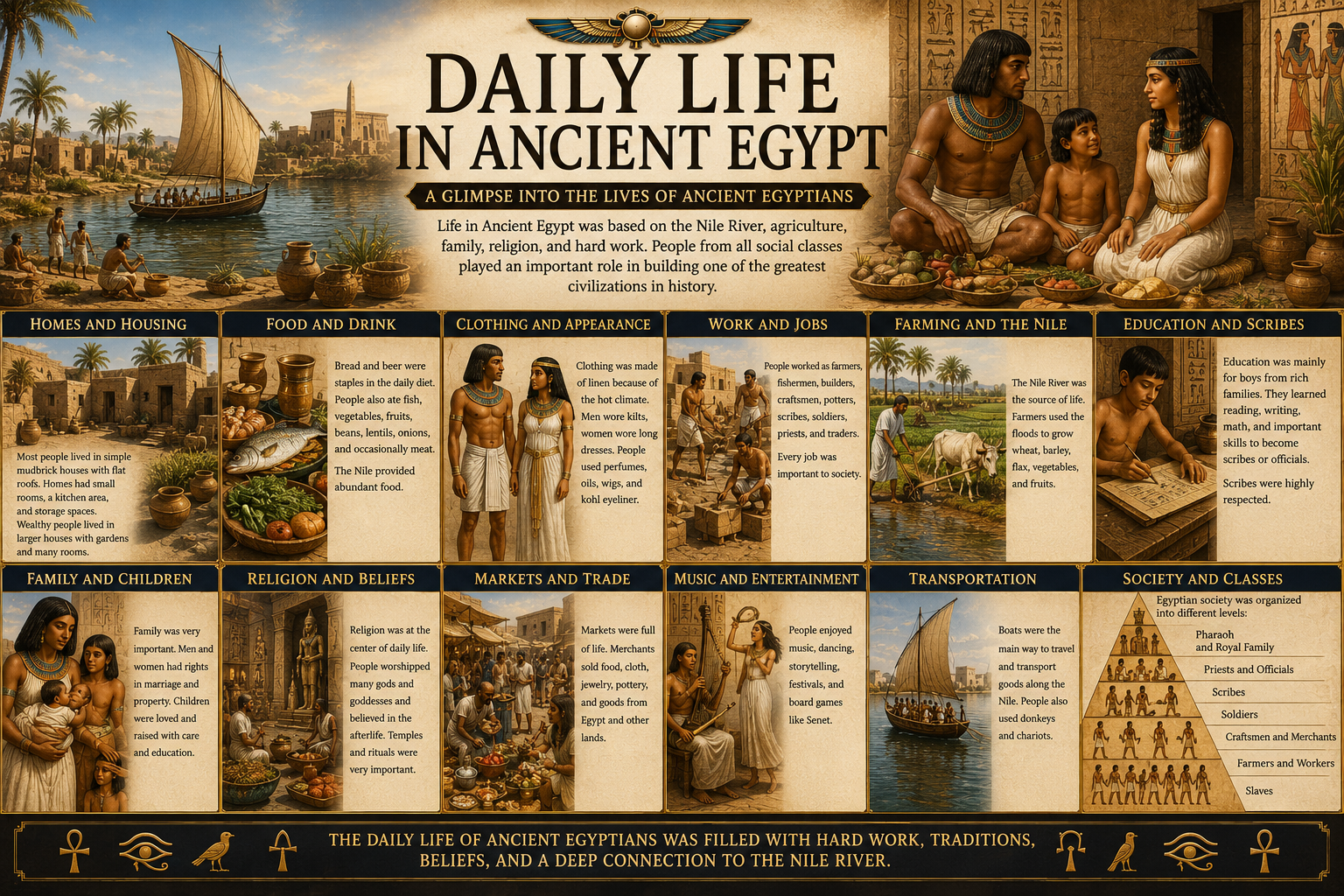
Daily life in Ancient Egypt was deeply connected to the Nile River, religion, agriculture, family traditions, and social structure. Although the lives of pharaohs and nobles were very different from ordinary workers and farmers, Egyptian society was highly organized and supported one of the greatest civilizations in human history for thousands of years.
Most Ancient Egyptians lived in villages and towns near the Nile River because the fertile land surrounding the river was ideal for farming and daily survival. Mudbrick houses were common and were built using clay mixed with straw and dried under the sun.
Homes of ordinary people were usually simple and practical, containing small rooms, flat roofs, storage areas, and basic furniture. Wealthy families and nobles lived in much larger houses with gardens, decorative furniture, servants, and private storage rooms.
Agriculture was the foundation of Ancient Egyptian life. Farmers grew crops such as wheat, barley, onions, beans, lettuce, and flax. The annual flooding of the Nile River provided fertile soil that allowed Egypt to produce large amounts of food.
Many Egyptians worked as farmers, builders, craftsmen, fishermen, merchants, or laborers. Skilled workers created pottery, jewelry, statues, furniture, tools, and textiles that were used throughout the kingdom.
Bread and beer were among the most important foods in Ancient Egypt and were consumed daily by people of all social classes. Egyptians also ate vegetables, fruits, fish, poultry, and occasionally meat. Wealthier families enjoyed larger varieties of food and imported luxury products.
Clothing in Ancient Egypt was usually made from linen produced from flax plants. Because of Egypt’s hot climate, most clothing was lightweight and simple. Men often wore short kilts, while women wore long dresses. Wealthy Egyptians wore finer linen, jewelry, perfumes, and decorative accessories.
Ancient Egyptians cared greatly about cleanliness and appearance. Both men and women used oils, perfumes, makeup, and wigs. Kohl eyeliner was commonly used not only for beauty but also for protection against sunlight and eye infections.
Family life was extremely important in Ancient Egyptian society. Marriage was common, and children were highly valued. Women in Ancient Egypt enjoyed more rights and freedoms compared to many other ancient civilizations. They could own property, manage businesses, inherit wealth, and participate in legal matters.
Education was mainly available to wealthy families and future scribes. Boys trained as scribes learned reading, writing, mathematics, and administration. Scribes were highly respected because literacy was limited.
Religion influenced nearly every part of daily life. Egyptians worshipped many gods and believed strongly in the afterlife. Temples, religious festivals, ceremonies, and offerings were regular parts of society.
Music, dancing, storytelling, and games were also important forms of entertainment. Egyptians played board games, enjoyed festivals, and participated in celebrations connected to religion and seasonal events.
Large cities such as Memphis, Thebes, and Alexandria became centers of trade, politics, religion, and culture. Markets were filled with merchants selling food, clothing, jewelry, pottery, and imported goods from distant regions.
Despite social differences between classes, Ancient Egyptian society remained remarkably stable for thousands of years because of strong government organization, agricultural success, religious traditions, and the importance of the Nile River.
Today, historians and archaeologists continue to study Ancient Egyptian daily life through tomb paintings, writings, tools, homes, and artifacts that reveal how ordinary people lived in one of history’s most extraordinary civilizations.
Egyptian Mythology
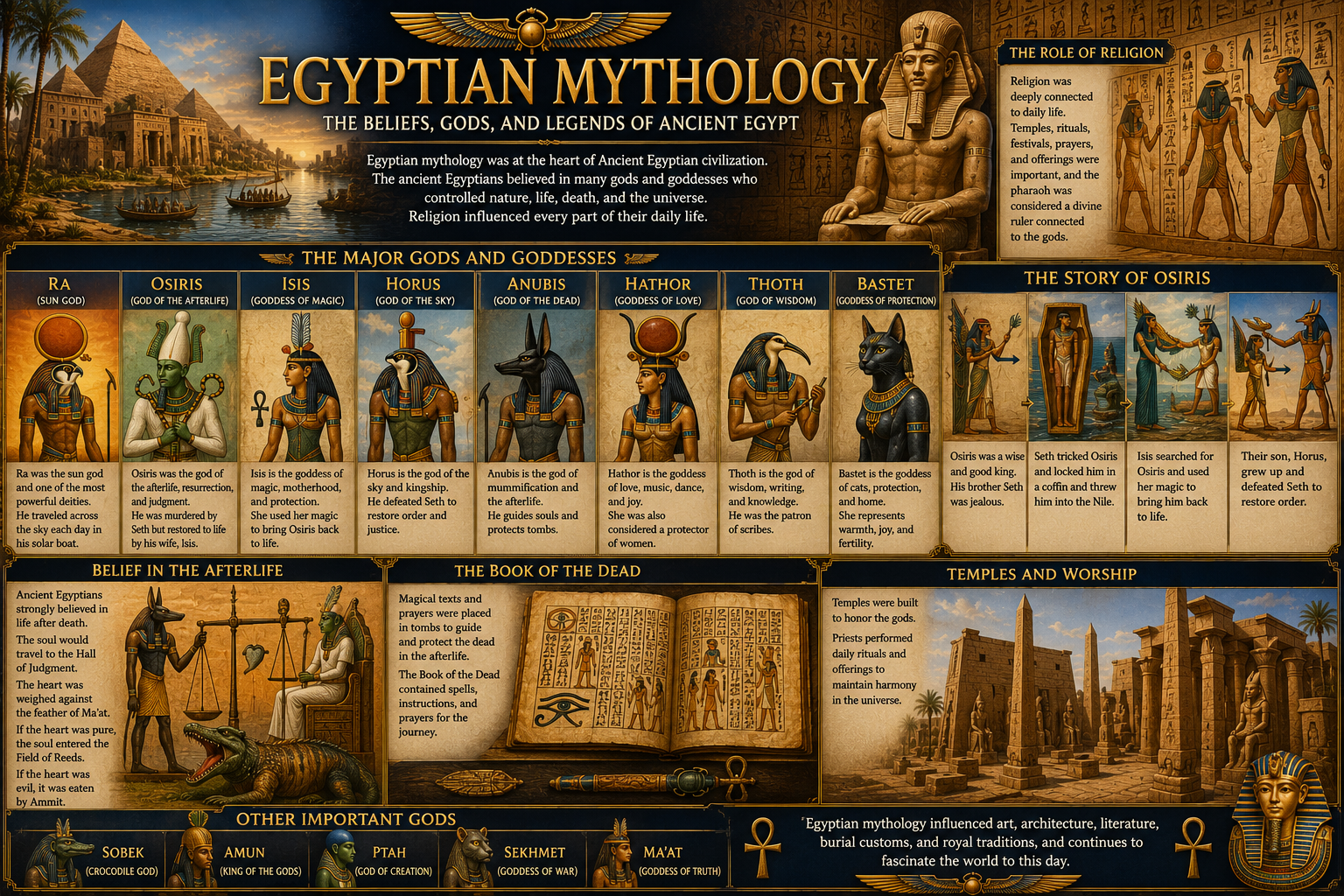
Egyptian mythology was one of the most important parts of Ancient Egyptian civilization and influenced religion, art, architecture, politics, and daily life for thousands of years. The ancient Egyptians believed in many gods and goddesses who controlled nature, life, death, the sky, the Nile River, and the universe itself.
Religion was deeply connected to every aspect of Egyptian society. Temples, rituals, festivals, prayers, and offerings were central parts of daily life, and the pharaoh was considered a divine ruler connected to the gods.
One of the most important gods in Egyptian mythology was Ra, the sun god. Ra was believed to travel across the sky each day in a solar boat, bringing light and life to the world. At night, he journeyed through the underworld before rising again at sunrise. Because the sun was essential for life, Ra became one of the most powerful and respected deities in Ancient Egypt.
Osiris was another major god and was associated with the afterlife, resurrection, and judgment of the dead. According to Egyptian mythology, Osiris was murdered by his brother Seth, who represented chaos and disorder. Osiris’s wife, Isis, used magic to restore him, and their son Horus later defeated Seth to restore order and justice.
The story of Osiris, Isis, Horus, and Seth became one of the most important myths in Ancient Egypt and symbolized the eternal struggle between order and chaos.
Horus, often represented as a falcon-headed god, was associated with kingship, protection, and the sky. Egyptian pharaohs were believed to be earthly representations of Horus, which strengthened their divine authority.
Anubis, the jackal-headed god, was closely connected to mummification and the protection of tombs. He guided souls into the afterlife and played a major role in funeral rituals and burial ceremonies.
Ancient Egyptians strongly believed in life after death. They believed that after death, a person’s soul would travel to the Hall of Judgment, where the heart of the deceased would be weighed against the feather of Ma’at, the goddess of truth and justice.
If the heart was pure and balanced, the soul could enter the eternal paradise known as the Field of Reeds. If the person had lived an evil life, the heart would be devoured by a terrifying creature called Ammit.
To help guide the dead through the afterlife, Egyptians placed magical texts and prayers inside tombs. One of the most famous collections of these texts is known as the Book of the Dead, which contained instructions, spells, and protective formulas for the journey after death.
The ancient Egyptians also worshipped many other gods and goddesses, including:
- Isis — goddess of magic and motherhood
- Hathor — goddess of love, music, and joy
- Thoth — god of wisdom and writing
- Bastet — goddess associated with cats and protection
- Sobek — crocodile god connected to the Nile
- Amun — king of the gods during parts of Egyptian history
Temples dedicated to these deities were built throughout Egypt, including Karnak, Luxor, Philae, and Edfu. Priests performed daily rituals to honor the gods and maintain harmony in the universe.
Egyptian mythology influenced Ancient Egyptian art, architecture, literature, burial customs, and royal traditions. Gods and myths were represented in temple carvings, tomb paintings, statues, jewelry, and sacred texts across the kingdom.
Today, Egyptian mythology continues to fascinate people around the world and remains one of the most famous mythological systems in human history. Its gods, legends, and symbols still inspire books, movies, documentaries, games, and modern culture thousands of years after the fall of Ancient Egypt.
Women in Ancient Egypt
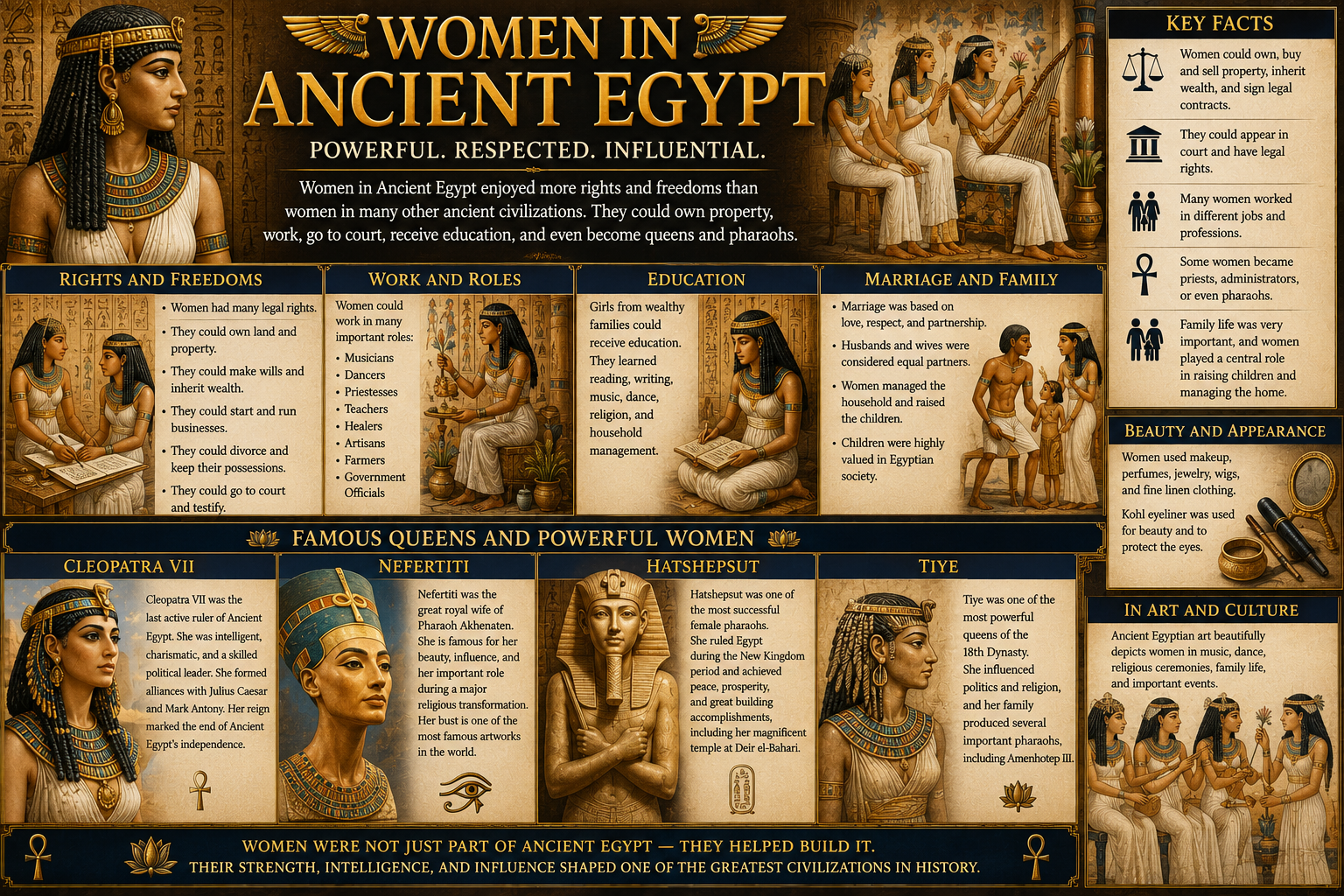
Women in Ancient Egypt held an important and respected position in society and enjoyed more legal rights and freedoms than women in many other ancient civilizations. Although Egyptian society was traditionally led by men, women could own property, inherit wealth, manage businesses, participate in legal matters, and even rule Egypt as powerful queens and pharaohs.
Family was the foundation of Ancient Egyptian society, and women played a central role in maintaining the household, raising children, and preserving family traditions. Marriage was highly valued, and many Egyptian artworks and writings show husbands and wives together as partners in daily life.
Unlike women in some ancient cultures, Egyptian women had the legal right to buy and sell property, sign contracts, inherit land, and appear in court. Wealthy women could manage estates, supervise servants, and participate in economic activities.
Most women in Ancient Egypt were responsible for caring for the home, preparing food, making clothing, and raising children. However, women could also work as musicians, dancers, priestesses, servants, healers, and artisans. Some women worked in temples or assisted in religious ceremonies.
Royal women often held enormous political and religious influence. Queens and princesses were respected members of the royal court and sometimes played important roles in diplomacy, government, and religion.
One of the most famous queens in Ancient Egypt was Cleopatra VII, the last active ruler of Ancient Egypt. Cleopatra became known for her intelligence, leadership, and political alliances with powerful Roman figures such as Julius Caesar and Mark Antony. Her reign marked the final chapter of Ancient Egyptian independence before Egypt became part of the Roman Empire.
Another legendary royal figure was Queen Nefertiti, the wife of Pharaoh Akhenaten. Nefertiti became famous for her beauty, influence, and role during a major religious transformation in Ancient Egypt. Her iconic bust remains one of the most recognizable artworks from the ancient world.
Queen Hatshepsut was another extraordinary ruler who became one of the few female pharaohs in Egyptian history. She ruled during the New Kingdom period and oversaw successful trade expeditions, construction projects, and economic growth. Hatshepsut presented herself with many of the traditional symbols of kingship usually associated with male pharaohs.
Women also participated in religious life and could serve as priestesses dedicated to major gods and goddesses. Some women held respected titles connected to temples and royal ceremonies.
Beauty and appearance were important aspects of life for many Egyptian women. They used cosmetics, perfumes, jewelry, wigs, and fine linen clothing. Makeup such as kohl eyeliner was commonly used for beauty and protection from the sun.
Ancient Egyptian art often portrayed women with elegance and dignity. Tomb paintings, statues, and carvings show women participating in banquets, religious ceremonies, music, dance, and family life.
Although social class greatly affected daily life, the rights and visibility of women in Ancient Egypt were remarkable compared to many neighboring civilizations of the same period.
The stories of powerful queens such as Cleopatra, Nefertiti, and Hatshepsut continue to fascinate historians and travelers around the world. Their legacy demonstrates the significant role women played in shaping the culture, politics, and history of Ancient Egypt.
Ancient Egyptian Art and Architecture
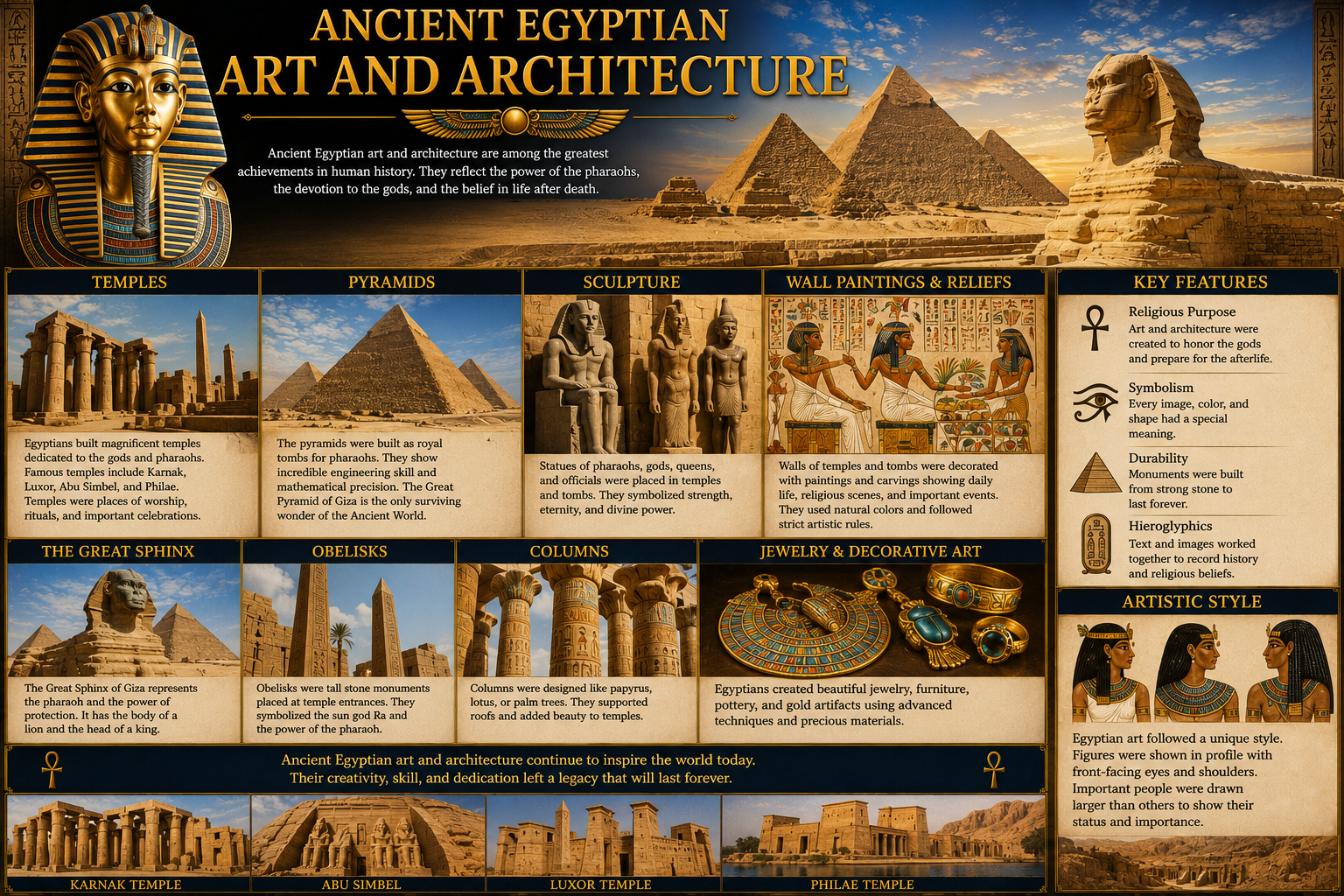
Ancient Egyptian art and architecture are considered among the greatest achievements in human history. For thousands of years, Egyptian artists, architects, and craftsmen created magnificent monuments, temples, statues, tombs, paintings, and decorative objects that reflected the power, religion, and culture of one of the world’s most advanced civilizations.
Art in Ancient Egypt was deeply connected to religion and royal authority. Most artistic works were created to honor the gods, preserve the memory of pharaohs, and prepare the dead for the afterlife. Egyptian artists followed strict artistic rules and symbolic styles that remained remarkably consistent for centuries.
One of the most famous achievements of Ancient Egyptian architecture was the construction of the pyramids. Built as royal tombs for pharaohs, the pyramids demonstrated extraordinary engineering skill and mathematical precision. The Great Pyramid of Giza remains one of the most impressive structures ever built and is the only surviving wonder of the Ancient Seven Wonders of the World.
Ancient Egyptians also built enormous temples dedicated to gods and pharaohs. Temples such as Karnak Temple, Luxor Temple, Abu Simbel, and Philae Temple featured massive stone columns, colossal statues, obelisks, ceremonial courtyards, and beautifully carved walls covered with hieroglyphics and religious scenes.
The architecture of Egyptian temples was carefully planned according to religious beliefs and astronomical alignments. Long processional avenues, sacred lakes, towering gateways known as pylons, and massive halls created powerful spiritual spaces designed to honor the gods.
Ancient Egyptian sculpture played an important role in temples, tombs, and royal monuments. Statues of pharaohs, gods, queens, and officials were carved from stone, wood, and metal. Many statues symbolized strength, eternity, and divine authority.
One of the most famous sculptures in the world is the Great Sphinx of Giza, which combines the body of a lion with the head of a pharaoh. The Sphinx became a symbol of protection, royal power, and mystery.
Wall paintings and relief carvings decorated tombs and temples across Egypt. These artworks often showed scenes of religious ceremonies, farming, hunting, feasts, military victories, and daily life. The paintings used bright natural colors and followed distinctive artistic conventions.
Egyptian artists often represented important figures such as pharaohs larger than ordinary people to symbolize their higher status and power. Human figures were usually drawn using a unique style that combined profile views with front-facing eyes and shoulders.
Hieroglyphics were frequently integrated into artistic designs. Text and images worked together to tell stories, record historical events, honor the gods, and guide the dead through the afterlife.
Obelisks were another important form of Egyptian architecture. These tall stone monuments were carved from single blocks of granite and placed at temple entrances as symbols of the sun god Ra and royal authority.
Ancient Egyptian craftsmen also created remarkable jewelry, furniture, pottery, gold artifacts, and decorative objects using advanced techniques and precious materials. Gold was especially valued because Egyptians associated it with eternity and divine power.
The preservation of Ancient Egyptian art and architecture over thousands of years continues to amaze historians, archaeologists, architects, and travelers from around the world. The monuments and artistic masterpieces of Ancient Egypt provide valuable insight into the beliefs, achievements, and creativity of one of history’s greatest civilizations.
Today, Ancient Egyptian art and architecture remain powerful symbols of Egypt’s cultural heritage and continue to inspire modern artists, designers, architects, and historians worldwide.
Famous Pharaohs of Ancient Egypt
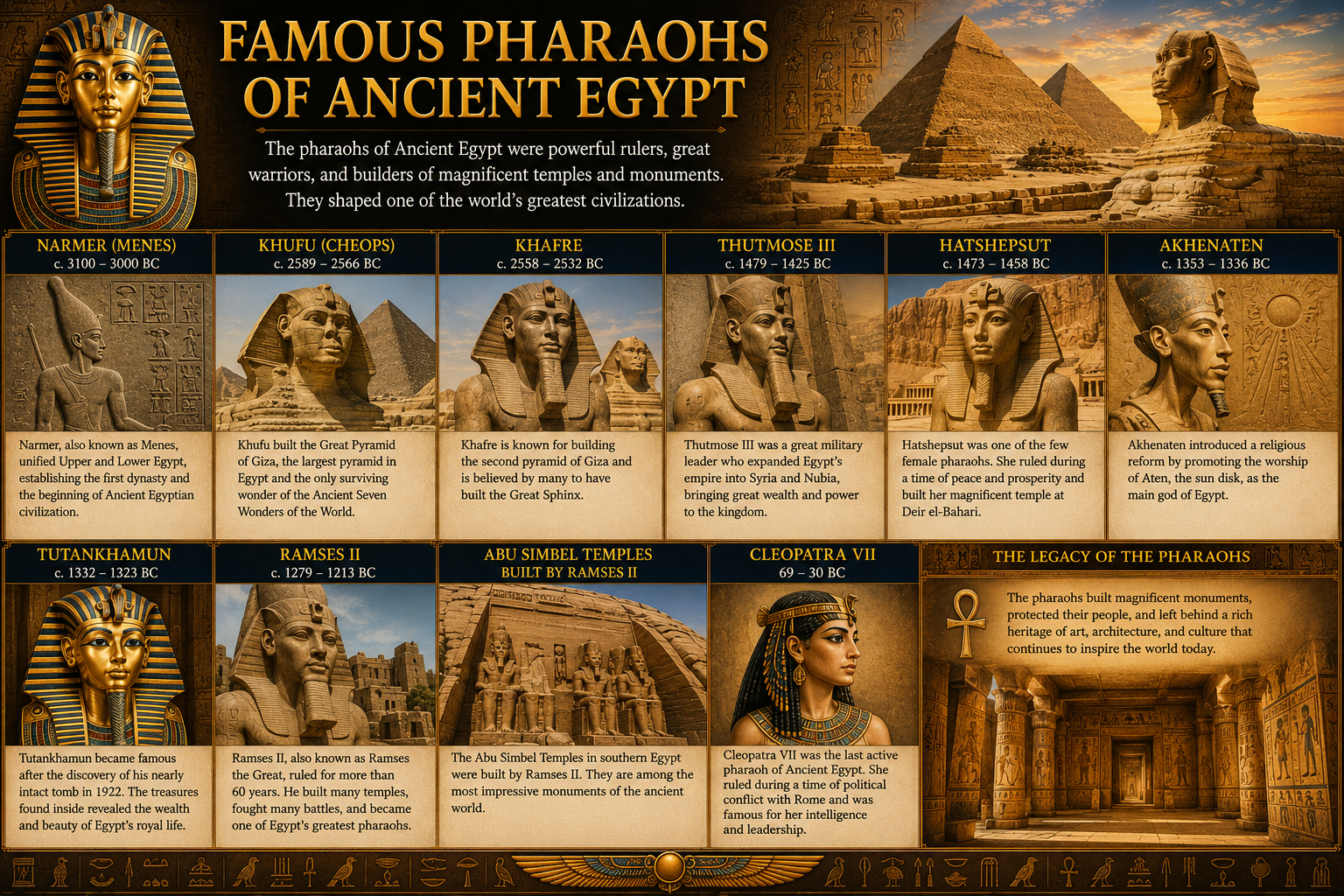
The pharaohs of Ancient Egypt were among the most powerful rulers in human history. Considered both kings and divine figures, pharaohs controlled the government, military, religion, economy, and major construction projects of the Egyptian kingdom. For thousands of years, these rulers shaped the rise of one of the world’s greatest civilizations and left behind extraordinary monuments, temples, and historical achievements that continue to fascinate the world today.
Ancient Egyptians believed that pharaohs were chosen by the gods and served as the link between heaven and earth. They were responsible for maintaining order, protecting Egypt, leading religious ceremonies, and ensuring the prosperity of the kingdom.
One of the earliest and most important rulers was King Narmer, also known as Menes, who is traditionally credited with unifying Upper and Lower Egypt around 3100 BC. This unification marked the beginning of Ancient Egyptian civilization and established the foundation of the pharaonic state.
King Khufu became one of Egypt’s most famous rulers during the Old Kingdom period because of the construction of the Great Pyramid of Giza, the largest pyramid ever built in Egypt. The Great Pyramid remains one of the greatest architectural achievements in human history and is the only surviving wonder of the Ancient Seven Wonders of the World.
Another famous Old Kingdom ruler was King Khafre, believed by many historians to have built the Great Sphinx of Giza, the massive limestone statue with the body of a lion and the head of a pharaoh.
During the New Kingdom period, Egypt reached the height of its military power and wealth under several legendary rulers. One of the greatest military leaders in Egyptian history was Thutmose III, often called the “Napoleon of Ancient Egypt.” He led successful military campaigns that expanded Egypt’s empire into Syria and Nubia, bringing enormous wealth and influence to the kingdom.
Queen Hatshepsut became one of the few female pharaohs in Ancient Egyptian history. She ruled during a period of peace and economic prosperity and focused heavily on trade, architecture, and monumental construction projects. Her magnificent mortuary temple at Deir el-Bahari remains one of Egypt’s greatest architectural masterpieces.
Akhenaten became famous for introducing major religious reforms by promoting the worship of Aten, the sun disk, as the central god of Egypt. His religious revolution dramatically changed Egyptian culture and remains one of the most controversial periods in Ancient Egyptian history.
Tutankhamun, often known as King Tut, became world-famous after the discovery of his nearly intact tomb in the Valley of the Kings in 1922 by archaeologist Howard Carter. Although Tutankhamun ruled for only a short time and died at a young age, the treasures discovered in his tomb became one of the greatest archaeological finds in history.
Ramses II, also known as Ramses the Great, is considered one of the most powerful and celebrated pharaohs of Ancient Egypt. He ruled for more than 60 years during the New Kingdom and led military campaigns, built enormous temples, and commissioned massive statues throughout Egypt.
The Abu Simbel Temples in southern Egypt were built by Ramses II and remain among the most impressive monuments of the ancient world. Ramses II also fought the famous Battle of Kadesh against the Hittites, one of the largest chariot battles in ancient history.
Cleopatra VII became the final ruler of Ancient Egypt and one of the most famous women in world history. Although she belonged to the Greek Ptolemaic Dynasty, Cleopatra embraced Egyptian culture and ruled during a period of political conflict involving Rome.
Her relationships with Julius Caesar and Mark Antony became legendary, but after her defeat by Octavian in 30 BC, Egypt became part of the Roman Empire, marking the end of the pharaonic era.
The pharaohs of Ancient Egypt left behind an extraordinary legacy of pyramids, temples, tombs, monuments, art, and historical achievements that continue to attract millions of visitors to Egypt every year.
Today, the names of Khufu, Hatshepsut, Ramses II, Tutankhamun, Cleopatra, and many other pharaohs remain symbols of one of the greatest civilizations in human history.
Ancient Egyptian Medicine
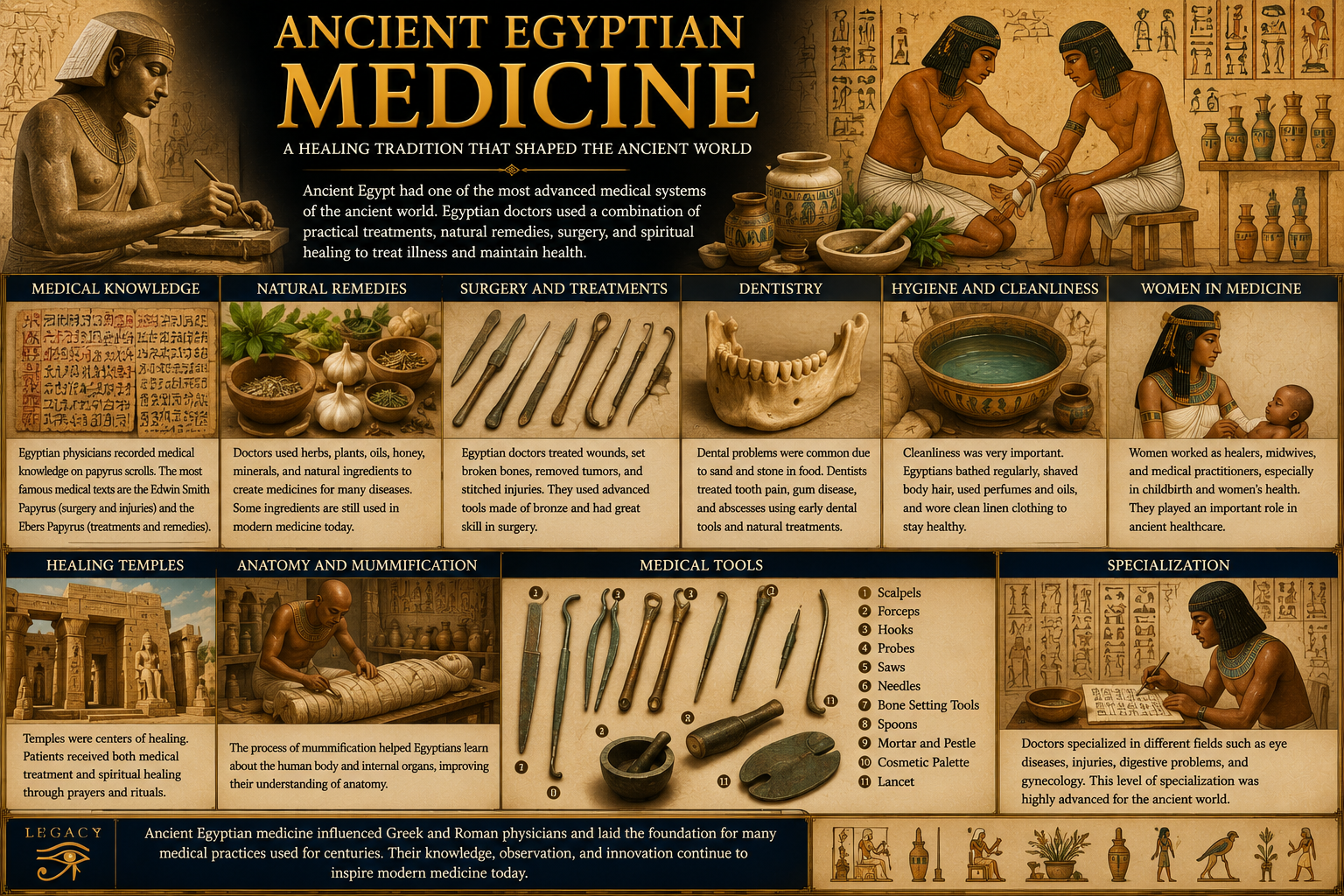
Ancient Egyptian medicine was among the most advanced medical systems of the ancient world and played an important role in the development of healthcare, surgery, anatomy, and medical knowledge. Egyptian doctors were highly respected throughout the ancient world, and many of their medical practices influenced later Greek and Roman medicine.
The ancient Egyptians believed that health was connected to both physical and spiritual balance. Illness could be caused by injuries, natural diseases, or supernatural forces, so doctors often combined practical medical treatments with religious rituals and prayers.
Egyptian physicians studied the human body carefully and developed surprisingly advanced knowledge about anatomy, wounds, bones, and internal organs. Medical information was recorded on papyrus scrolls, some of which still survive today.
One of the most famous medical documents is the Edwin Smith Papyrus, which contains detailed descriptions of injuries, fractures, surgical procedures, and treatments. Another important text, the Ebers Papyrus, includes hundreds of remedies and medical prescriptions for various diseases and health conditions.
Ancient Egyptian doctors treated patients using herbs, natural medicines, oils, honey, minerals, and plant-based remedies. Many treatments involved ingredients such as garlic, onions, aloe vera, cumin, and frankincense, some of which are still recognized for their medicinal properties today.
Surgery was also practiced in Ancient Egypt. Egyptian physicians treated wounds, repaired broken bones, stitched injuries, and performed minor surgical procedures using knives, hooks, forceps, and other medical tools made from bronze or stone.
Dentistry was another important area of Egyptian medicine. Because sand and stone particles often entered food during grinding, many Egyptians suffered from dental problems. Egyptian dentists treated tooth pain, gum disease, and oral infections using early dental techniques and herbal treatments.
Hygiene and cleanliness were considered essential for good health. Egyptians bathed regularly, shaved body hair, used perfumes and oils, and wore clean linen clothing. Many priests and medical practitioners followed strict cleanliness rituals.
Women also played important roles in healthcare. Some women served as healers, midwives, and medical practitioners, especially in areas related to childbirth and family care.
Ancient Egyptian hospitals and healing temples provided places where patients could receive treatment, rest, and religious healing ceremonies. Priests connected to temple medicine often combined spiritual practices with practical medical care.
The process of mummification also helped Egyptians gain knowledge about the human body and internal organs. Although religious beliefs limited scientific dissection, embalmers developed practical anatomical understanding through centuries of preserving bodies.
Egyptian medicine included medical specialization. Some doctors focused on eye diseases, digestive problems, women’s health, or specific types of injuries. This level of specialization was highly advanced for the ancient world.
Many Greek scholars, including Hippocrates and later Roman physicians, were influenced by Egyptian medical knowledge. Egypt became known as an important center of medicine and healing in the ancient Mediterranean world.
Today, historians and scientists continue to study Ancient Egyptian medical texts, tools, and mummies to better understand the origins of medicine and healthcare. The achievements of Ancient Egyptian physicians demonstrate the intelligence, observation, and innovation of one of history’s greatest civilizations.
Ancient Egyptian Military and Wars
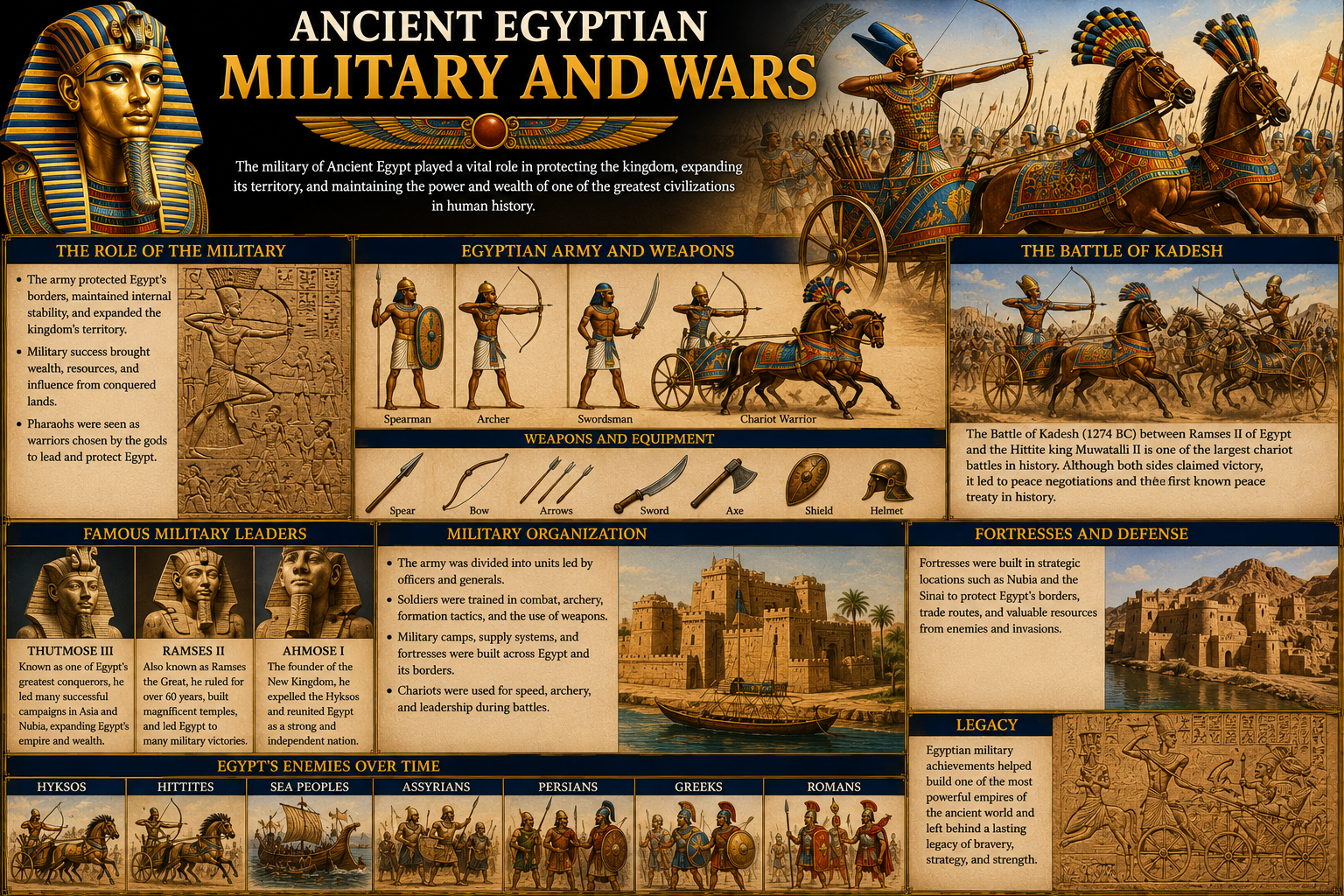
The military of Ancient Egypt played a major role in protecting the kingdom, expanding its territory, and maintaining the power of one of the greatest civilizations in human history. Over thousands of years, Egyptian armies evolved from simple local forces into one of the strongest military powers of the ancient world.
In the early periods of Ancient Egypt, armies were mainly organized to defend cities, protect trade routes, and maintain internal stability. Soldiers used basic weapons such as spears, bows, shields, axes, and clubs made from stone, copper, and later bronze.
As Egypt grew stronger, pharaohs began leading military campaigns beyond the Nile Valley to expand Egyptian influence and secure valuable resources such as gold, wood, livestock, and trade goods.
The Egyptian military became especially powerful during the New Kingdom period, often called the Golden Age of Egypt. During this era, Egypt developed a professional standing army supported by advanced weapons, organized training, and military leadership.
One of the most important military innovations introduced to Egypt was the horse-drawn chariot. The Egyptians learned about chariot warfare after conflicts with the Hyksos, foreign rulers who invaded parts of Egypt during the Second Intermediate Period.
Egyptian chariots became fast and highly effective weapons used in battle for mobility, archery, and command. Skilled chariot warriors played a major role in military victories and became symbols of royal power.
The Egyptian army was divided into organized units led by officers and generals. Soldiers were trained in combat, archery, formation tactics, and the use of weapons. Military camps, supply systems, and defensive fortresses were established throughout Egypt and along its borders.
One of the greatest military leaders in Egyptian history was Pharaoh Thutmose III, who conducted numerous successful campaigns into Syria and Nubia. His victories expanded Egypt’s empire and brought enormous wealth, tribute, and political influence to the kingdom.
Another legendary ruler was Ramses II, also known as Ramses the Great. He became famous for leading Egyptian forces during the Battle of Kadesh against the Hittite Empire around 1274 BC.
The Battle of Kadesh is considered one of the largest chariot battles in ancient history and remains one of the best-documented military confrontations of the ancient world. Although both sides claimed victory, the conflict eventually led to one of history’s earliest known peace treaties between Egypt and the Hittites.
Egyptian armies also protected important trade routes, mines, and border regions from foreign invasions and nomadic tribes. Fortresses were built in strategic areas such as Nubia and the Sinai Peninsula to defend Egyptian territory and control valuable resources.
Military success allowed Egypt to become one of the most powerful empires in the ancient Near East. Conquered territories provided gold, taxes, slaves, livestock, luxury goods, and access to important trade networks.
Religion was closely connected to warfare in Ancient Egypt. Pharaohs were believed to fight with divine support from the gods, and military victories were often presented as proof of divine favor and royal strength.
Temple walls across Egypt display detailed carvings of military campaigns, battles, prisoners, and royal triumphs. These artistic records continue to provide historians with valuable information about Egyptian warfare, weapons, and military organization.
Despite periods of strength, Ancient Egypt later faced invasions from foreign powers such as the Sea Peoples, Assyrians, Persians, Greeks, and Romans. Over time, these invasions weakened Egyptian independence and eventually brought the pharaonic era to an end.
Today, the military history of Ancient Egypt remains an important part of the country’s historical legacy and continues to fascinate historians, archaeologists, and travelers around the world.
Ancient Egyptian Agriculture and Farming
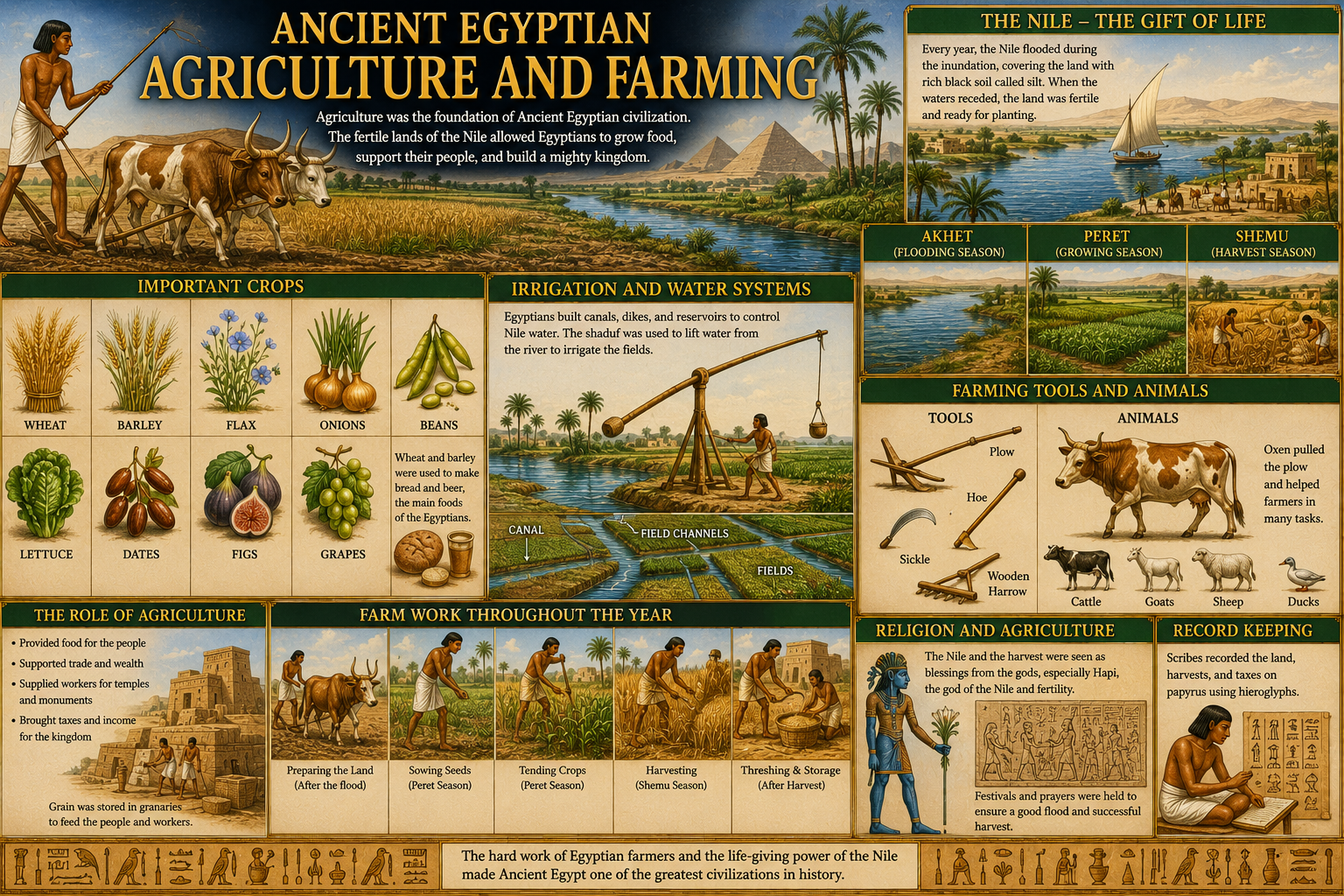
Agriculture was the foundation of Ancient Egyptian civilization and one of the main reasons why Egypt became one of the greatest and longest-lasting civilizations in human history. The fertile lands surrounding the Nile River allowed Ancient Egyptians to grow food, support large populations, build cities, and create a powerful kingdom in the middle of the desert.
The Nile River played the most important role in Egyptian farming. Every year, the river flooded during a natural cycle known as the inundation. The floodwaters covered the surrounding land with rich black soil filled with nutrients, making the land extremely fertile for agriculture.
Ancient Egyptians depended heavily on these annual floods because they provided the water and fertile soil needed to grow crops successfully. Without the Nile River, farming in Egypt would have been nearly impossible due to the dry desert climate.
Farmers in Ancient Egypt grew many important crops, including:
Wheat
Barley
Flax
Onions
Beans
Lettuce
Dates
Figs
Grapes
Wheat and barley were especially important because they were used to make bread and beer, two of the main foods consumed daily by Egyptians of all social classes.
Flax was another valuable crop because it was used to produce linen cloth for clothing, sails, and household items.
Ancient Egyptian farmers developed irrigation systems to control and distribute Nile water across agricultural land. They built canals, reservoirs, dikes, and small water channels to guide water into fields during dry seasons.
One important farming tool used in Ancient Egypt was the shaduf, a simple machine designed to lift water from the Nile and transport it into irrigation canals. This invention greatly improved farming efficiency.
Most farmers worked the land using simple tools made from wood, stone, or bronze. Oxen were often used to pull plows across fields to prepare the soil for planting.
Agriculture shaped the entire Egyptian economy. Successful harvests provided food for the population, supported trade, supplied workers building monuments, and generated wealth for the kingdom.
The Egyptian government carefully monitored agriculture and collected taxes based on crop production. Scribes recorded harvests, land ownership, and grain storage using hieroglyphic writing on papyrus scrolls.
The farming calendar in Ancient Egypt was closely connected to the Nile River and divided into three main seasons:
Akhet — the flooding season
Peret — the growing season
Shemu — the harvest season
Religious beliefs were also connected to farming and the Nile. Egyptians viewed the annual floods as a divine blessing from the gods, especially the god Hapi, who represented the Nile and fertility.
Many festivals and ceremonies celebrated successful harvests and agricultural abundance. Farmers prayed for good floods, healthy crops, and protection from drought or famine.
Animals also played an important role in agriculture. Egyptians raised cattle, sheep, goats, ducks, and geese for food, labor, and religious purposes.
Agricultural success allowed Ancient Egypt to become wealthy, stable, and politically powerful for thousands of years. Surplus food production supported trade with neighboring civilizations and helped finance major construction projects such as pyramids and temples.
Today, historians and archaeologists continue to study Ancient Egyptian farming techniques, irrigation systems, and agricultural tools to better understand how the civilization thrived for so long in a desert environment.
The story of Ancient Egyptian agriculture demonstrates the intelligence, organization, and deep connection between the Egyptian people and the Nile River, which truly became the lifeline of their civilization.
Ancient Egyptian Clothing and Fashion
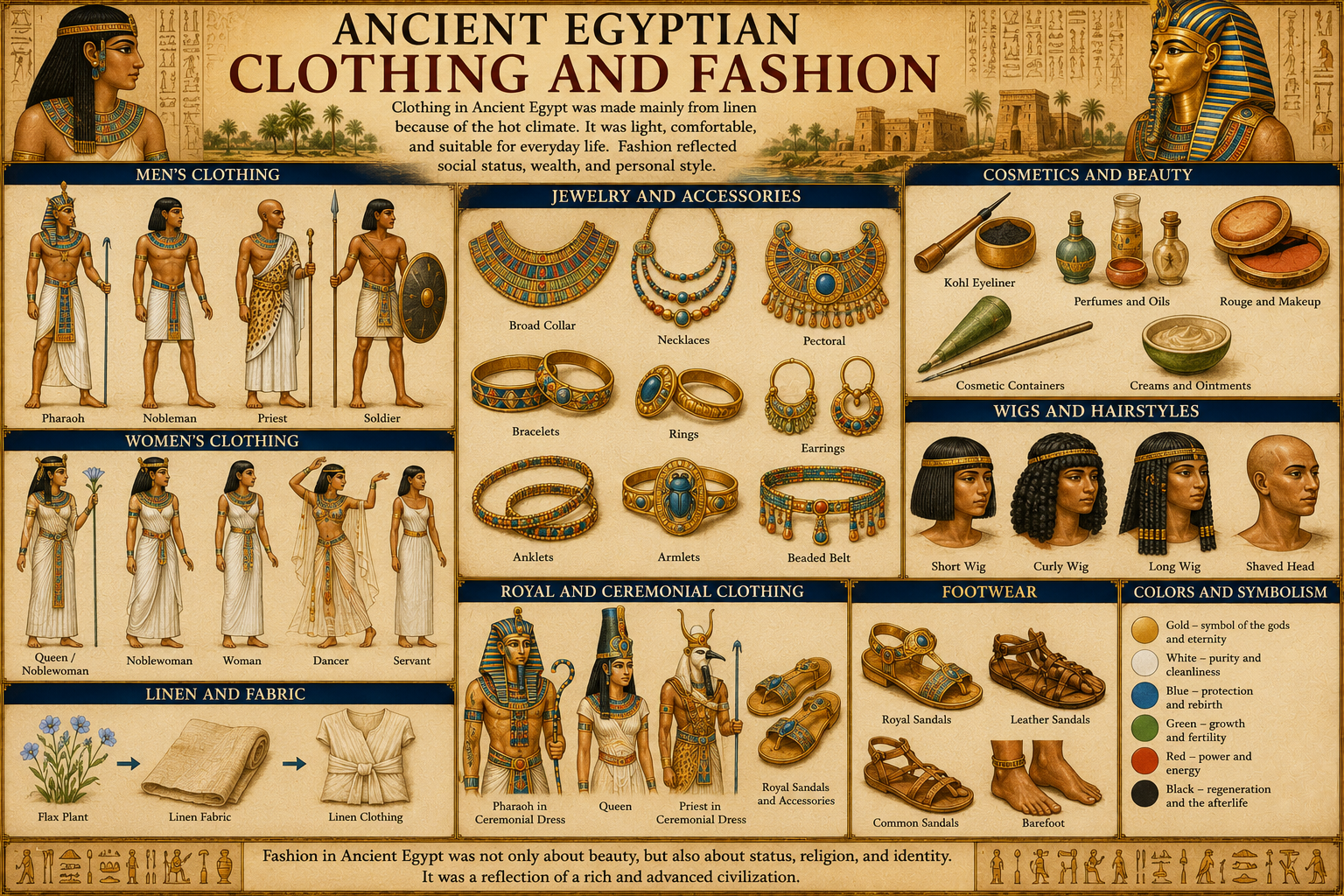
Clothing and fashion were important parts of daily life in Ancient Egypt and reflected social status, wealth, occupation, and personal style. Because Egypt had a hot desert climate, Ancient Egyptians wore lightweight clothing designed to keep them cool while also expressing beauty, elegance, and identity.
Most Ancient Egyptian clothing was made from linen, a fabric produced from the flax plant grown along the Nile River. Linen was highly valued because it was light, comfortable, and suitable for Egypt’s warm weather. Wealthier people wore finer and softer linen, while ordinary workers usually wore simpler garments.
Men in Ancient Egypt commonly wore short linen kilts tied around the waist. Laborers and farmers often dressed in simple practical clothing that allowed them to work comfortably in the heat.
Women usually wore long linen dresses that could be simple or highly decorative depending on social class and wealth. Noblewomen and royal figures often wore finely pleated garments decorated with beads, embroidery, and jewelry.
Children in Ancient Egypt typically wore very little clothing because of the hot climate. Many young children went barefoot and wore simple garments until they grew older.
Jewelry played an important role in Egyptian fashion and was worn by both men and women. Egyptians used necklaces, bracelets, rings, earrings, anklets, and decorative collars made from gold, silver, gemstones, glass, and precious stones.
Gold was especially admired because Ancient Egyptians associated it with the gods, eternity, and royal power. Wealthy Egyptians often wore elaborate jewelry to display status and beauty.
Makeup and cosmetics were extremely popular in Ancient Egypt and used by both genders. Kohl eyeliner was applied around the eyes to create dramatic appearance and protect against sunlight, dust, and eye infections.
Egyptians also used perfumes, oils, creams, and ointments made from flowers, herbs, and natural ingredients. Personal cleanliness and appearance were considered signs of health, beauty, and social respect.
Wigs became fashionable among wealthy Egyptians and royalty. Some people shaved their heads because of the heat and wore carefully styled wigs during ceremonies, celebrations, and daily life.
Royal clothing and ceremonial outfits were especially elaborate. Pharaohs wore symbolic crowns, decorative robes, sandals, jewelry, and ceremonial accessories that represented their divine authority and connection to the gods.
Different crowns symbolized different regions and powers within Egypt. The famous double crown represented the unification of Upper and Lower Egypt under one ruler.
Ancient Egyptian fashion was also connected to religion and symbolism. Certain colors, materials, and decorative patterns carried spiritual meanings and were associated with protection, rebirth, or divine power.
Artists and craftsmen created beautiful fabrics, jewelry, cosmetics containers, mirrors, and accessories that demonstrated extraordinary artistic skill and attention to detail.
Wall paintings, statues, and tomb decorations provide valuable information about Egyptian clothing and appearance. These artworks show how people from different social classes dressed and decorated themselves throughout Egyptian history.
Although styles changed over thousands of years, Ancient Egyptian fashion remained elegant, practical, and highly recognizable. The influence of Egyptian jewelry, cosmetics, and artistic design can still be seen in modern fashion and culture today.
The clothing and beauty traditions of Ancient Egypt continue to fascinate historians, designers, archaeologists, and travelers around the world as symbols of one of history’s most sophisticated civilizations.
Ancient Egyptian Food and Drink
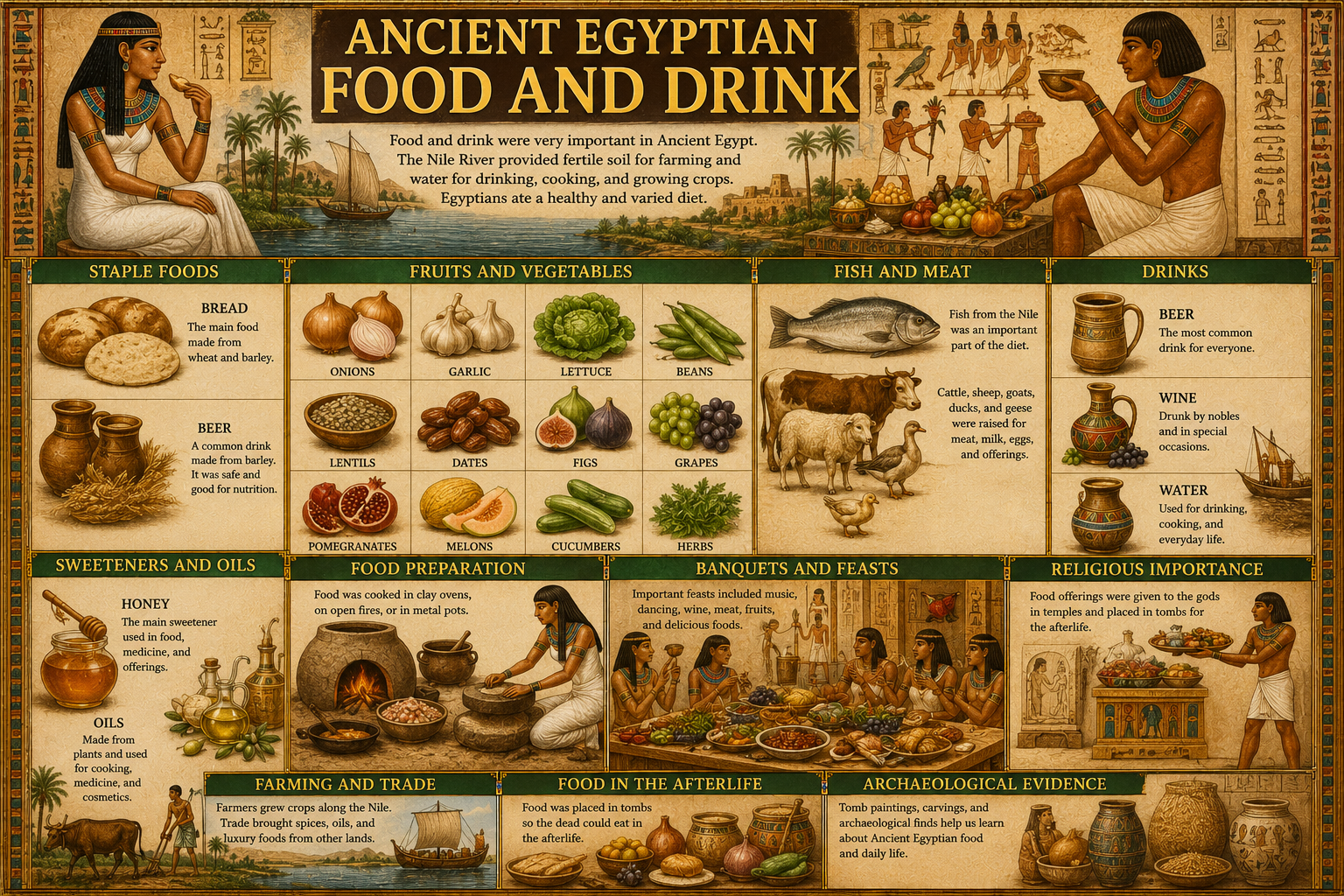
Food and drink were essential parts of daily life in Ancient Egypt and reflected the country’s agricultural success, social traditions, and connection to the Nile River. Ancient Egyptians developed a rich diet based on farming, fishing, animal husbandry, and trade, allowing their civilization to thrive for thousands of years.
Bread was the most important food in Ancient Egypt and was eaten by people of all social classes every day. Egyptians produced bread using wheat and barley grown along the fertile banks of the Nile River. Bakers created many different types of bread, including flatbreads, sweet breads, and loaves flavored with dates, honey, or herbs.
Beer was one of the most common drinks in Ancient Egypt and was consumed daily by both rich and poor. Egyptian beer was made mainly from barley and was considered an important source of nutrition. Workers building pyramids and temples often received bread and beer as part of their wages.
The Nile River provided a large variety of fish, which became an important food source for many Egyptians. Fishermen used nets, hooks, and boats to catch fish from the river and surrounding canals.
Ancient Egyptians also raised animals such as cattle, sheep, goats, ducks, and geese for meat, milk, eggs, and religious offerings. Wealthier families enjoyed larger amounts of meat during festivals and special occasions.
Fruits and vegetables were widely consumed throughout Ancient Egypt. Common foods included:
Onions
Garlic
Lettuce
Beans
Lentils
Dates
Figs
Grapes
Pomegranates
Melons
Onions and garlic were especially valued because Egyptians believed they provided strength and health benefits.
Honey was the main sweetener used in Ancient Egypt because sugar did not yet exist. Egyptians used honey in desserts, bread, cakes, medicines, and religious offerings.
Wine was mostly consumed by nobles, priests, and wealthy families. Vineyards existed in parts of Egypt, especially in the Nile Delta region, and wine became associated with celebrations and elite society.
Meals were often prepared using clay ovens, open fires, and stone grinding tools. Women usually handled cooking and food preparation within the household.
Large feasts and banquets played important roles in religious festivals, royal celebrations, and ceremonies. Wealthy Egyptians hosted elaborate banquets featuring music, dancing, wine, roasted meat, fruits, and decorative foods.
Food also had strong religious significance in Ancient Egypt. Egyptians placed food offerings inside temples and tombs because they believed the gods and the dead required nourishment in the afterlife.
Tomb paintings and archaeological discoveries provide valuable information about Ancient Egyptian food culture. Scenes found inside tombs show farming, baking, brewing, fishing, hunting, cooking, and banquet celebrations.
Trade with neighboring regions introduced additional foods, spices, oils, and luxury products into Egypt. Merchants imported goods from Nubia, the Levant, and the Mediterranean world.
Clean water was not always available, which made beer and wine safer daily drinks in many situations because the brewing and fermentation processes helped reduce contamination.
The success of Egyptian agriculture and food production supported population growth, economic stability, and the construction of monumental projects such as pyramids and temples.
Today, historians and archaeologists continue to study Ancient Egyptian food and drink to better understand daily life, health, farming, religion, and social traditions in one of history’s greatest civilizations.
Ancient Egyptian Clothing and Fashion
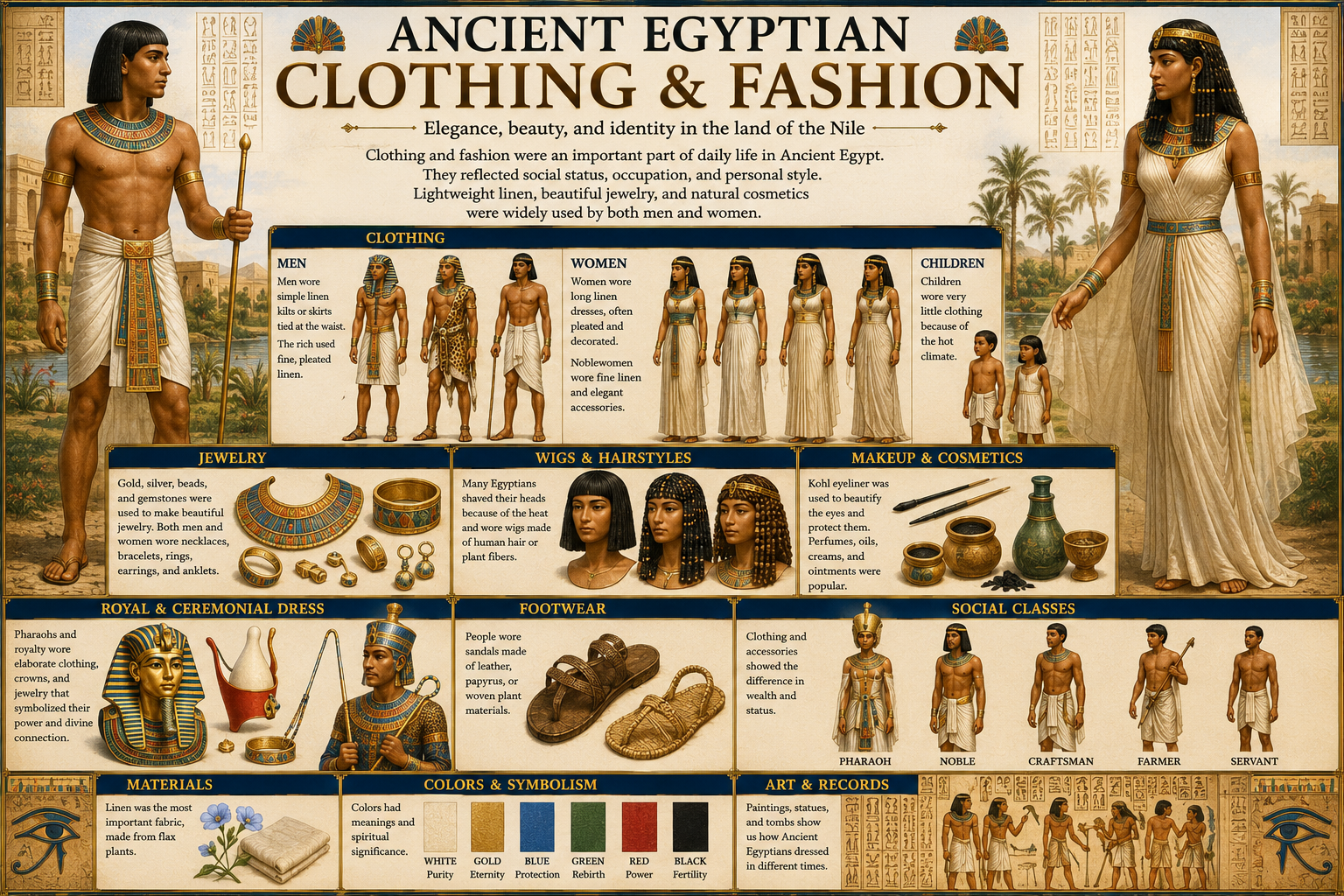
Clothing and fashion were important parts of daily life in Ancient Egypt and reflected social status, wealth, occupation, and personal style. Because Egypt had a hot desert climate, Ancient Egyptians wore lightweight clothing designed to keep them cool while also expressing beauty, elegance, and identity.
Most Ancient Egyptian clothing was made from linen, a fabric produced from the flax plant grown along the Nile River. Linen was highly valued because it was light, comfortable, and suitable for Egypt’s warm weather. Wealthier people wore finer and softer linen, while ordinary workers usually wore simpler garments.
Men in Ancient Egypt commonly wore short linen kilts tied around the waist. Laborers and farmers often dressed in simple practical clothing that allowed them to work comfortably in the heat.
Women usually wore long linen dresses that could be simple or highly decorative depending on social class and wealth. Noblewomen and royal figures often wore finely pleated garments decorated with beads, embroidery, and jewelry.
Children in Ancient Egypt typically wore very little clothing because of the hot climate. Many young children went barefoot and wore simple garments until they grew older.
Jewelry played an important role in Egyptian fashion and was worn by both men and women. Egyptians used necklaces, bracelets, rings, earrings, anklets, and decorative collars made from gold, silver, gemstones, glass, and precious stones.
Gold was especially admired because Ancient Egyptians associated it with the gods, eternity, and royal power. Wealthy Egyptians often wore elaborate jewelry to display status and beauty.
Makeup and cosmetics were extremely popular in Ancient Egypt and used by both genders. Kohl eyeliner was applied around the eyes to create dramatic appearance and protect against sunlight, dust, and eye infections.
Egyptians also used perfumes, oils, creams, and ointments made from flowers, herbs, and natural ingredients. Personal cleanliness and appearance were considered signs of health, beauty, and social respect.
Wigs became fashionable among wealthy Egyptians and royalty. Some people shaved their heads because of the heat and wore carefully styled wigs during ceremonies, celebrations, and daily life.
Royal clothing and ceremonial outfits were especially elaborate. Pharaohs wore symbolic crowns, decorative robes, sandals, jewelry, and ceremonial accessories that represented their divine authority and connection to the gods.
Different crowns symbolized different regions and powers within Egypt. The famous double crown represented the unification of Upper and Lower Egypt under one ruler.
Ancient Egyptian fashion was also connected to religion and symbolism. Certain colors, materials, and decorative patterns carried spiritual meanings and were associated with protection, rebirth, or divine power.
Artists and craftsmen created beautiful fabrics, jewelry, cosmetics containers, mirrors, and accessories that demonstrated extraordinary artistic skill and attention to detail.
Wall paintings, statues, and tomb decorations provide valuable information about Egyptian clothing and appearance. These artworks show how people from different social classes dressed and decorated themselves throughout Egyptian history.
Although styles changed over thousands of years, Ancient Egyptian fashion remained elegant, practical, and highly recognizable. The influence of Egyptian jewelry, cosmetics, and artistic design can still be seen in modern fashion and culture today.
The clothing and beauty traditions of Ancient Egypt continue to fascinate historians, designers, archaeologists, and travelers around the world as symbols of one of history’s most sophisticated civilizations.
Ancient Egyptian Food and Drink
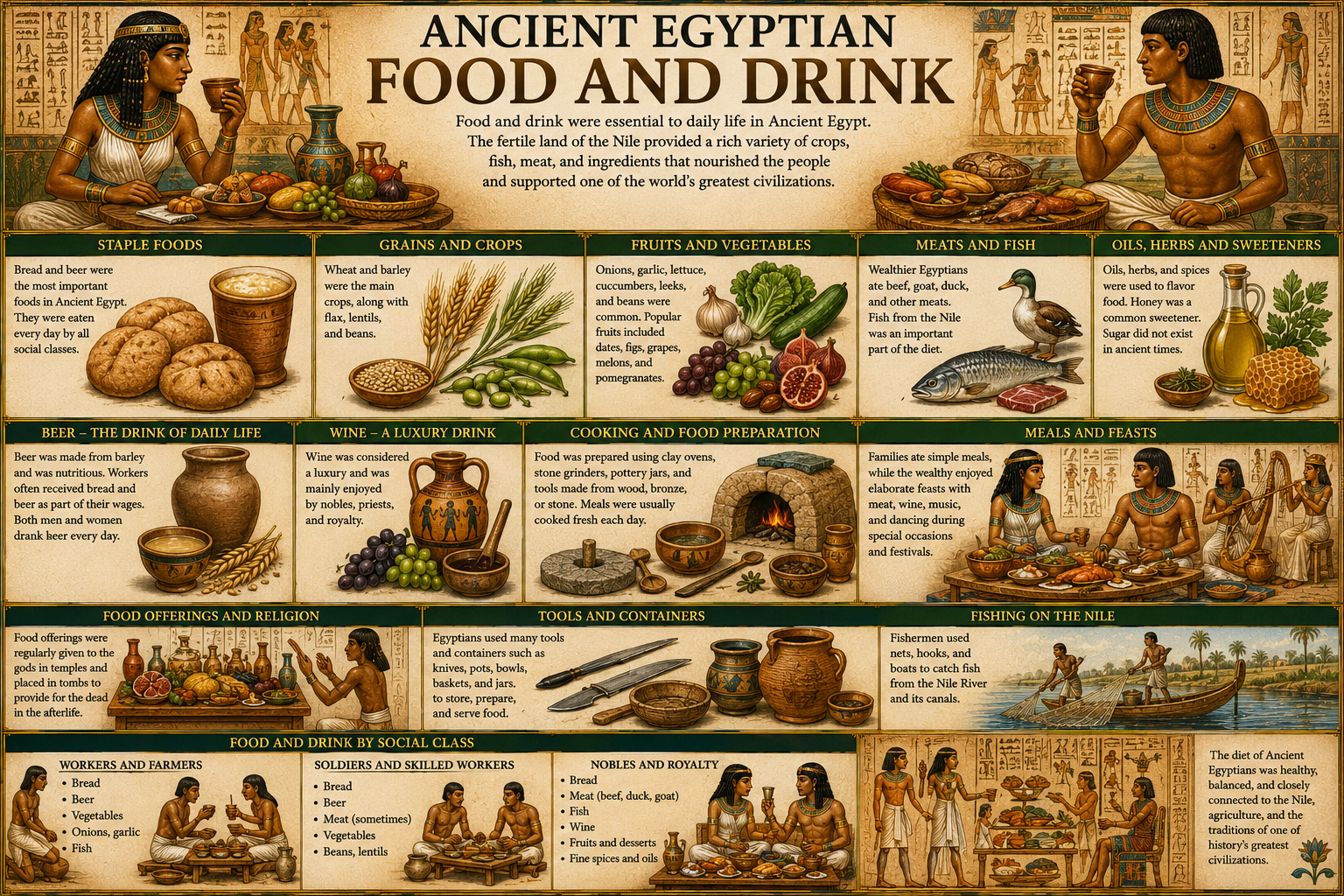
Food and drink were essential parts of daily life in Ancient Egypt and reflected the country’s strong connection to agriculture, the Nile River, religion, and social traditions. Ancient Egyptians relied heavily on farming, fishing, and livestock to produce the food that supported one of the world’s greatest civilizations for thousands of years.
The fertile lands surrounding the Nile River allowed Egyptians to grow a wide variety of crops. The annual flooding of the Nile provided rich soil that helped farmers produce large amounts of food even in the middle of the desert.
Bread was the most important food in Ancient Egypt and was eaten daily by people from all social classes. Egyptians made bread using wheat and barley, which were among the kingdom’s main agricultural crops. Bakers created different shapes and types of bread, some flavored with dates, honey, herbs, or seeds.
Beer was another major part of Egyptian life and was consumed by both adults and workers every day. Ancient Egyptian beer was made from barley and was often thick and nutritious. Workers building pyramids and temples sometimes received bread and beer as part of their wages.
Wealthier Egyptians enjoyed a more varied diet that included meat such as beef, duck, goose, goat, and fish from the Nile River. Hunting and fishing were common activities, especially among nobles and wealthy families.
Vegetables played an important role in Egyptian meals. Common vegetables included onions, garlic, lettuce, cucumbers, beans, lentils, and leeks. Fruits such as dates, figs, grapes, melons, and pomegranates were also widely consumed.
The Nile River provided abundant fish, which became an important food source for many Egyptians. Fishermen used nets, hooks, and small boats to catch fish from the river and nearby canals.
Ancient Egyptians also used oils, herbs, and spices to flavor food. Honey was commonly used as a natural sweetener because sugar did not yet exist in the ancient world.
Food preparation was usually done using clay ovens, stone grinders, pottery jars, and cooking tools made from wood, bronze, or stone. Meals were often prepared fresh each day because preserving food for long periods was difficult in Egypt’s hot climate.
Large feasts and banquets were important during religious festivals, royal celebrations, and special occasions. Wealthy Egyptians organized elaborate banquets with music, dancing, fine foods, and wine.
Wine was considered a luxury product mainly enjoyed by nobles, priests, and royalty. Vineyards existed in parts of Egypt, especially in the Nile Delta and desert oases.
Religion also influenced Egyptian food traditions. Food offerings were regularly presented to gods in temples and placed inside tombs to provide nourishment for the deceased in the afterlife.
Ancient Egyptian tomb paintings often show scenes of farming, fishing, cooking, bread-making, and banquet celebrations. These artworks provide historians with valuable information about Egyptian food culture and daily life.
Social class greatly affected diet in Ancient Egypt. While wealthy families enjoyed meat, wine, and luxury foods regularly, ordinary workers relied more heavily on bread, beer, vegetables, and fish.
Despite these differences, Egyptian agriculture produced enough food to support large cities, royal projects, armies, and trade networks for thousands of years.
Today, historians and archaeologists continue to study Ancient Egyptian food remains, pottery, farming tools, and tomb paintings to better understand the eating habits and culinary traditions of one of history’s greatest civilizations.
Ancient Egyptian Trade and Economy
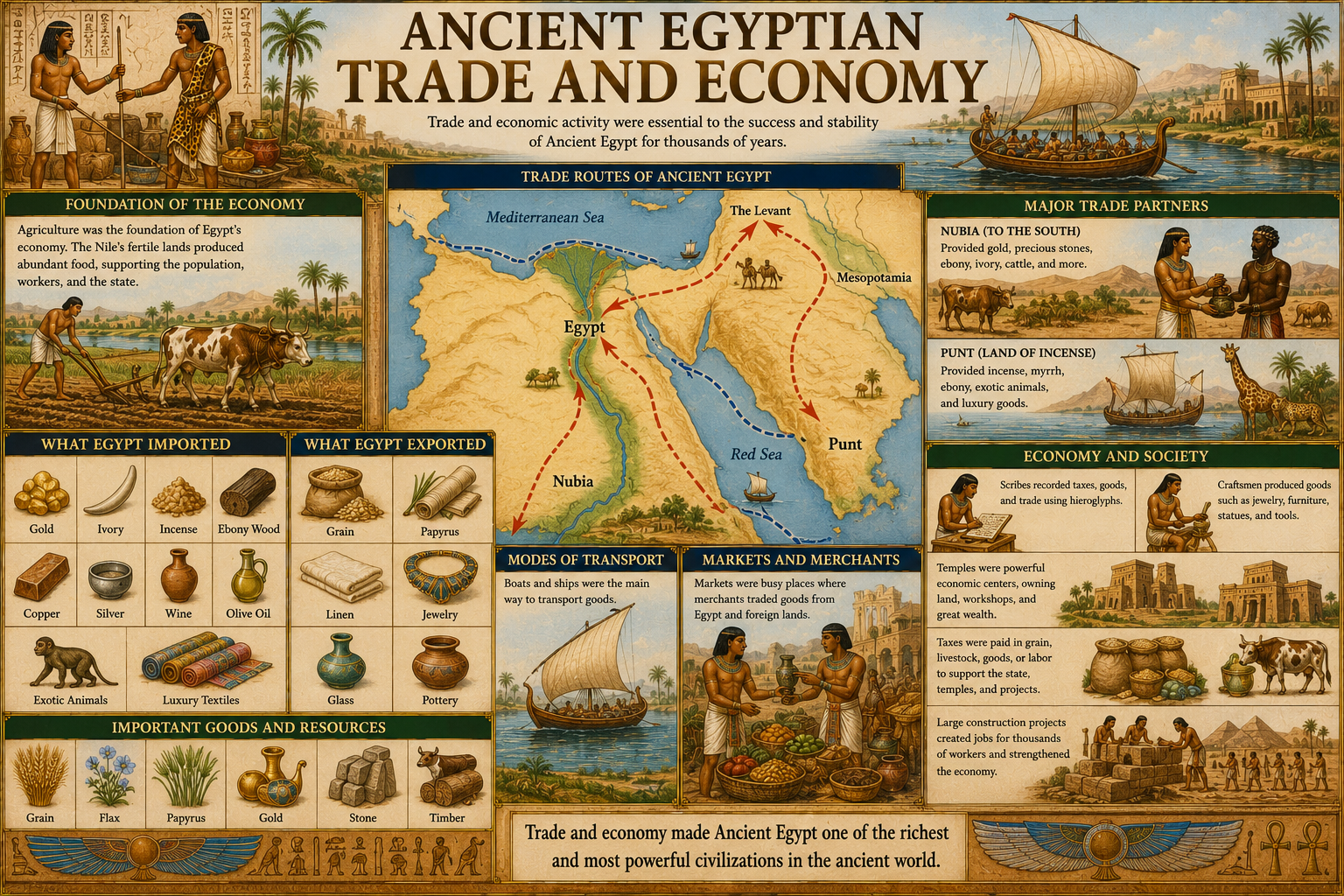
Trade and economic activity were essential to the success and stability of Ancient Egypt for thousands of years. The Egyptian economy was built on agriculture, trade, craftsmanship, taxation, and the rich natural resources provided by the Nile River and surrounding regions.
The Nile River served as the main economic lifeline of Ancient Egypt. Its fertile lands allowed farmers to produce large food supplies that supported cities, armies, workers, temples, and royal construction projects. Surplus crops such as wheat and barley became valuable trade goods exchanged with neighboring civilizations.
Agriculture formed the foundation of the Egyptian economy. Farmers produced grain, vegetables, fruits, flax, and livestock that were carefully managed by the government. Scribes recorded harvests, taxes, land ownership, and food storage using hieroglyphic writing.
Ancient Egyptians traded with many regions across Africa, the Mediterranean, and the Middle East. Trade routes connected Egypt with Nubia, Punt, the Levant, Mesopotamia, and later the Greek and Roman worlds.
Egypt imported valuable goods such as:
Gold
Ivory
Incense
Ebony wood
Copper
Silver
Wine
Olive oil
Exotic animals
Luxury textiles
In return, Egypt exported grain, papyrus, linen, jewelry, glass, pottery, and manufactured goods.
One of the most important trade partners of Ancient Egypt was Nubia, located south of Egypt. Nubia provided gold, precious stones, cattle, and other valuable resources that increased Egypt’s wealth and power.
The mysterious Land of Punt, believed to have been located near the Horn of Africa, was another major trading partner. Egyptian expeditions to Punt brought back incense, myrrh, exotic animals, ebony, and rare luxury goods highly valued in Egyptian temples and royal courts.
Trade was conducted using boats traveling along the Nile River and across the Red Sea and Mediterranean Sea. Egyptian ships transported goods between cities and international ports, making Egypt an important commercial center of the ancient world.
Markets and trading centers existed in towns and cities across Egypt. Merchants sold food, clothing, jewelry, pottery, tools, perfumes, and imported luxury products.
Although Ancient Egypt did not use coins during much of its early history, goods were exchanged through barter systems based on the value of products such as grain, copper, livestock, or crafted items. Later periods under Greek and Roman influence introduced coin-based economies.
Craftsmen and artisans played an important role in the economy by producing statues, furniture, gold jewelry, textiles, glassware, cosmetics, and decorative objects admired throughout the ancient world.
Temples also became powerful economic institutions. Large temple complexes owned farmland, workshops, livestock, ships, and storage facilities. They employed priests, laborers, scribes, and craftsmen while controlling enormous wealth and resources.
Taxes were carefully organized by the Egyptian government. Farmers and workers paid taxes in grain, livestock, labor, or goods that helped support the state, military, temples, and large building projects.
The construction of pyramids, temples, tombs, canals, and monuments created employment for thousands of workers, engineers, artists, and laborers across the kingdom.
Economic strength allowed Ancient Egypt to become one of the richest and most influential civilizations in the ancient world. Trade networks helped spread Egyptian culture, religion, technology, and artistic styles throughout neighboring regions.
Today, archaeological discoveries such as shipwrecks, papyrus records, trade goods, and ancient ports continue to provide historians with valuable insight into the complex economy and international connections of Ancient Egypt.
Ancient Egyptian Science and Astronomy
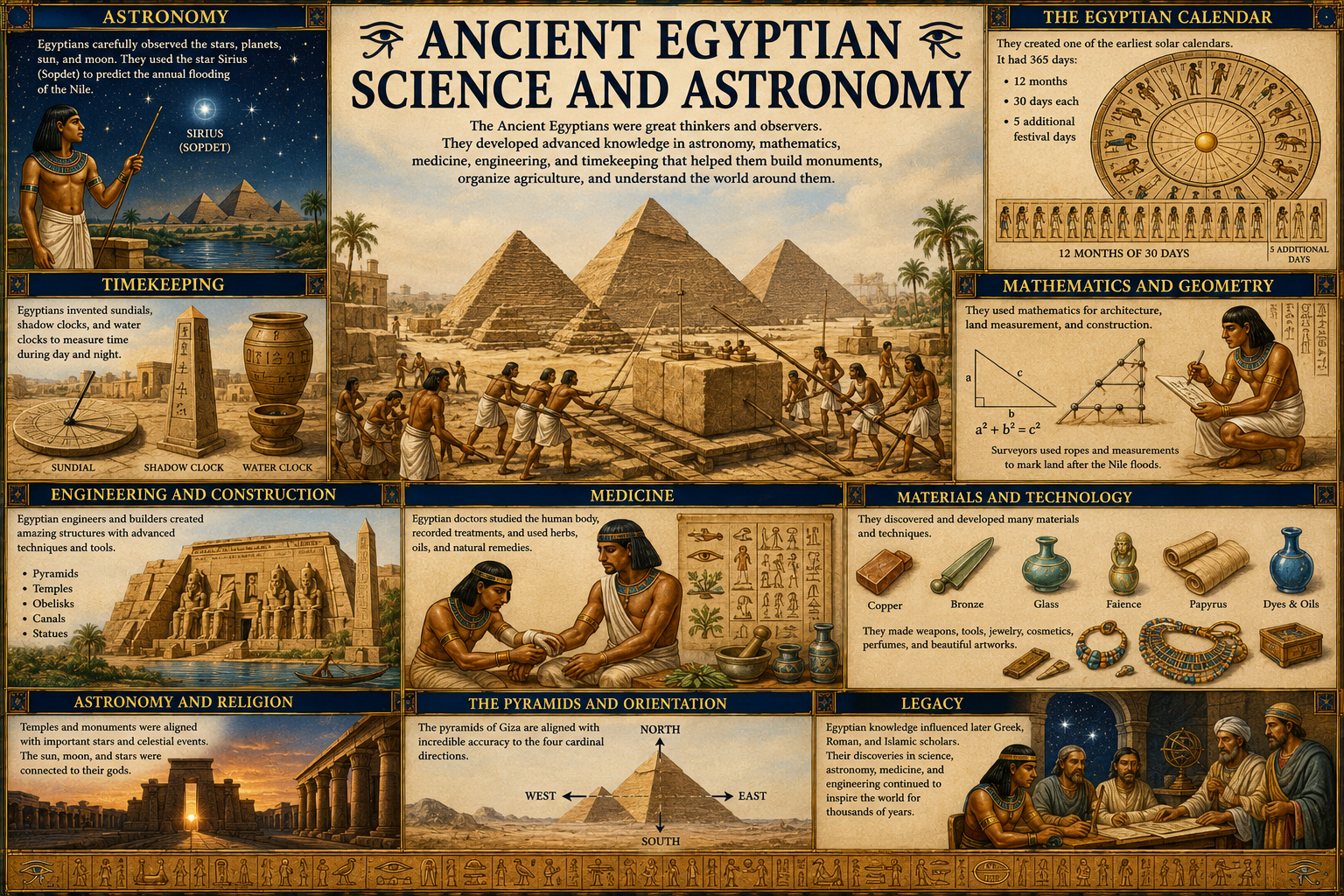
Ancient Egypt was one of the earliest civilizations to make remarkable advances in science, mathematics, engineering, astronomy, and timekeeping. Egyptian knowledge developed over thousands of years and played a major role in the construction of monuments, the organization of agriculture, religious ceremonies, medicine, and the administration of the kingdom.
Astronomy was especially important in Ancient Egypt because Egyptian life depended heavily on the Nile River and seasonal farming cycles. Egyptian astronomers carefully observed the stars, planets, and movements of the sun and moon to track time and predict the annual flooding of the Nile.
One of the most important astronomical observations involved the star Sirius, known in Ancient Egypt as Sopdet. The appearance of Sirius in the early morning sky usually occurred just before the Nile flood began each year. This event became extremely important for Egyptian agriculture and calendar systems.
Ancient Egyptians developed one of the earliest solar calendars in history. Their calendar contained 365 days divided into:
12 months
30 days per month
plus 5 additional festival days
This calendar became one of the foundations for later calendar systems used in other civilizations.
Timekeeping was another important scientific achievement. Egyptians created sundials, shadow clocks, and water clocks to measure time during both day and night. These inventions helped organize religious rituals, work schedules, and government activities.
Mathematics played a major role in Egyptian engineering and construction. Egyptian builders used geometry, measurement systems, and advanced calculations to construct pyramids, temples, obelisks, canals, and massive statues with remarkable precision.
Surveyors used mathematical techniques to measure land boundaries after the Nile floods changed the landscape each year. This helped maintain agricultural organization and property records.
Ancient Egyptian engineers developed sophisticated building methods that allowed them to transport enormous stone blocks and construct monuments that still stand thousands of years later.
Medicine also benefited from Egyptian scientific observation. Doctors recorded symptoms, treatments, injuries, and surgical procedures on papyrus scrolls. Their practical understanding of anatomy, healing, and hygiene was highly advanced for the ancient world.
Egyptians also studied natural materials such as minerals, plants, oils, and metals. They developed techniques for glassmaking, metalworking, cosmetics, dyes, perfumes, and jewelry production.
Religious beliefs were closely connected to astronomy and science. Many temples and monuments were carefully aligned with celestial events such as solstices, sunrise positions, and star movements.
The pyramids of Giza themselves demonstrate extraordinary knowledge of orientation and engineering. The structures were aligned with impressive accuracy to the cardinal directions north, south, east, and west.
Ancient Egyptian scientific knowledge influenced later Greek, Roman, and Islamic scholars. Greek thinkers such as Pythagoras, Plato, and Herodotus admired Egyptian learning and visited Egypt to study its knowledge and traditions.
Astronomy, mathematics, medicine, and engineering helped Ancient Egypt become one of the most organized and technologically advanced civilizations of the ancient world.
Today, historians, archaeologists, astronomers, and engineers continue to study Ancient Egyptian achievements to better understand how such an early civilization developed knowledge that remained influential for thousands of years.
The scientific and astronomical accomplishments of Ancient Egypt remain powerful examples of human curiosity, intelligence, and innovation in the ancient world.
Ancient Egyptian Festivals and Celebrations
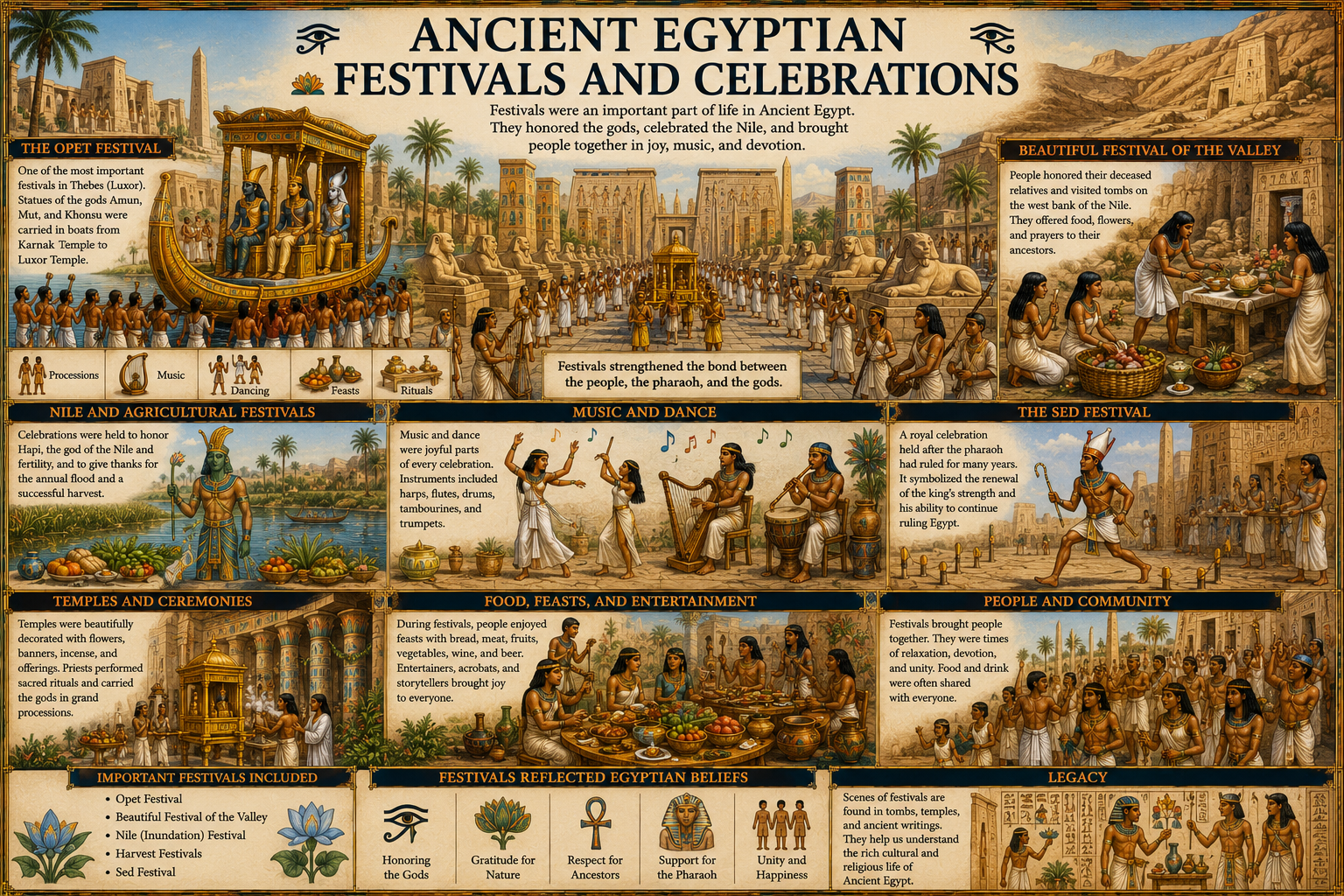
Festivals and celebrations were important parts of life in Ancient Egypt and reflected the civilization’s strong connection to religion, community, kingship, and the natural cycles of the Nile River. Egyptians organized numerous festivals throughout the year to honor the gods, celebrate successful harvests, and strengthen the relationship between the people, the pharaoh, and the divine world.
Religion was at the center of nearly every Egyptian celebration. Temples became major gathering places where priests performed rituals, offered food and prayers to the gods, and organized grand public ceremonies attended by crowds of people.
One of the most famous festivals in Ancient Egypt was the Opet Festival, celebrated mainly in the city of Thebes (modern Luxor). During this important event, statues of the gods Amun, Mut, and Khonsu were carried in ceremonial boats from Karnak Temple to Luxor Temple along the famous Avenue of Sphinxes.
The Opet Festival celebrated the divine power of the pharaoh and renewed the connection between the king and the gods. Music, dancing, feasts, religious rituals, and public celebrations filled the streets during the festival.
Another important celebration was the Beautiful Festival of the Valley, during which people honored deceased relatives and visited tombs on the west bank of the Nile near Thebes. Families gathered to offer food, flowers, and prayers to ancestors and loved ones who had passed away.
Ancient Egyptians also celebrated festivals connected to the Nile River and agriculture. Because the Nile flood was essential for farming and survival, ceremonies were held to honor Hapi, the god of the Nile and fertility.
Harvest festivals celebrated successful crops and agricultural abundance. Farmers thanked the gods for fertile land, healthy animals, and food supplies that supported the kingdom.
Music and dance played major roles in Egyptian celebrations. Musicians used instruments such as harps, flutes, drums, tambourines, and trumpets during religious ceremonies and public festivals.
Dancers, singers, and entertainers performed during royal events, temple ceremonies, banquets, and seasonal celebrations. Wealthy Egyptians often hosted elaborate feasts with food, wine, music, and entertainment.
The pharaoh also participated in important state festivals that reinforced royal authority and divine legitimacy. One famous royal ceremony was the Sed Festival, held after a pharaoh had ruled for many years. This celebration symbolized the renewal of the king’s strength and ability to continue ruling Egypt.
Temples were beautifully decorated during festivals with flowers, banners, incense, and offerings. Sacred statues were carried in processions while priests performed rituals and prayers.
Ordinary Egyptians looked forward to festivals because they provided opportunities for relaxation, entertainment, religious devotion, and social gatherings. During many celebrations, food and drink were distributed to the public.
Ancient Egyptian festivals also reflected the civilization’s belief in balance, harmony, and the relationship between humans and the gods. Celebrations helped unite communities and strengthen religious identity across the kingdom.
Many scenes of festivals and celebrations appear in tomb paintings, temple carvings, and papyrus texts. These artworks provide historians with valuable insight into Egyptian music, clothing, religious rituals, and social traditions.
Today, historians and archaeologists continue to study Ancient Egyptian festivals to better understand the spiritual and cultural life of one of history’s greatest civilizations. The traditions, ceremonies, and celebrations of Ancient Egypt remain powerful symbols of the civilization’s rich religious and cultural heritage.
Ancient Egyptian Symbols and Sacred Animals
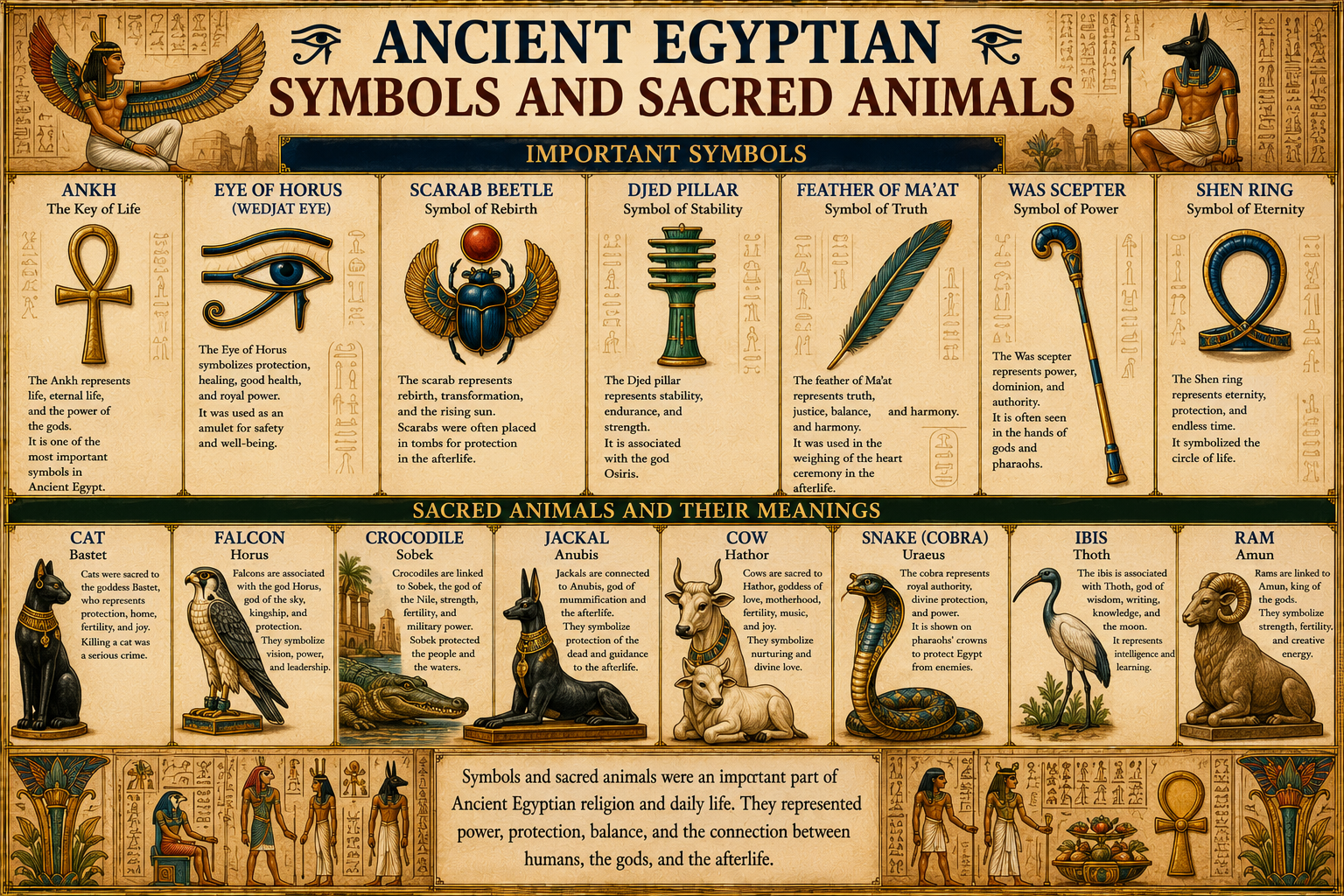
Symbols and sacred animals played a central role in Ancient Egyptian religion, culture, art, and daily life. Ancient Egyptians believed that many symbols carried spiritual power and that certain animals were connected to gods, protection, strength, fertility, and the afterlife.
These symbols and sacred creatures appeared everywhere in Egyptian civilization, including temples, tombs, jewelry, statues, paintings, royal decorations, and religious ceremonies. Many of them remain famous around the world today as powerful symbols of Ancient Egypt.
One of the most important Egyptian symbols was the Ankh, often called the “Key of Life.” The Ankh represented life, immortality, and divine power. Gods and pharaohs were frequently shown holding the Ankh in temple carvings and artwork as a symbol of eternal life.
Another famous symbol was the Eye of Horus, also known as the Wedjat Eye. According to Egyptian mythology, the eye belonged to the god Horus and symbolized protection, healing, strength, and good health. Egyptians wore Eye of Horus amulets for safety and spiritual protection.
The Scarab Beetle became another powerful symbol in Ancient Egypt. Scarabs represented rebirth, transformation, and the rising sun. Egyptians observed scarab beetles rolling balls across the ground and connected this behavior to the movement of the sun across the sky.
Scarab amulets were commonly placed inside tombs and worn as jewelry to provide luck and protection in both life and the afterlife.
The Djed Pillar symbolized stability, endurance, and strength. It was associated with the god Osiris and often appeared in religious ceremonies and temple decorations.
The feather of Ma’at represented truth, justice, balance, and harmony. Ancient Egyptians believed that after death, the heart of a person would be weighed against the feather of Ma’at during judgment in the afterlife.
Animals held special spiritual importance because Egyptians believed many gods could appear in animal form or share characteristics with certain creatures.
Cats were among the most respected animals in Ancient Egypt and were associated with the goddess Bastet, who represented protection, motherhood, music, and home life. Killing a cat, even accidentally, was considered a serious crime in some periods of Egyptian history.
Falcons symbolized kingship, the sky, and divine power because they were connected to the god Horus. Many royal symbols and temple carvings featured falcons protecting pharaohs.
Crocodiles were linked to the god Sobek, associated with the Nile River, strength, military power, and fertility. Temples dedicated to Sobek existed in several regions of Egypt, especially near crocodile habitats.
Jackals became connected to Anubis, the god of mummification and the afterlife. Because jackals were often seen near cemeteries, Egyptians believed they protected the dead.
Cows symbolized motherhood, fertility, and love because of their connection to the goddess Hathor, one of the most beloved deities in Ancient Egypt.
Snakes also carried important symbolic meaning. The cobra represented royal authority and divine protection. Pharaohs often wore the uraeus cobra symbol on their crowns to demonstrate power and protection from enemies.
Sacred animals were sometimes kept in temples and honored through religious ceremonies. Some animals were even mummified after death as offerings to the gods.
Symbols and sacred creatures appeared throughout Egyptian art, architecture, jewelry, clothing, and religious objects. Their meanings helped express spiritual beliefs and preserve religious traditions for thousands of years.
Today, Ancient Egyptian symbols and sacred animals remain among the most recognizable elements of Egyptian civilization and continue to inspire art, fashion, movies, books, and popular culture around the world.
Ancient Egyptian Burial Tombs
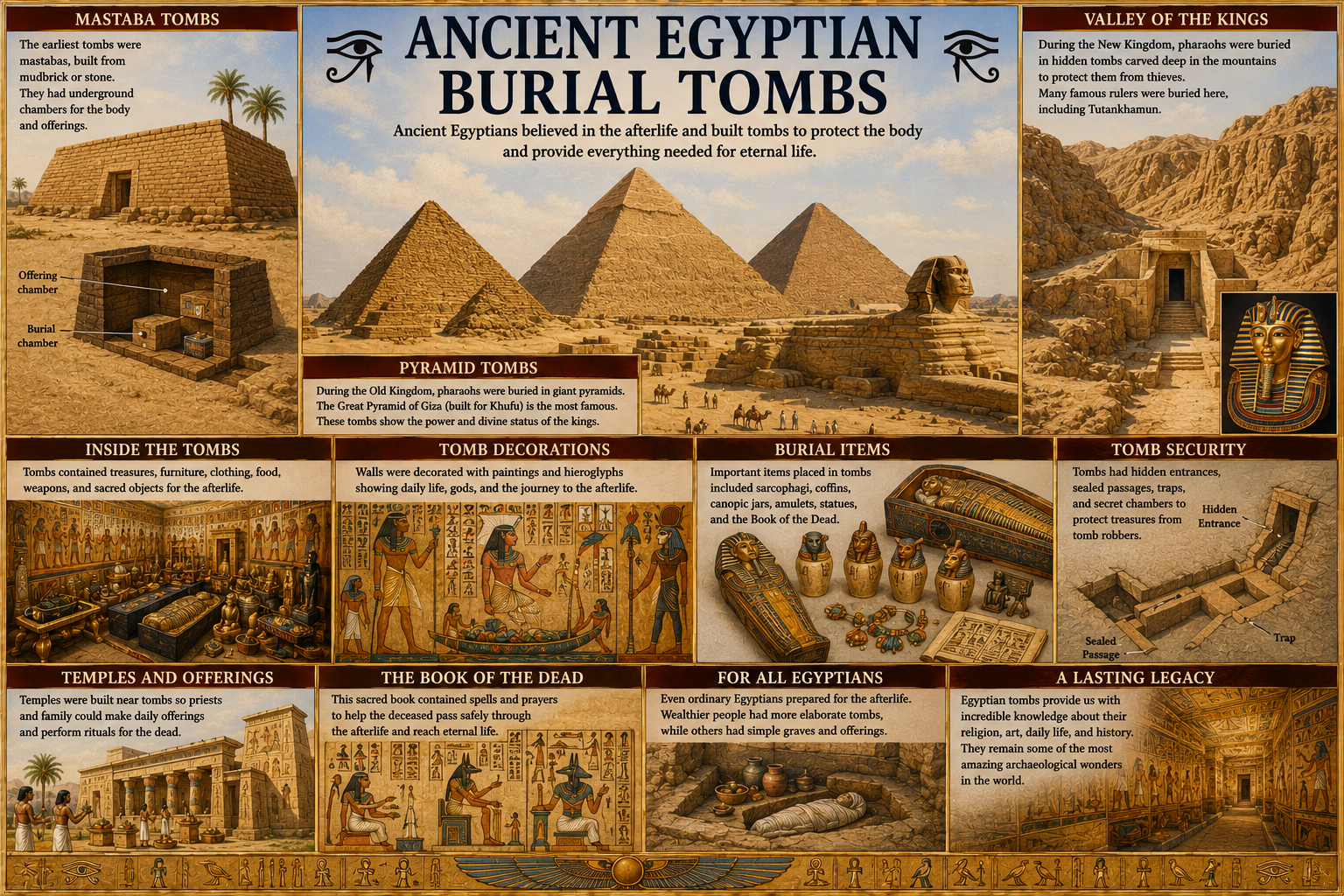
Burial tombs were among the most important and impressive structures in Ancient Egypt because Egyptians believed strongly in the afterlife and eternal existence. Tombs were designed to protect the body, preserve treasures, and provide everything needed for life after death.
Ancient Egyptians believed that death was only the beginning of another journey. To survive in the afterlife, the deceased needed a preserved body, food, possessions, magical protection, and sacred rituals. As a result, tomb construction became a major part of Egyptian religion and culture for thousands of years.
The earliest Egyptian tombs were simple rectangular structures called mastabas, built from mudbrick or stone. These tombs contained underground burial chambers and storage areas for offerings and personal belongings.
Over time, Egyptian tomb architecture became more advanced and eventually led to the construction of pyramids during the Old Kingdom period. Pharaohs built massive pyramids as royal tombs designed to demonstrate power, wealth, and divine authority.
The most famous example is the Great Pyramid of Giza, built for Pharaoh Khufu. It remains one of the greatest engineering achievements in human history and the only surviving wonder of the Ancient Seven Wonders of the World.
Inside royal tombs, Egyptians placed treasures, jewelry, statues, furniture, clothing, weapons, food, and sacred objects believed to help the deceased in the afterlife.
Tomb walls were decorated with colorful paintings, hieroglyphics, and religious scenes showing daily life, ceremonies, gods, and journeys into the next world. These decorations were intended to magically assist and protect the dead.
The Valley of the Kings near Luxor became one of the most important burial sites during the New Kingdom period. Instead of pyramids, pharaohs were buried in hidden tombs carved deep into desert mountains to protect them from tomb robbers.
Many famous rulers were buried in the Valley of the Kings, including Ramses II, Seti I, and Tutankhamun. The discovery of Tutankhamun’s nearly intact tomb in 1922 by Howard Carter became one of the greatest archaeological discoveries in history.
Ancient Egyptian tombs often contained magical texts such as the Book of the Dead, which provided instructions, prayers, and spells to guide the deceased safely through the afterlife.
Burial chambers included sarcophagi, coffins, canopic jars, amulets, and statues placed carefully according to religious beliefs and funerary traditions.
Security became a major concern because tombs contained enormous wealth and valuable treasures. Egyptians designed hidden chambers, sealed passages, traps, and secret entrances to protect royal burials from thieves.
Temples were sometimes built near tombs to allow priests and family members to continue performing rituals and offerings for the dead.
Even ordinary Egyptians tried to prepare for the afterlife according to their social class and financial ability. Wealthier families could afford decorated tombs and elaborate burial goods, while poorer people used simpler graves and modest offerings.
The study of Egyptian tombs has provided historians and archaeologists with extraordinary knowledge about religion, daily life, art, government, medicine, and royal history in Ancient Egypt.
Today, Egyptian tombs remain some of the world’s most fascinating archaeological sites and attract millions of visitors to Egypt every year. Their incredible architecture, artwork, and preserved treasures continue to reveal the secrets of one of history’s greatest civilizations.
Ancient Egyptian Boats and Nile Transportation
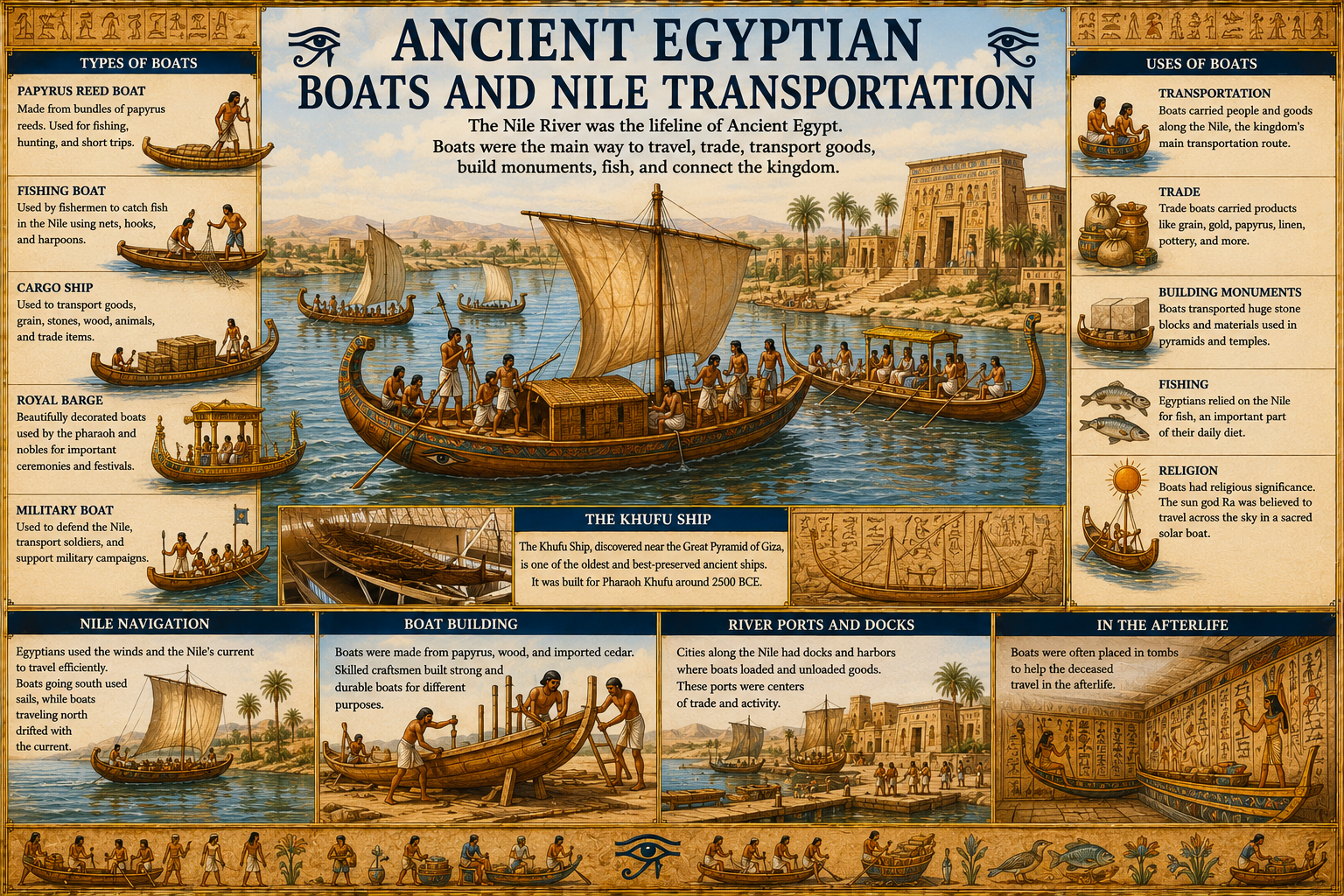
The Nile River was the lifeline of Ancient Egypt and served as the kingdom’s main transportation route for thousands of years. Boats and river travel played a vital role in trade, agriculture, communication, religion, fishing, and the movement of people and goods across the Egyptian kingdom.
Because most Egyptian cities and settlements were located along the Nile River, boats became one of the most important technologies in Ancient Egyptian civilization. The river connected Upper and Lower Egypt and allowed the kingdom to function as a united and organized state.
Ancient Egyptians built many types of boats for different purposes, including fishing boats, cargo ships, ceremonial boats, military vessels, and royal barges.
The earliest Egyptian boats were made from bundles of papyrus reeds tied together. These lightweight boats were suitable for fishing, hunting, and traveling short distances along calm waters.
As Egyptian engineering improved, builders began constructing larger wooden ships using imported cedar wood from Lebanon and local materials. These stronger vessels allowed Egyptians to transport heavy cargo, stone blocks, livestock, food supplies, and trade goods across long distances.
The Nile’s natural current and seasonal winds made transportation highly efficient. Boats traveling south used sails to move against the river current, while boats traveling north could drift with the flow of the Nile.
Trade ships transported grain, gold, papyrus, linen, pottery, and luxury goods between Egyptian cities and neighboring civilizations. The Nile became the foundation of Egypt’s economy and commercial success.
Boats also played an important role in the construction of pyramids and temples. Massive stone blocks used for monuments were transported across the Nile on large cargo barges before being moved to construction sites.
Fishing boats supplied Egyptians with fish, an important food source for many people across the kingdom. Fishermen used nets, hooks, harpoons, and traps while working along the Nile and nearby canals.
Royal and ceremonial boats were beautifully decorated and used by pharaohs, nobles, and priests during religious festivals and official journeys. Some ceremonial vessels symbolized the divine journey of the gods across the heavens.
One of the most famous discoveries connected to Egyptian boats is the Khufu Ship, found near the Great Pyramid of Giza. This remarkably preserved wooden ship was built for Pharaoh Khufu and is considered one of the oldest and most impressive ancient ships ever discovered.
Religion and mythology were also strongly connected to boats and river travel. Ancient Egyptians believed that the sun god Ra traveled across the sky each day in a sacred solar boat before journeying through the underworld at night.
Funerary boats were sometimes buried near royal tombs to provide transportation for the deceased in the afterlife. Boat imagery frequently appeared in tomb paintings and temple carvings.
Military boats protected trade routes, transported soldiers, and supported Egyptian campaigns along the Nile and neighboring regions.
Ports, docks, canals, and river harbors became important centers of transportation and trade throughout Egypt. Cities along the Nile flourished because of easy access to river travel and commerce.
Today, ancient Egyptian boats provide historians and archaeologists with valuable information about engineering, navigation, trade, religion, and daily life in Ancient Egypt.
The development of Nile transportation helped Ancient Egypt become one of the most powerful and organized civilizations in the ancient world and demonstrated the Egyptian people’s remarkable understanding of river navigation and shipbuilding.
Ancient Egyptian Education and Scribes
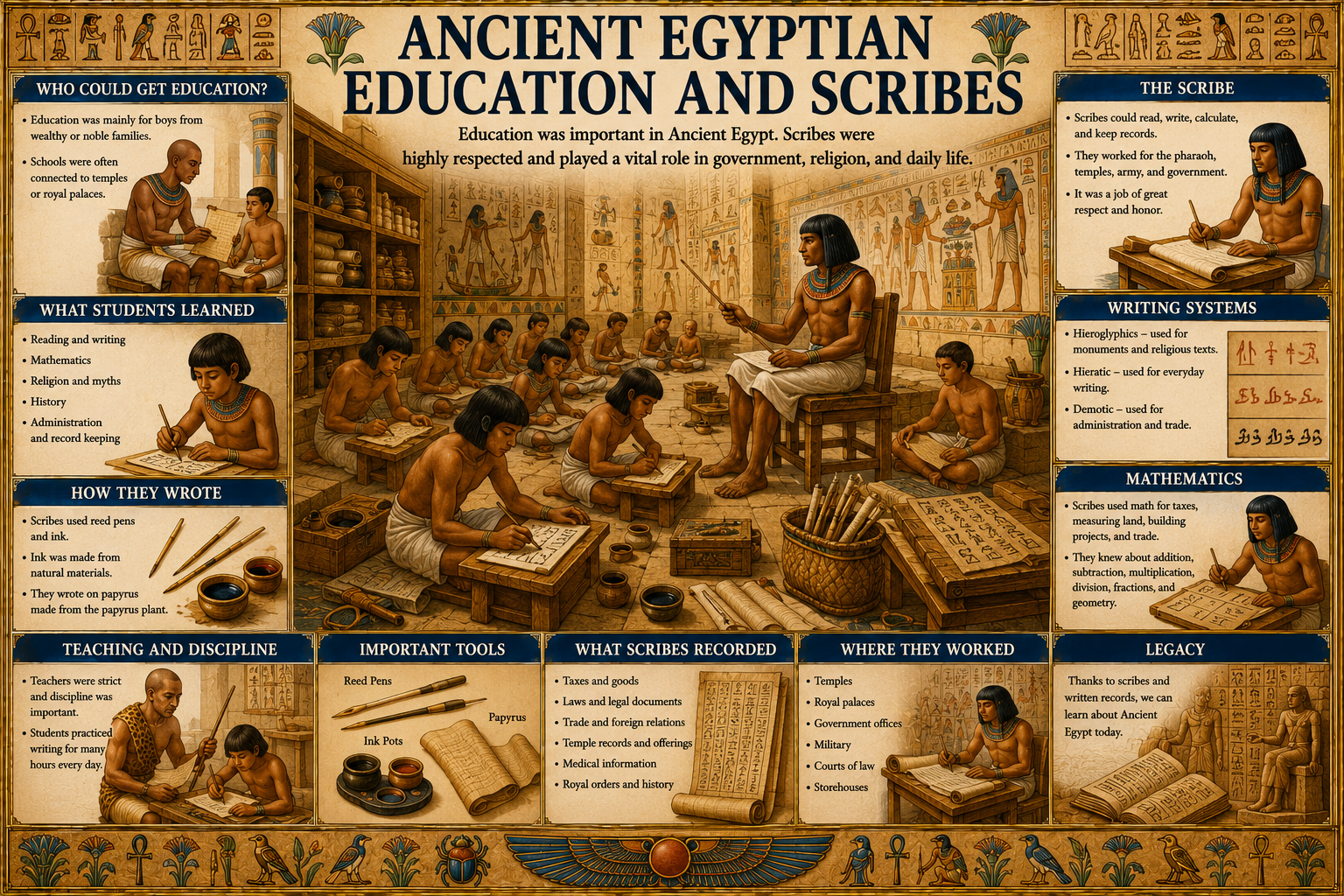
Education and writing were highly respected in Ancient Egypt and played an essential role in the organization of government, religion, trade, and daily life. Although most ordinary people worked as farmers or laborers, educated individuals held important positions in society and were often admired for their knowledge and skills.
The most educated people in Ancient Egypt were scribes, specialists trained in reading, writing, mathematics, and record keeping. Scribes worked for the government, temples, military, and royal administration, helping manage one of the most organized civilizations in the ancient world.
Ancient Egyptians developed one of the world’s earliest writing systems known as hieroglyphics. This complex system used symbols, pictures, and signs to represent sounds, words, and ideas. Hieroglyphic writing appeared on temples, tombs, monuments, papyrus scrolls, statues, and official documents.
In addition to hieroglyphics, Egyptians also used simplified writing systems called hieratic and later demotic scripts for everyday administration, trade records, and communication.
Education was mainly available to boys from wealthy or noble families, especially those connected to government officials or temple institutions. Many young students attended schools attached to temples or royal courts where they received formal training.
Students learned reading, writing, mathematics, religion, history, and administrative skills. Writing practice often involved copying texts repeatedly onto papyrus, pottery fragments, or wooden tablets.
Scribes used reed pens and black or red ink made from natural materials. Papyrus paper, produced from the papyrus plant growing along the Nile River, became one of Egypt’s greatest inventions and an important export to other civilizations.
Mathematics education was also important because scribes needed to calculate taxes, measure farmland, organize construction projects, and manage food storage and trade.
Teachers in Ancient Egypt were often strict, and discipline was considered an important part of education. Ancient texts describe students practicing writing for many hours and memorizing lessons carefully.
Becoming a scribe offered opportunities for wealth, social status, and stable employment. Unlike manual laborers, scribes often worked indoors and held respected positions in society.
Scribes recorded nearly every aspect of Egyptian civilization, including taxes, legal documents, trade agreements, religious texts, military campaigns, medical records, royal decrees, and historical events.
Without scribes, the Egyptian government would have struggled to manage its vast kingdom and monumental construction projects.
Temples also served as important centers of learning and knowledge preservation. Priests and scholars studied religion, astronomy, medicine, mathematics, and sacred rituals.
Some women in Ancient Egypt may also have received education, especially among royal or noble families, although most formal education was dominated by men.
Ancient Egyptian literature included religious writings, wisdom texts, poetry, stories, instructions, and historical records. Famous works such as the Book of the Dead preserved religious beliefs and funerary traditions for generations.
The preservation of written records on temple walls, monuments, and papyrus scrolls has allowed modern historians and archaeologists to understand Ancient Egyptian civilization in remarkable detail.
Today, the achievements of Egyptian scribes and scholars remain among the greatest intellectual accomplishments of the ancient world and continue to inspire historians, linguists, and researchers studying the origins of writing and education.
Ancient Egyptian Music and Entertainment
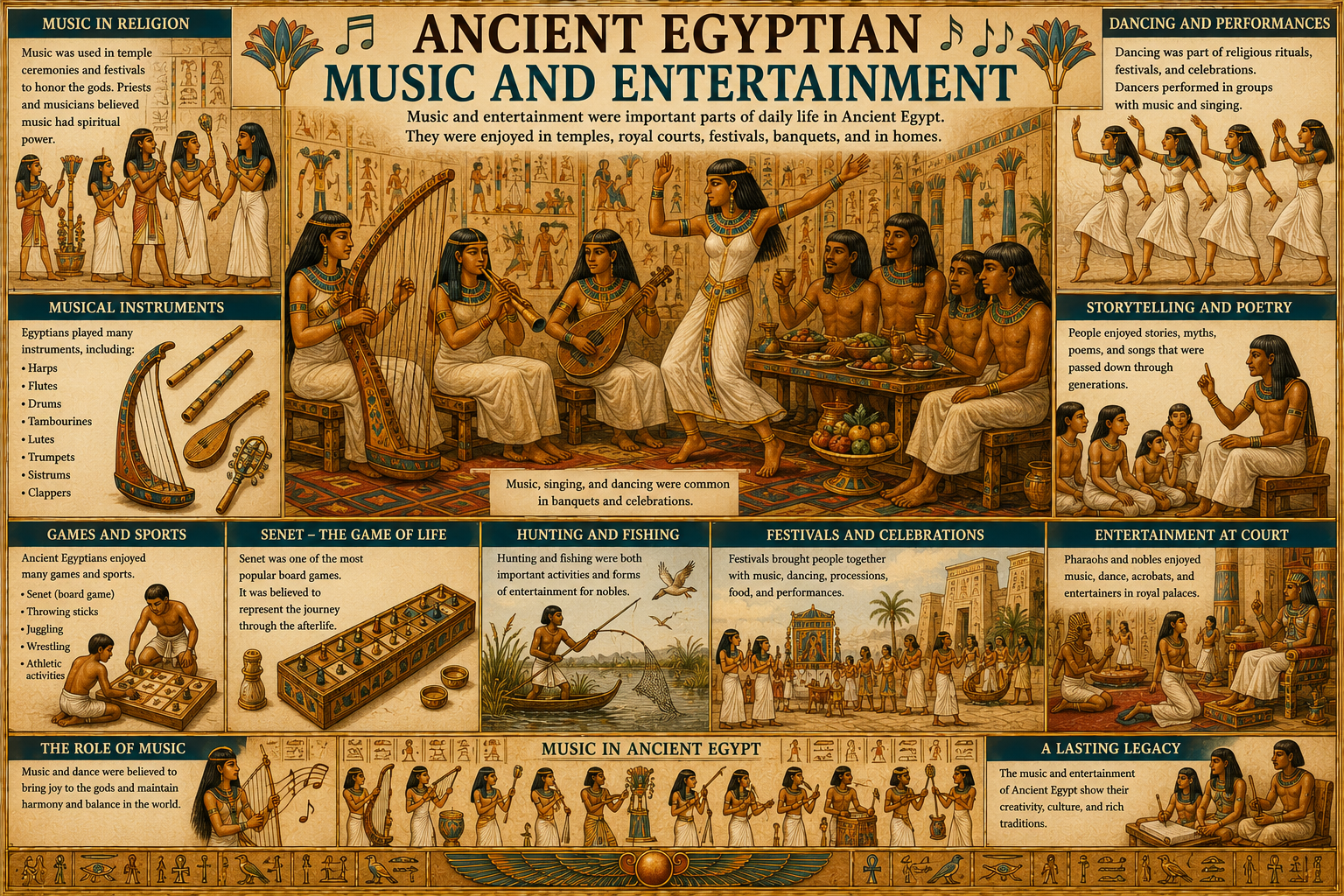
Music and entertainment were important parts of daily life in Ancient Egypt and played a major role in religion, festivals, royal ceremonies, banquets, and social gatherings. Ancient Egyptians enjoyed music, dancing, storytelling, games, and performances that reflected both their cultural traditions and religious beliefs.
Music was deeply connected to religion in Ancient Egypt. Priests and musicians performed sacred songs and instrumental music during temple rituals, religious festivals, and ceremonies honoring the gods. Egyptians believed music had spiritual power and could create harmony between humans and the divine world.
Many temples employed professional musicians, singers, and dancers who participated in religious celebrations and processions. Instruments were often played during ceremonies dedicated to gods such as Hathor, the goddess of music, dance, joy, and love.
Ancient Egyptians used a wide variety of musical instruments, including:
Harps
Flutes
Drums
Tambourines
Lutes
Trumpets
Sistrums
Clappers
The sistrum, a sacred rattle-like instrument, became especially important in religious ceremonies connected to Hathor and temple worship.
Music was also common during banquets and royal celebrations. Wealthy Egyptians organized feasts with food, wine, dancers, musicians, and entertainers performing for guests.
Dancing was another major form of entertainment and appeared in religious rituals, festivals, funerals, and celebrations. Dancers often performed in groups accompanied by musicians and singers.
Storytelling and poetry were highly valued forms of entertainment. Ancient Egyptians shared myths, heroic tales, wisdom literature, and historical stories that preserved cultural traditions across generations.
Children and adults also enjoyed games and sports. One of the most famous Egyptian board games was Senet, a strategic game believed to symbolize the journey through the afterlife. Senet boards have been discovered in tombs belonging to pharaohs and nobles.
Other games involved throwing sticks, juggling, wrestling, hunting competitions, and athletic activities. Physical activities helped prepare soldiers and provided recreation for ordinary people.
Hunting and fishing were both practical activities and forms of entertainment for wealthy Egyptians. Nobles often hunted birds, fish, lions, and desert animals as symbols of skill and power.
Festivals brought communities together through music, dancing, performances, food, and public celebrations. Large religious festivals transformed cities into lively centers of entertainment and social interaction.
Royal courts employed professional entertainers, musicians, acrobats, and performers who entertained pharaohs and nobles during official events and ceremonies.
Ancient Egyptian art frequently shows scenes of musicians, dancers, banquets, and games inside tombs and temples. These paintings provide historians with valuable information about entertainment and social life in Ancient Egypt.
Entertainment also had symbolic and religious meanings. Music and dance were believed to bring joy to the gods and maintain balance and harmony within the world.
The influence of Ancient Egyptian music and artistic traditions spread to neighboring civilizations throughout the Mediterranean and the Near East.
Today, historians and archaeologists continue to study Egyptian instruments, tomb paintings, texts, and artifacts to better understand the cultural and artistic life of Ancient Egypt.
The music and entertainment of Ancient Egypt remain fascinating examples of the creativity, spirituality, and social traditions of one of the world’s greatest civilizations.
Ancient Egyptian Technology and Engineering
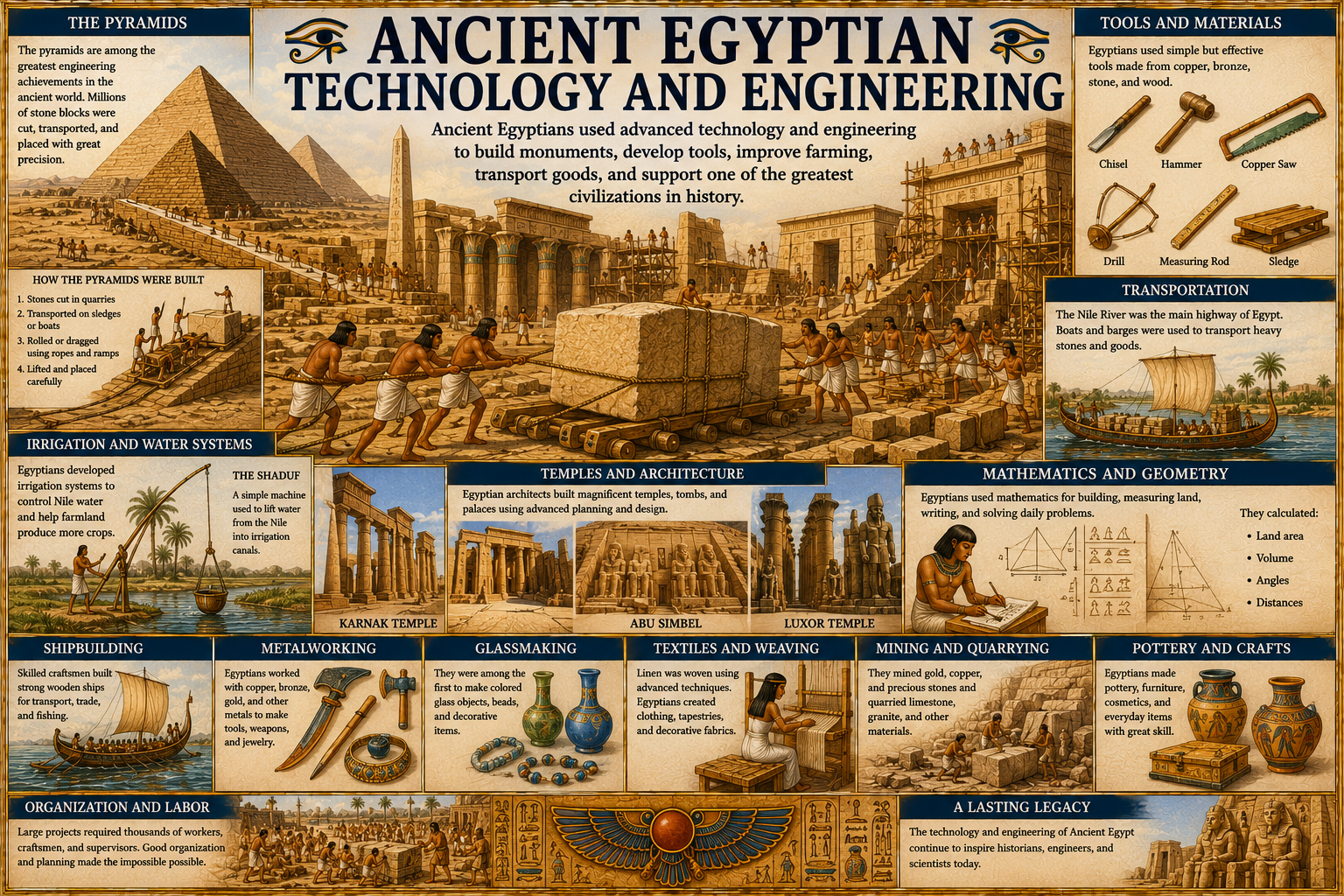
Ancient Egypt became one of the greatest civilizations in human history largely because of its remarkable achievements in technology and engineering. Egyptian engineers, architects, builders, and craftsmen developed advanced construction methods, tools, transportation systems, and scientific techniques that allowed them to create monuments and infrastructure that still survive thousands of years later.
One of the greatest engineering achievements of Ancient Egypt was the construction of the pyramids. The pyramids required extraordinary planning, organization, mathematics, and labor management. Millions of massive stone blocks were carefully cut, transported, and assembled with remarkable precision.
The Great Pyramid of Giza, built for Pharaoh Khufu, remains one of the most impressive structures ever created by human civilization. Its alignment, stability, and enormous scale continue to amaze engineers and historians today.
Ancient Egyptian builders used simple but highly effective tools made from copper, bronze, stone, and wood. Workers used chisels, hammers, ropes, levers, sledges, and measuring instruments to shape and move heavy stones.
Transportation engineering played a major role in construction projects. Egyptians used the Nile River to transport massive stone blocks from quarries to construction sites using large cargo boats and barges.
Ramps and sled systems were developed to move enormous materials across desert landscapes and lift stones into position during pyramid and temple construction.
Ancient Egyptians also became highly skilled in architecture. They designed temples, palaces, tombs, obelisks, and statues with careful planning and artistic precision. Massive columns, ceremonial halls, courtyards, and decorative carvings demonstrated both engineering skill and artistic beauty.
Temples such as Karnak, Luxor, Abu Simbel, and Philae remain among the greatest architectural achievements of the ancient world.
Egyptian engineers also developed irrigation systems that helped control Nile water and improve agriculture. Canals, reservoirs, dikes, and water-lifting devices allowed farmers to distribute water across fertile farmland.
One important invention was the shaduf, a simple machine used to lift water from the Nile into irrigation canals. This technology greatly improved farming efficiency and supported food production for the growing population.
Mathematics and geometry were essential parts of Egyptian engineering. Builders used precise measurements and calculations to align structures, measure land, and design monuments.
Surveyors carefully measured farmland after the annual Nile floods changed property boundaries. Their mathematical skills helped maintain order and support government administration.
Ancient Egyptians also made important technological advances in glassmaking, metalworking, pottery, shipbuilding, jewelry production, and textile manufacturing.
They created strong wooden ships, sophisticated gold jewelry, decorative glass objects, cosmetics, furniture, and tools admired throughout the ancient world.
Mining and quarrying technologies allowed Egyptians to extract granite, limestone, gold, copper, and precious stones from deserts and mountains across Egypt and Nubia.
Engineering was closely connected to religion and royal authority. Pharaohs used massive monuments and construction projects to demonstrate power, divine connection, and national strength.
The organization of large labor forces also reflected Egypt’s advanced administrative and engineering systems. Thousands of workers, craftsmen, architects, and supervisors coordinated together on enormous state projects.
Today, archaeologists, engineers, and historians continue to study Ancient Egyptian technology to better understand how such an early civilization achieved extraordinary levels of construction and organization without modern machinery.
The technological and engineering achievements of Ancient Egypt remain lasting symbols of human creativity, intelligence, and innovation in the ancient world.
Why Ancient Egypt Was Important
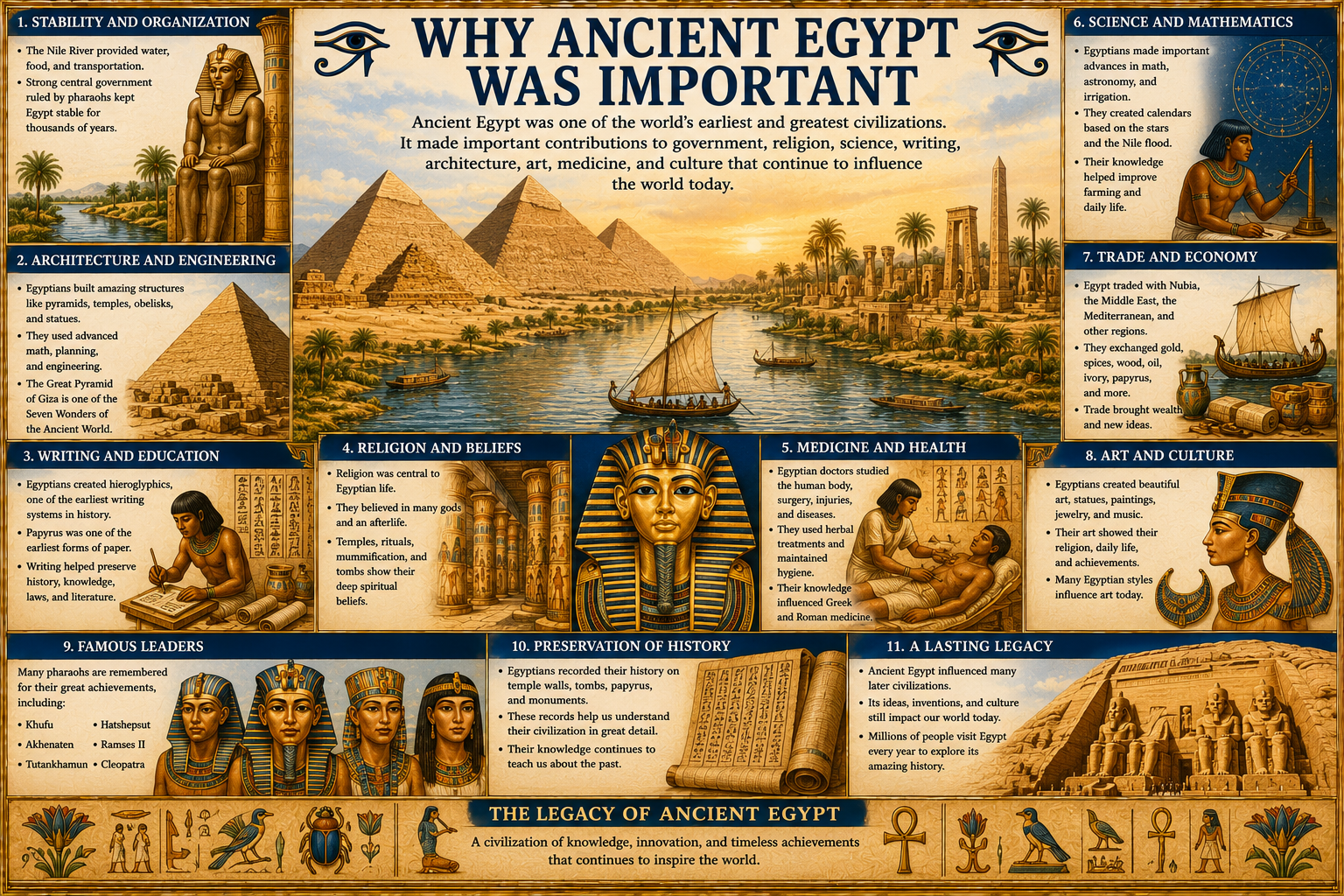
Ancient Egypt was one of the most important civilizations in human history and influenced the development of government, religion, architecture, science, writing, engineering, and culture for thousands of years. Located along the Nile River in northeastern Africa, Ancient Egypt became one of the world’s earliest and longest-lasting civilizations, surviving for more than 3,000 years.
One of the main reasons Ancient Egypt was important was its remarkable stability and organization. The Nile River provided fertile land, water, transportation, and food resources that allowed Egyptian society to grow into a powerful and wealthy kingdom surrounded by desert protection.
Ancient Egyptians developed one of the world’s first centralized governments ruled by pharaohs who controlled administration, laws, religion, taxation, trade, and major construction projects. Their organized political system helped maintain stability for centuries.
Egypt also made major contributions to architecture and engineering. The pyramids, temples, obelisks, statues, and tombs built by the Egyptians demonstrated extraordinary mathematical knowledge, planning, and construction skills.
The Great Pyramid of Giza remains one of the most impressive structures ever built and is the only surviving wonder of the Ancient Seven Wonders of the World.
Ancient Egypt also became famous for its advances in writing and education. Egyptians created hieroglyphics, one of the earliest writing systems in history, which allowed them to preserve religious texts, historical records, scientific knowledge, literature, and government documents.
Papyrus, developed from plants growing along the Nile River, became one of the earliest forms of paper and greatly improved communication and record keeping.
Religion played a central role in Egyptian civilization and influenced nearly every aspect of life. Egyptian mythology, gods, temples, burial traditions, and beliefs about the afterlife became some of the most famous religious systems of the ancient world.
The practice of mummification and the construction of elaborate burial tombs reflected the Egyptians’ deep spiritual beliefs and advanced understanding of preservation and funerary rituals.
Ancient Egyptian medicine was highly advanced for its time. Egyptian doctors studied anatomy, surgery, injuries, herbal treatments, hygiene, and medical procedures. Their knowledge later influenced Greek and Roman medicine.
Egyptians also made important achievements in mathematics, astronomy, irrigation, shipbuilding, metalworking, and agriculture. Their scientific observations helped create calendars, improve farming systems, and organize daily life.
Trade networks connected Egypt with Nubia, the Mediterranean, the Middle East, and Africa, allowing the exchange of goods, technology, culture, and ideas with neighboring civilizations.
Ancient Egyptian art and culture also became highly influential. Egyptian statues, paintings, jewelry, music, architecture, and decorative styles continue to inspire artists and designers around the world today.
The civilization produced many famous rulers and historical figures, including Khufu, Hatshepsut, Akhenaten, Ramses II, Tutankhamun, and Cleopatra. Their achievements and monuments remain symbols of power and cultural greatness.
Ancient Egypt also preserved enormous amounts of historical information through temples, inscriptions, tomb paintings, papyrus texts, and monuments. These records continue to help historians understand the ancient world in remarkable detail.
Even after the fall of the pharaonic kingdom, Egyptian knowledge and culture continued influencing Greek, Roman, Islamic, and modern civilizations.
Today, Ancient Egypt remains one of the most studied and admired civilizations in the world. Millions of tourists visit Egypt each year to explore its pyramids, temples, museums, tombs, and archaeological sites.
The legacy of Ancient Egypt continues to shape modern history, archaeology, architecture, literature, entertainment, and global culture, making it one of the greatest and most influential civilizations in human history.
The Legacy of Ancient Egypt
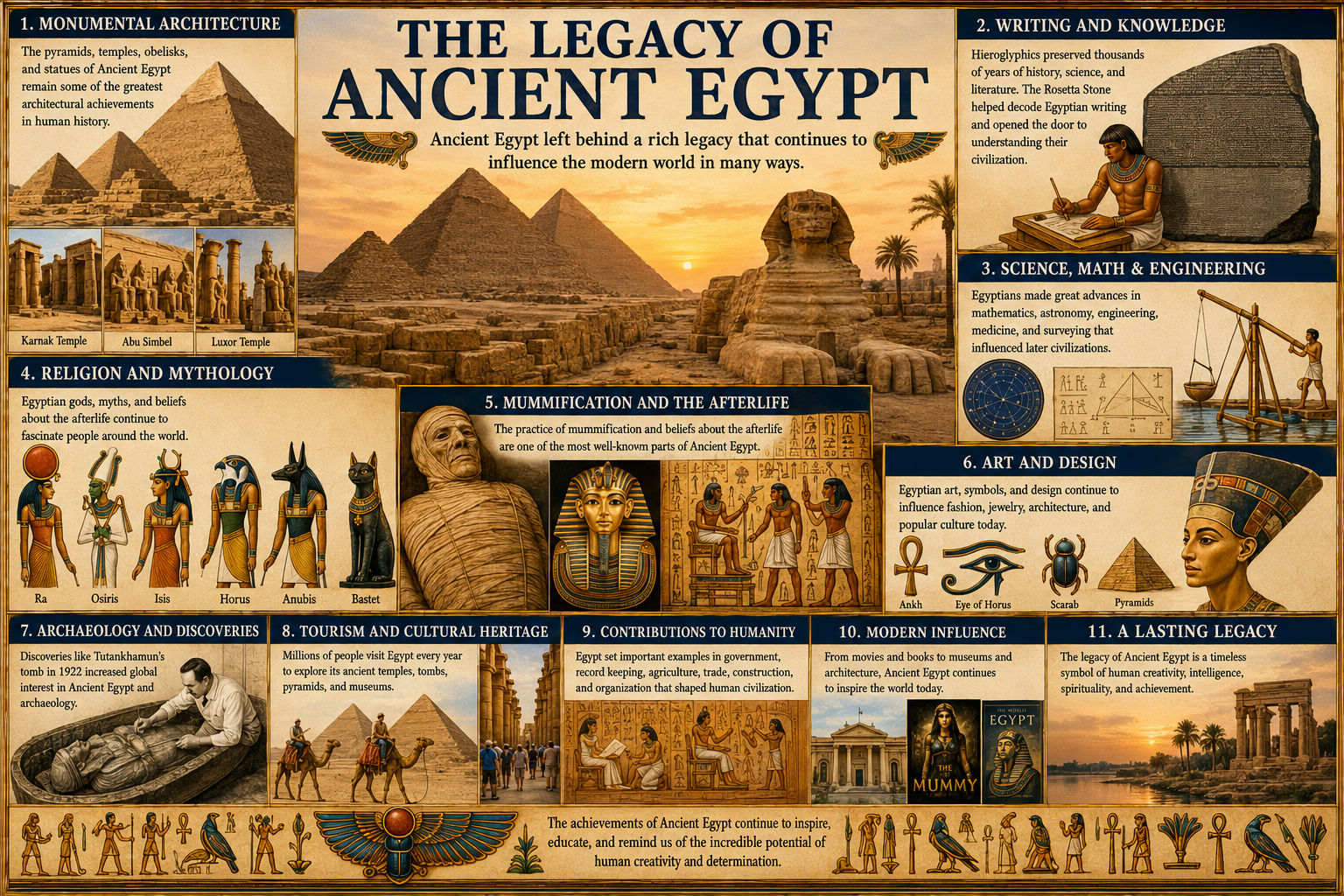
The legacy of Ancient Egypt continues to influence the modern world thousands of years after the fall of the pharaohs. Ancient Egyptian civilization left behind extraordinary achievements in architecture, science, writing, religion, art, engineering, medicine, and culture that continue to inspire historians, archaeologists, artists, architects, and travelers across the globe.
One of the most visible parts of Egypt’s legacy is its monumental architecture. Structures such as the pyramids of Giza, the Great Sphinx, Karnak Temple, Luxor Temple, Abu Simbel, and the Valley of the Kings remain among the greatest achievements in human history.
The pyramids especially became global symbols of mystery, engineering, and ancient human achievement. Modern engineers and scientists still study how Ancient Egyptians managed to construct such massive structures with incredible precision using ancient tools and techniques.
Ancient Egyptian writing systems also left a lasting impact on civilization. Hieroglyphics helped preserve thousands of years of Egyptian history, religion, science, and literature. The discovery of the Rosetta Stone in 1799 allowed scholars to decode hieroglyphic writing and opened the door to understanding Ancient Egyptian civilization in much greater detail.
Egyptian advances in mathematics, astronomy, and engineering influenced later civilizations including the Greeks, Romans, and Islamic scholars. Egyptian knowledge helped shape developments in architecture, medicine, surveying, and scientific observation.
Ancient Egyptian medicine was highly respected in the ancient world. Egyptian doctors studied anatomy, injuries, surgery, hygiene, and herbal treatments. Many medical practices later influenced Greek and Roman medicine.
Religion and mythology from Ancient Egypt continue to fascinate people today. Gods such as Ra, Osiris, Isis, Horus, Anubis, and Bastet remain famous figures in world mythology and frequently appear in books, films, games, documentaries, and modern art.
The practice of mummification and Egyptian beliefs about the afterlife also became some of the most recognizable aspects of Ancient Egyptian culture. Museums around the world display mummies and burial artifacts that attract millions of visitors every year.
Ancient Egyptian art and design continue to inspire architecture, jewelry, fashion, tattoos, interior decoration, and visual arts. Egyptian symbols such as the Ankh, Eye of Horus, scarabs, and pyramids remain popular cultural icons worldwide.
Archaeology itself was deeply transformed by discoveries in Egypt. The discovery of Tutankhamun’s tomb by Howard Carter in 1922 became one of the greatest archaeological events in history and increased global fascination with Ancient Egypt.
Tourism connected to Ancient Egyptian history remains one of Egypt’s most important industries today. Millions of travelers visit Egypt each year to explore temples, tombs, pyramids, museums, and archaeological sites.
Ancient Egypt also contributed to humanity’s understanding of government organization, record keeping, monumental construction, religion, and cultural preservation. The civilization demonstrated how advanced societies could organize labor, agriculture, trade, engineering, and administration on a massive scale.
Many universities, researchers, historians, and scientists continue studying Ancient Egypt to better understand the origins of civilization and the development of human culture.
Modern technology has also helped uncover new discoveries through satellite imaging, DNA analysis, digital reconstruction, and archaeological scanning of tombs and monuments.
The influence of Ancient Egypt can still be seen today in architecture, entertainment, museums, education, tourism, and global popular culture. Movies, books, exhibitions, and documentaries continue introducing new generations to the wonders of Ancient Egyptian civilization.
The legacy of Ancient Egypt remains one of humanity’s greatest cultural treasures and stands as a lasting symbol of creativity, intelligence, spirituality, and human achievement throughout history.
Ancient Egyptian Daily Life
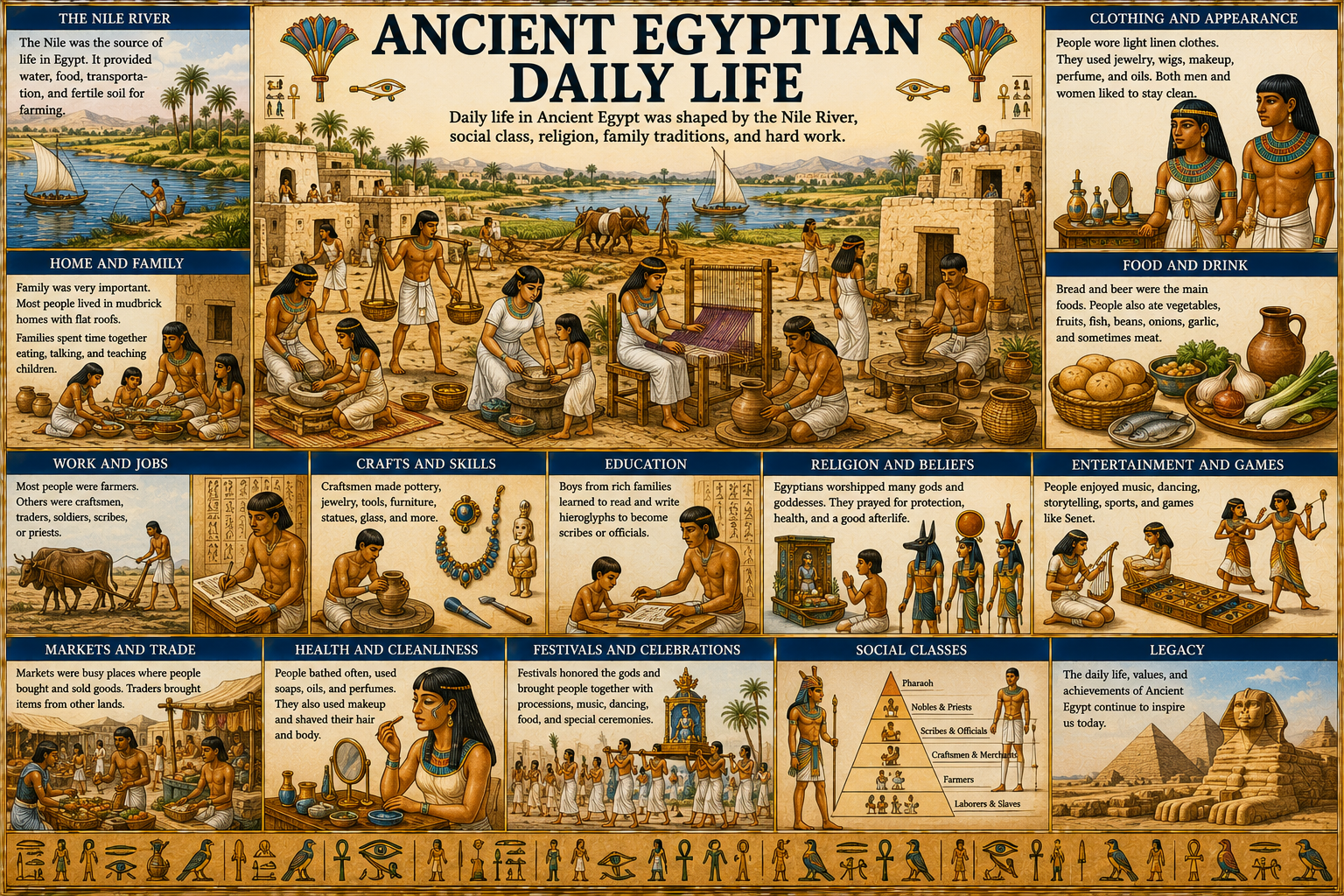
Daily life in Ancient Egypt was shaped by the Nile River, social class, religion, family traditions, and agricultural work. Although pharaohs, nobles, priests, and wealthy officials lived luxurious lives, most Egyptians were farmers, craftsmen, laborers, and merchants who worked hard to support one of the world’s greatest civilizations.
The Nile River influenced nearly every aspect of Egyptian daily life. It provided water for drinking, farming, transportation, fishing, and trade. Most Egyptians lived in villages and cities located close to the river because the surrounding desert was extremely dry.
Family was the center of Egyptian society. Men usually worked as farmers, craftsmen, fishermen, soldiers, scribes, or traders, while women managed households, raised children, prepared food, and sometimes worked in weaving, music, medicine, or trade.
Unlike many ancient civilizations, women in Ancient Egypt had relatively strong legal rights. They could own property, inherit wealth, manage businesses, and even become rulers such as Queen Hatshepsut and Cleopatra.
Most homes in Ancient Egypt were built from mudbrick because stone was mainly reserved for temples, pyramids, and monuments. Houses were designed to stay cool during the hot climate and often included storage rooms, kitchens, and rooftop spaces.
Ancient Egyptians wore lightweight linen clothing made from flax grown along the Nile. Wealthier people wore fine linen, jewelry, perfumes, and decorative wigs, while ordinary workers dressed more simply.
Food was an important part of daily life. Bread and beer were the main foods consumed by most Egyptians. People also ate vegetables, fruits, fish, beans, onions, garlic, and occasionally meat depending on wealth and social status.
Markets and trade centers allowed people to buy pottery, clothing, tools, jewelry, food, cosmetics, and imported goods. Merchants traveled across Egypt and neighboring regions exchanging products and resources.
Religion played a major role in everyday life. Egyptians prayed to gods for protection, health, successful harvests, and safety in the afterlife. Small household shrines and amulets were common in many homes.
Children in Ancient Egypt often helped their families from a young age. Boys sometimes learned farming or crafts from their fathers, while girls learned household skills from their mothers. Wealthier children could receive formal education and become scribes or officials.
Entertainment included music, dancing, storytelling, games, festivals, hunting, fishing, and sports. The board game Senet was especially popular and believed to symbolize the journey through the afterlife.
Work was an important part of Egyptian society. Farmers cultivated fields during the growing season, while many workers participated in massive construction projects such as pyramids, temples, canals, and tombs.
Craftsmen created pottery, jewelry, statues, furniture, tools, glassware, cosmetics, and decorative artwork admired throughout the ancient world.
Ancient Egyptians also valued cleanliness and appearance. People bathed regularly, shaved body hair, used scented oils, and wore makeup for beauty and protection from the sun.
Festivals and religious celebrations brought communities together with music, dancing, food, ceremonies, and public gatherings.
Although life could be difficult for ordinary laborers, Ancient Egypt developed a highly organized society that survived for thousands of years because of strong agriculture, government administration, religion, and cultural traditions.
Today, tomb paintings, papyrus texts, archaeological discoveries, and preserved artifacts continue to provide historians with valuable information about the daily life of Ancient Egyptians and the fascinating civilization they created.
Ancient Egyptian Gods and Goddesses
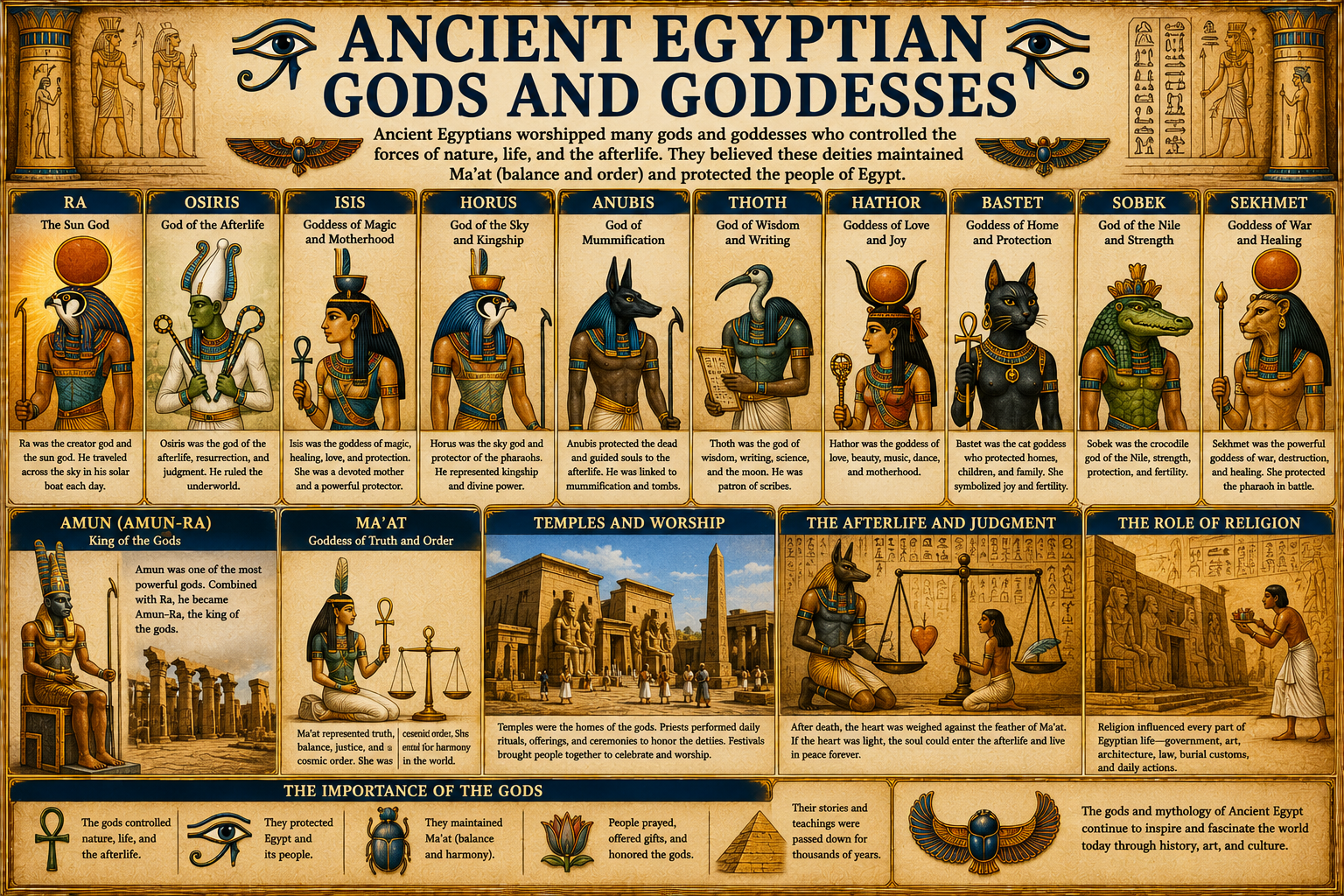
Religion was one of the most important parts of life in Ancient Egypt, and the Egyptians worshipped hundreds of gods and goddesses connected to nature, the afterlife, the Nile River, the sky, the sun, animals, and human life. Ancient Egyptians believed that these powerful deities controlled the forces of the universe and maintained balance and harmony in the world.
The Egyptian gods were often represented in human form combined with animal features, symbolizing their unique powers and characteristics. Temples, statues, rituals, festivals, and offerings were dedicated to honoring these deities across Egypt for thousands of years.
One of the most important gods in Ancient Egypt was Ra, the sun god and creator deity. Egyptians believed Ra traveled across the sky each day in a solar boat, bringing light and life to the world before journeying through the underworld at night.
Osiris became the god of the afterlife, resurrection, and judgment of the dead. According to Egyptian mythology, Osiris ruled the underworld and helped determine whether souls could enter eternal life.
Isis, the wife of Osiris, was one of the most beloved goddesses in Ancient Egypt. She represented motherhood, magic, healing, love, and protection. Egyptians believed Isis possessed powerful magical abilities and protected both the living and the dead.
Horus, the son of Isis and Osiris, was the falcon-headed god of the sky, kingship, and royal power. Pharaohs were often considered earthly representations of Horus, linking the king directly to divine authority.
Anubis, the jackal-headed god, became closely associated with mummification, tombs, and funeral rituals. Egyptians believed Anubis protected the dead and guided souls safely into the afterlife.
Thoth, often shown with the head of an ibis bird, was the god of wisdom, writing, knowledge, science, and the moon. Scribes and scholars especially respected Thoth because he was believed to have invented writing and language.
Hathor was the goddess of love, music, beauty, dance, joy, and motherhood. She played an important role in festivals, celebrations, and religious ceremonies throughout Egypt.
Bastet, the cat goddess, symbolized home, protection, fertility, and family life. Cats became sacred animals in Ancient Egypt because of their connection to Bastet.
Sobek, the crocodile god, represented strength, military power, fertility, and the Nile River. Temples dedicated to Sobek were especially important in regions near crocodile habitats.
Sekhmet, the lioness goddess, symbolized war, protection, healing, and destruction. Egyptians both feared and respected her powerful nature.
Amun became one of the most powerful gods during the New Kingdom period. Combined with Ra as Amun-Ra, he became considered the king of the gods and was worshipped in massive temple complexes such as Karnak.
Egyptian religion focused heavily on maintaining Ma’at, the concept of truth, balance, justice, and cosmic order. The gods were believed to protect this harmony and punish chaos and disorder.
Temples served as homes for the gods, where priests performed daily rituals, prayers, offerings, and ceremonies. Large religious festivals allowed ordinary Egyptians to participate in public worship and celebrations.
The afterlife was another major focus of Egyptian religion. Egyptians believed the soul would face judgment after death, where the heart would be weighed against the feather of Ma’at to determine eternal destiny.
Religion influenced nearly every part of Egyptian civilization, including government, architecture, art, burial customs, law, and daily life.
Today, the gods and mythology of Ancient Egypt remain among the most famous and fascinating religious traditions in world history, continuing to inspire books, movies, museums, archaeology, and popular culture around the globe.